
 By Dwi Wanna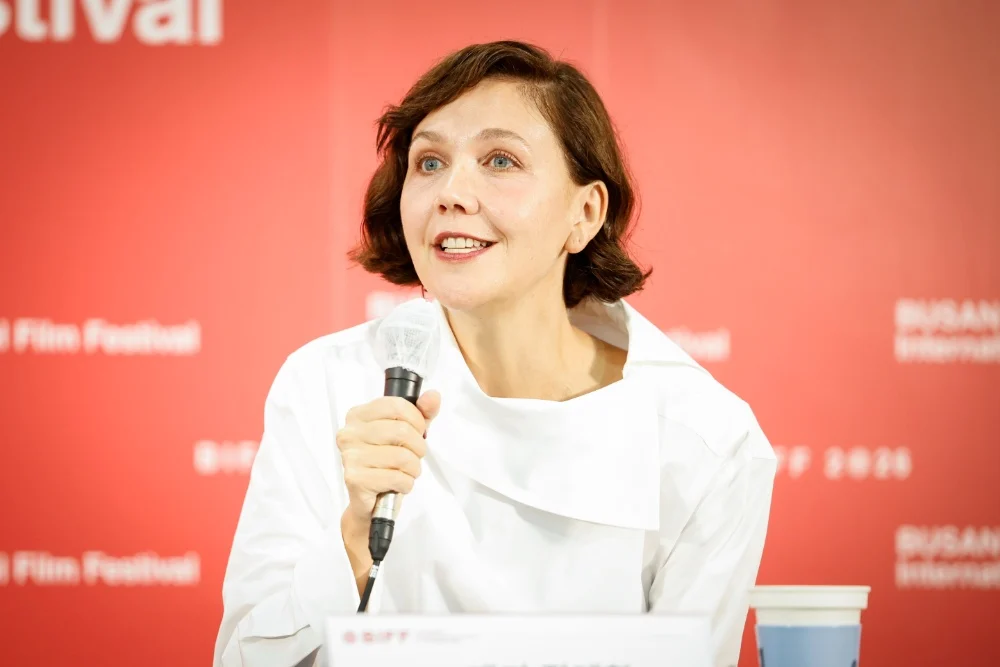
At the Busan International Film Festival this week, Maggie Gyllenhaal offered a masterclass in modern filmmaking, not through a technical lecture, but through a candid reflection on the nature of authority. For Gyllenhaal, a director’s true power does not reside in the ability to dictate, but in the capacity to synthesize the brilliance of those around them. Her transition from an acclaimed performer to a formidable director—marked by the success of The Lost Daughter and her latest project, Flesh Impact—has been defined by a philosophy of radical inclusivity.
The Philosophy of the Collaborative Set
Gyllenhaal’s presence at the Busan festival served as a platform to articulate the shifts she has witnessed in the industry. During a press conference on Wednesday, the director dismantled the antiquated trope of the “autocratic auteur,” arguing that the most successful directors she encountered during her decades as an actress were those who prioritized collective intelligence.
“It was the people who were very scared—or just not very smart—who tried to squash other people’s voices,” Gyllenhaal noted.
This philosophy was the bedrock of her feature directorial debut, The Lost Daughter. Recognizing that her role as director afforded her the final word, she reasoned that this very security provided the freedom to empower her crew. Whether collaborating with cinematographers, production designers, or lighting technicians, Gyllenhaal views the set as a tapestry of expertise. “It is ultimately up to me as the director. I have the power, so there’s no reason to squash anyone else’s voice,” she asserted. “It’s just so obvious that the movie that I will make that includes all the minds of the people on my crew… is going to be exponentially better than the movie I can make trying to recreate something I imagined all alone by myself in my room.”
Chronology of a Creative Pivot
Gyllenhaal’s trajectory from acting to directing was not an overnight decision but a gradual, organic evolution. Having spent years in front of the camera, she reached a point where the traditional boundaries of performance began to feel restrictive.
“It felt satisfying and exciting for a long time, and then I think I hit the edge of what I was able to do as an actress,” she explained.
The move into writing and directing began in earnest eight years ago. This shift was perhaps inevitable, given her upbringing in a household steeped in cinema. The daughter of director Stephen Gyllenhaal and screenwriter Naomi Foner, she grew up in an environment where storytelling was the primary language. The family ritual of Friday night movies provided a foundation for her cinematic sensibilities.
Her mother, Naomi Foner, remains a pivotal influence, one whom Gyllenhaal credits as her most incisive critic. In a touching nod to the generational shift in the industry, Gyllenhaal pointed out that her mother directed her first film only after becoming a grandmother—a testament to the fact that creative potential is not bound by age. Similarly, her brother, actor Jake Gyllenhaal, serves as a vital sounding board, with their differing tastes providing a "gift" that helps refine her creative process.
Case Study: The Genesis of Flesh Impact
Gyllenhaal’s latest project, Flesh Impact, serves as a poignant example of her willingness to subvert expectations. Commissioned by the luxury automotive brand Genesis to mark what would have been Marilyn Monroe’s 100th birthday, the project initially presented a standard branding challenge. However, Gyllenhaal refused to settle for a conventional tribute.
After spending a week immersed in Monroe’s filmography and biographical literature, she realized she wanted to explore the icon through a lens of aging—an often-ignored reality for a figure synonymous with eternal youth.
“I don’t think that when Genesis came to me… they imagined she would actually be 100 years old in the movie,” Gyllenhaal admitted. “I thought, ‘Okay, I have this idea. They’re never going to go for it.’”
To her surprise, the brand embraced the bold vision. Gyllenhaal completed the script in a single weekend. The film, which features Ellen Burstyn as a centenarian Marilyn Monroe and Dakota Johnson as her younger self, also stars Peter Sarsgaard and Sepideh Moafi. Beyond the thematic exploration of the screen icon, Gyllenhaal views the short film as a deep tribute to the careers of her lead actresses. It premiered out of competition at the Venice Film Festival, cementing Gyllenhaal’s reputation as a director capable of blending high-concept art with industry-commissioned work.
Implications for the Industry and Future Projects
Gyllenhaal’s career is currently on a rapid upward trajectory. She is actively developing two new, as-yet-unnamed projects, reveling in the early, nebulous stage of creation where ideas have not yet calcified into concrete narratives.
Furthermore, her partnership with Warner Bros. for an adaptation of Rachel Kushner’s acclaimed novel Creation Lake signals a significant escalation in her production scale. This project follows the studio’s involvement in The Bride, further solidifying her place within the major studio ecosystem.
However, her success does not blind her to the structural inequalities of the business. During her tenure as jury president at the Venice Film Festival, she noted that only one woman had a film in competition. This sobering statistic remains at the forefront of her advocacy. She is keenly aware that while she has managed to break through the “glass ceiling” of directing, many systemic hurdles remain for female filmmakers.
By emphasizing that her transition to directing felt “natural,” she challenges the industry to view female leadership behind the camera as a standard rather than a novelty. Her work, both in the chair and in the writers’ room, suggests a future where the “auteur” is defined not by isolation, but by the ability to curate the collective brilliance of a diverse and talented team.
Conclusion: A Legacy in the Making
As Maggie Gyllenhaal continues to refine her craft, her impact on the industry is twofold. First, she is delivering high-quality, thought-provoking narratives that challenge audiences to rethink cultural icons. Second, and perhaps more importantly, she is modeling a new form of leadership.
By de-centering her own ego and championing the voices of her crew and cast, Gyllenhaal is proving that the most effective way to lead is to listen. In an era of cinema that is increasingly defined by blockbusters and data-driven content, her commitment to the human element of filmmaking serves as a necessary, and hopeful, counter-narrative. Whether she is tackling the complexities of the human psyche or the legacy of a Hollywood icon, Gyllenhaal remains a director who understands that the strongest stories are those built upon the foundations of shared experience and mutual respect.
 Reynand Wu
  Neng Nana