
 By Azzam Bilal Chamdy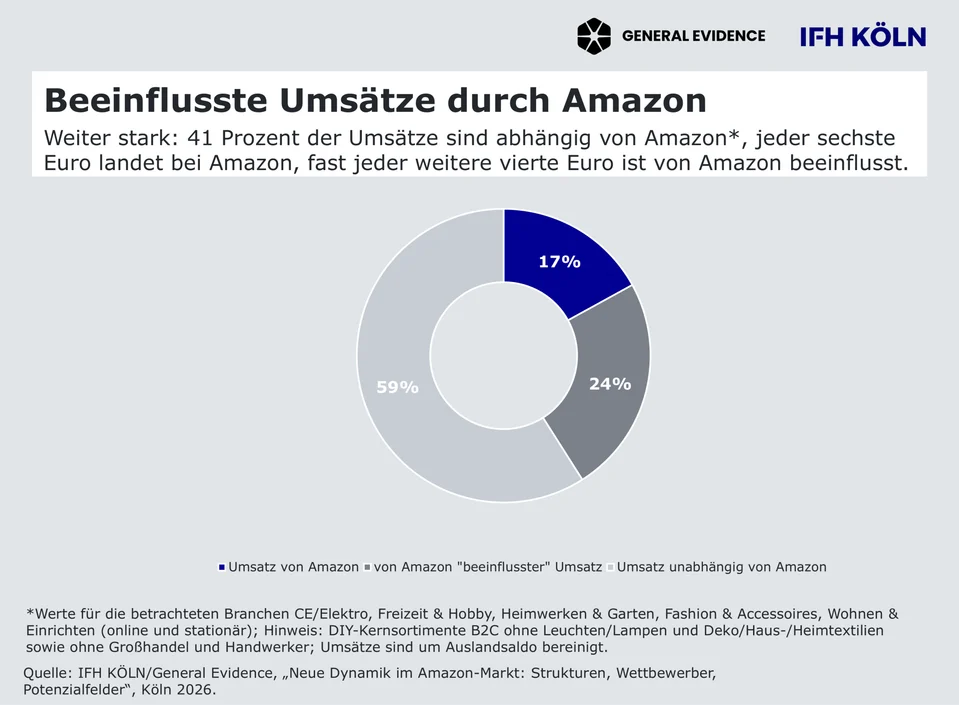
In the landscape of European e-commerce, few entities command as much structural influence as Amazon. A comprehensive new study conducted by the Institute for Retail Research (IFH KÖLN) in collaboration with General Evidence has shed light on the staggering scale of Amazon’s footprint in Germany, revealing that the retail titan now dictates the flow of commerce for a vast majority of the nation’s consumers. With a 63 percent share of the total online retail market and a profound influence that ripples into the physical brick-and-mortar sector, Amazon has effectively transformed from a mere marketplace into the foundational infrastructure of German consumption.
Main Facts: A Titan at the Center of Commerce
The data released by IFH KÖLN paints a picture of an ecosystem where Amazon is not merely a participant but the primary arbiter of retail. According to the research, sales generated via the Amazon platform in Germany reached a monumental 69.1 billion euros last year. This represents a robust year-on-year growth of 3.2 billion euros—a 5 percent increase that solidifies the company’s lead despite a maturing market.
The sheer reach of the platform is reflected in consumer behavior: 97 percent of all German online shoppers utilize Amazon, a figure that borders on total market saturation. This ubiquity is bolstered by the “Prime effect,” with 59 percent of German online shoppers holding an active Prime membership, thereby locking themselves into a logistics and entertainment ecosystem that discourages migration to competing platforms.
The Breakdown of Market Power
Crucially, the study identifies that Amazon’s dominance is largely powered by its third-party selling partners. Of the 63 percent total online market share:
- Selling Partners: Account for 46.1 percent of total online retail spending.
- Amazon Direct Sales: Account for 17.2 percent.
This demonstrates that Amazon has successfully pivoted from being a simple retailer to becoming a global marketplace infrastructure provider, capturing commissions and logistics fees from millions of independent sellers while simultaneously maintaining its own formidable direct retail arm.
Chronology: The Evolution of Dominance
Amazon’s ascent in Germany did not happen overnight; it is the result of decades of strategic infrastructure investment and consumer behavioral conditioning.
- The Early Years (1998–2010): Amazon entered the German market by acquiring ABC Bücherdienst, setting its sights on the book trade before rapidly diversifying into electronics, home goods, and media.
- The Marketplace Pivot (2010–2018): This period marked the aggressive expansion of the Marketplace model. By allowing third-party merchants to leverage Amazon’s logistics (Fulfillment by Amazon), the company solved the “long tail” problem, offering a near-infinite product selection that local retailers could not match.
- The Prime Era (2018–2023): With the introduction of next-day and same-day delivery, Amazon shifted from being a shop to being a utility. The integration of Prime Video and music services further anchored the brand in the daily lives of German households.
- The Current Competitive Shift (2024–Present): The market is now witnessing a new phase characterized by the rise of ultra-low-cost Chinese platforms like Temu and Shein, which are forcing Amazon to defend its value proposition against a new wave of aggressive, price-driven competition.
Supporting Data: By the Numbers
To understand the scope of this influence, one must look beyond online sales. The IFH KÖLN study highlights that Amazon’s influence extends deep into the physical retail sector.
The Hybrid Impact
Amazon directly accounts for 17 percent of all retail spending—covering both online and offline channels—within the specific product categories analyzed. However, when accounting for "indirect influence"—such as consumers researching products on Amazon before purchasing them in a physical store (a phenomenon known as "webrooming")—the figure jumps to 41 percent. In essence, nearly half of all product-related spending in Germany is touched by an Amazon interface.
The Competitive Landscape
While Amazon grew by 3.2 billion euros, it is not the only player seeing growth. Domestic incumbents and international challengers are fighting for the remaining market share:
- Otto and Zalando: These German e-commerce stalwarts managed to grow their combined sales by 1.4 billion euros.
- Shein and Temu: The Chinese platforms recorded a combined growth of approximately 1 billion euros.
While the absolute growth of the Chinese players remains lower than Amazon’s, the rate of their ascent is causing concern for traditional retailers. The study notes that one in eight Amazon shoppers in Germany has already begun shifting some of their spending toward these emerging platforms, primarily driven by extreme price sensitivity.
Official Perspectives and Market Implications
The IFH KÖLN report serves as a wake-up call for both traditional retailers and policy makers. The researchers emphasize that while Amazon is facing new competitive pressures, its core strengths—logistics, ease of ordering, and an unmatched product range—remain the gold standard.
The "Price vs. Quality" Dichotomy
In its press release, IFH KÖLN notes a clear divergence in consumer motivation. Consumers are increasingly drawn to Shein and Temu for low-cost, impulsive purchases. However, when reliability, delivery speed, and high-quality customer service are required, German shoppers consistently revert to Amazon. This creates a two-tiered e-commerce landscape where Amazon acts as the "reliable backbone" while others compete for the "discount" segment.
The Logistics War
Amazon’s response to these competitive threats has been further investment. The company continues to pour hundreds of millions of euros into its German logistics network, including advanced automation in distribution centers and an expanded fleet of delivery vehicles. This creates a "moat" that is increasingly difficult for competitors to cross, as the capital requirements to match Amazon’s delivery speed are prohibitive for most challengers.
Implications for the Future of German Retail
The data suggests several long-term implications for the German market:
1. The Decline of Independent E-commerce
With Amazon controlling nearly two-thirds of the online market, independent e-commerce stores are finding it increasingly difficult to survive. To compete, they must either become "niche" specialists or integrate their inventory into the Amazon Marketplace, further deepening their dependence on the platform.
2. The Blurred Line Between Online and Offline
The fact that Amazon influences 41 percent of all retail spending proves that the distinction between "online" and "offline" retail is becoming obsolete. Retailers who do not have a robust "omnichannel" strategy—where their digital presence feeds their physical traffic—are at a severe disadvantage.
3. Regulatory Scrutiny
Given that Amazon now acts as the primary gatekeeper for millions of transactions, it is likely that European antitrust regulators will continue to monitor the platform closely. Issues such as "self-preferencing" (where Amazon promotes its own private-label products over third-party sellers) and the data leverage the company gains from its sellers will remain focal points for the European Commission.
4. The Rise of the "Aggressive Discount" Platforms
The success of Temu and Shein in capturing 1 billion euros of growth in a single year suggests that there is a segment of the German population that is highly price-elastic. Should these platforms improve their logistics and quality control, they could pose a much more significant threat to Amazon’s market share in the years to come.
Conclusion
The latest study by IFH KÖLN confirms that Amazon’s influence in Germany is not merely a trend, but a structural reality. With a 63 percent online market share and a deep integration into the offline shopping journey of the German consumer, Amazon has effectively become the operating system of German retail.
While the rise of Chinese challengers and the resilience of domestic players like Otto and Zalando suggest that the market is not yet a total monopoly, the barriers to entry created by Amazon’s logistics and Prime ecosystem remain formidable. For the German retail sector, the coming years will be defined by how successfully traditional players can adapt to this "Amazon-first" reality, or whether the next wave of disruptive, low-cost global platforms will successfully fracture the giant’s dominance. For now, however, the throne of German commerce remains firmly occupied by the Seattle-based giant.
 Pevita Pearce
  Layla Zulfa
  Suro Senen