
 By Nana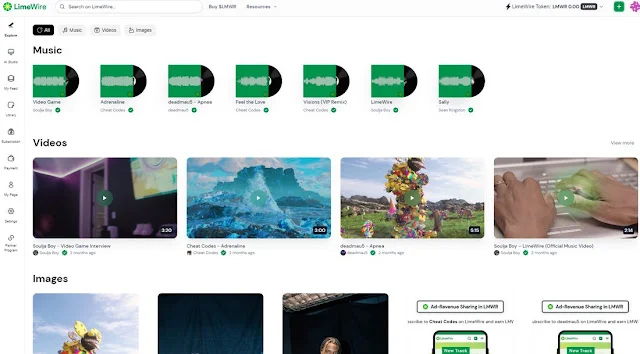
Main Facts
LimeWire, a brand once universally recognized as the peer-to-peer (P2P) file-sharing titan of the early 2000s, has completed one of the most unexpected corporate and technological resurrections in digital history. Long gone are the days of unauthorized MP3 downloads and legal battles that defined the original software’s legacy. Today, LimeWire has been entirely reimagined as a cutting-edge generative AI content publishing platform and Web3 creator economy ecosystem.
Headquartered in a modernized operational structure, the platform allows users to generate, publish, share, and monetize digital media—ranging from text-to-image AI art to forthcoming audio and video assets. By seamlessly blending state-of-the-art generative artificial intelligence models with blockchain technology, LimeWire enables creators to automatically mint their generated content as Non-Fungible Tokens (NFTs) on the Polygon and Algorand blockchains.
Furthermore, the platform introduces a lucrative financial model for digital artists. Through its native cryptographic asset, LMWR tokens, and an ad-revenue-sharing structure, LimeWire is positioning itself not merely as a creative suite, but as a sustainable marketplace where designers, musicians, and everyday users can build digital businesses. Major mainstream artists, including Deadmau5, Soulja Boy, and Sean Kingston, have already gravitated toward the ecosystem to publish and trade exclusive media, proving that the modern LimeWire holds serious weight in the contemporary digital art landscape.
Chronology of Transformation
To understand how LimeWire made the leap from a controversial P2P utility to a sophisticated Web3 AI studio, it is essential to trace its structural evolution over the past two decades:
- The 2000s (The P2P Era): LimeWire reigns supreme as one of the world’s most popular file-sharing applications, utilizing the Gnutella network. It becomes a cultural touchstone for digital music consumption before shutting down in 2010 following a landmark copyright infringement lawsuit.
- The Acquisition and Pivot (2022): Austrian entrepreneurs Julian and Paul Zehetmayr acquire the dormant LimeWire brand rights. Rather than reviving the file-sharing client, they announce a strategic pivot toward the burgeoning digital collectibles market as an NFT music marketplace.
- Integration of Generative AI (Early 2023): Capitalizing on the generative AI boom sparked by tools like Midjourney and OpenAI’s DALL-E, LimeWire launches its AI Studio. The platform pivots from a pure NFT marketplace to an end-to-end creation, publishing, and monetization hub.
- Token Launch and Ecosystem Expansion (Mid-2023 to Present): LimeWire introduces its native utility token, LMWR, launches multi-tiered subscription pricing models, integrates advanced text-to-image models (such as Stable Diffusion XL and DALL-E 2), and rolls out ad-revenue-sharing programs to incentivize platform growth.
Supporting Data and Platform Mechanics
LimeWire’s current architecture relies on a complex web of generative AI technologies, blockchain protocols, and creator-focused financial metrics.
AI Model Integration and Customization
The core of the platform is the LimeWire AI Studio, which currently focuses primarily on high-fidelity image generation. Users are not restricted to a single proprietary engine; instead, LimeWire integrates multiple industry-leading models, including Stable Diffusion 2.1, Stable Diffusion XL (SDXL), and DALL-E 2.
The platform caters to varying levels of technical expertise. Users can input concise, simple prompts or craft intricate instructions supplemented by negative prompts and advanced samplers to fine-tune image resolution, composition, and detail. Furthermore, creators can easily switch between diverse visual styles:
- Cinematic
- Digital Art and Pixel Art
- Anime and Illustration
- Analog Film and Vintage Aesthetics
Automated NFT Minting and Blockchain Infrastructure
Once an image or piece of digital media is generated and published on LimeWire Studio, the platform initiates an automated smart contract sequence. It mints the creation as an NFT on either the Polygon or Algorand blockchain. This grants the creator undeniable proof of ownership and a permanent digital signature.
Creators retain absolute control over how their minted assets are distributed:
- Public Release: Content is made discoverable to the entire LimeWire community, allowing any user to view, collect, and trade the digital asset on secondary markets.
- Subscriber-Only Exclusivity: Creators can lock content behind a paywall, offering exclusive drops strictly to their dedicated, paying followers.
The Financial Model: Revenue Sharing and LMWR Tokens
LimeWire distinguishes itself from free-to-use AI generators by actively returning capital to its user base. Creators can earn revenue through two primary streams:
- Ad Revenue Share: When other users view a creator’s published images, music, or videos on the platform, ad revenue is generated. Depending on the creator’s subscription tier, they receive between 50% and 70% of the ad revenue associated with their content views.
- Secondary Trading Royalties: Whenever a creator’s minted NFT is traded within the community marketplace, the original creator automatically earns a 2.5% royalty on the transaction.
Earnings are distributed monthly in LMWR tokens—LimeWire’s native cryptocurrency. These tokens can be traded on prominent external cryptocurrency exchanges such as Kraken, ByBit, and Uniswap, or reinvested directly into the platform to purchase additional prompt credits.
Subscription Pricing Tiers
LimeWire operates on a freemium model alongside four distinct professional tiers, scaling according to the creator’s output volume and revenue-share percentages:
- Free Plan:
- Cost: $0/month
- Credits: 10 free credits daily (up to 20 image generations per day)
- Ad Revenue Share: 50%
- Basic Plan:
- Cost: $9.99/month
- Credits: 1,000 monthly credits (up to 2,000 image generations)
- Ad Revenue Share: 50%
- Plus Plan:
- Cost: $29/month
- Credits: 3,750 monthly credits (up to 7,500 image generations)
- Ad Revenue Share: 60%
- Pro Plan:
- Cost: $49/month
- Credits: 5,000 monthly credits (up to 10,000 image generations)
- Ad Revenue Share: 70%
- Advanced Pro Plan:
- Cost: $99/month
- Credits: 11,250 monthly credits (up to 22,500 image generations)
- Ad Revenue Share: 70%
All paid tiers include additional perks: a Pro profile badge, complete creation history access, accelerated generation speeds, and an ad-free browsing experience.
Official Responses and Strategic Vision
Leadership at LimeWire has been transparent about the strategic intent behind the platform’s dramatic reinvention. By acquiring a universally known brand name laden with nostalgic value, the executive team bypassed years of brand-building friction, instantly capturing global headlines upon their return.
In public statements regarding the platform’s evolution, co-founders Julian and Paul Zehetmayr emphasized that the modern digital creator economy suffers from a lack of monetization options for early adopters of artificial intelligence. While platforms like Midjourney and OpenAI provide powerful generative tools, they rarely compensate the end-user for the commercial success or viral spread of their generated aesthetics.
LimeWire’s official corporate stance frames the AI Studio as a "democratizing force." By marrying generative art production with decentralized ledger technology (NFTs) and programmatic ad-revenue distribution, executive leadership argues that LimeWire is building the blueprint for how digital artists will sustain themselves in the Web3 era. Furthermore, official roadmap updates confirm that the platform is actively developing its own proprietary AI model, signaling a transition away from complete reliance on third-party engines like Stable Diffusion.
Broader Implications for the AI and Web3 Industries
The transformation and ongoing success of LimeWire carry significant implications for both the artificial intelligence sector and the decentralized web community.
1. The Blurring Lines Between AI Generation and Digital Ownership
For years, the generative AI community has grappled with questions of copyright, ownership, and monetization. Users generate millions of images daily, yet ownership rights remain legally ambiguous. LimeWire’s integration of automated NFT minting offers a functional, albeit Web3-centric, solution to provenance. By instantly stamping every prompt output onto a public blockchain, the platform establishes an immutable ledger of creation. This model could inspire mainstream image generators to incorporate blockchain-backed authentication to protect creator rights.
2. Mainstreaming Cryptocurrency via Creator Tools
Cryptocurrency adoption has historically suffered from a steep learning curve and user-experience friction. By routing platform payouts through LMWR tokens and allowing seamless conversion on major exchanges like Kraken and Uniswap, LimeWire successfully gamifies and normalizes crypto-earning for traditional digital designers who might otherwise avoid Web3 environments.
3. The Future of Multimodal Content Ecosystems
As LimeWire prepares to expand its toolset beyond static image generation into AI-driven music and video composition, it poses a direct challenge to standalone platforms. If a single interface allows a creator to prompt an image, compose an accompanying soundtrack via AI, mint both as a unified multimedia NFT, and distribute them to paying subscribers while collecting ad revenue, specialized single-feature tools may struggle to compete.
Ultimately, LimeWire has shed its controversial past to pioneer a new standard for creator empowerment. By transforming passive consumers of digital media into active, monetized digital artists, the platform demonstrates that even the most nostalgic relics of the early internet can find a lucrative, forward-thinking home in the age of artificial intelligence and Web3.
 Azzam Bilal Chamdy
  Evan Lee Salim
  Pevita Pearce