
 By Evan Lee Salim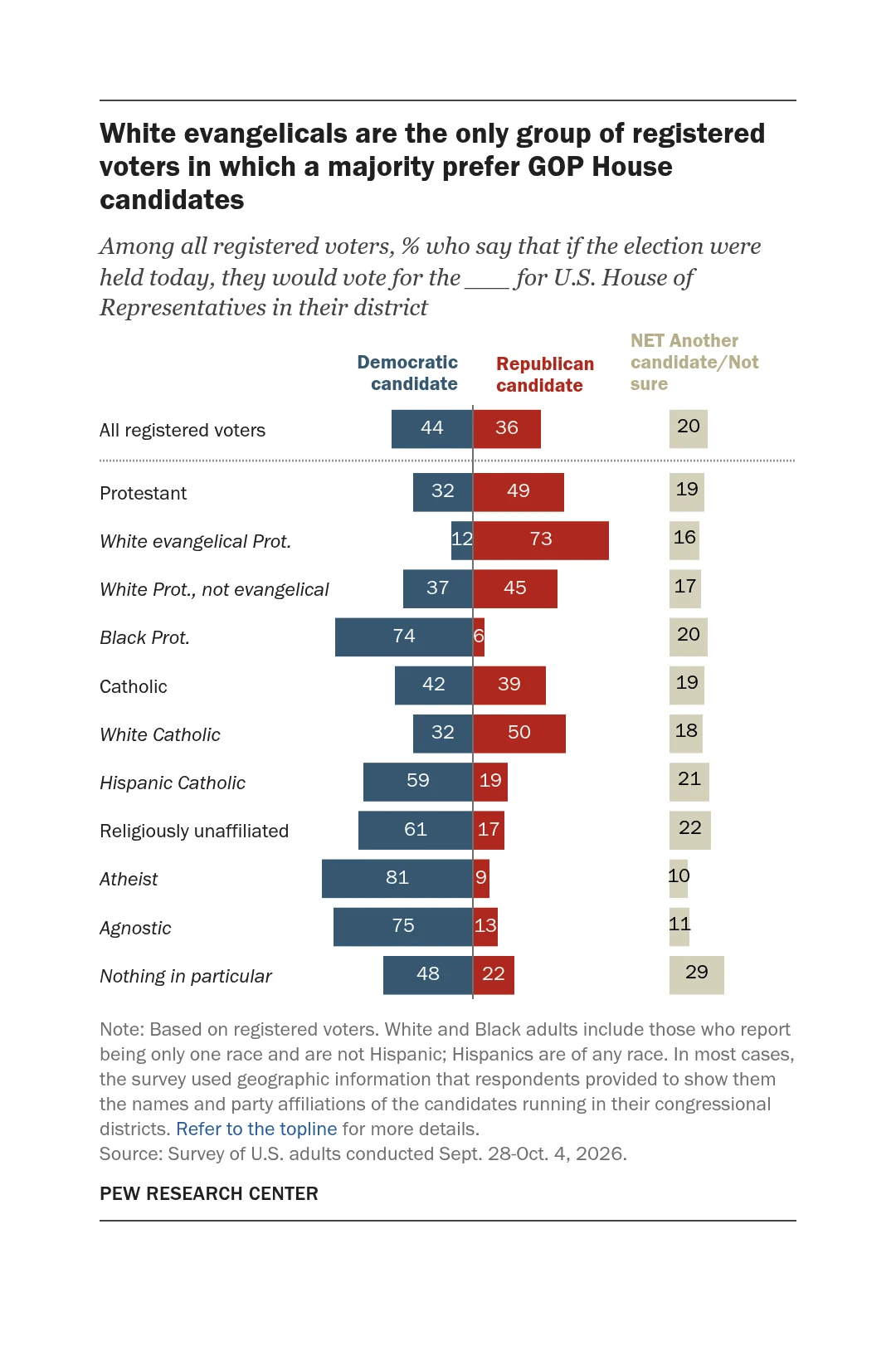
WASHINGTON — As the United States marches toward the closely watched 2026 midterm elections, a profound realignment and a striking sense of political weariness are reshaping the nation’s electorate. New data released by the Pew Research Center reveals a complex tapestry of voter intent, highlighting deep fractures along religious lines. While overall registered voters lean toward Democratic candidates for the U.S. House of Representatives—fueled by heightened enthusiasm and engagement among the party’s base—the religious makeup of the country tells a much more fractured story.
Beneath the surface of broad national polling figures lies a stark reality: White evangelical Protestants stand virtually alone as the only major religious demographic in which a clear majority firmly prefers Republican congressional candidates. Meanwhile, President Donald Trump faces a sweeping erosion of support, with his approval ratings sliding across every single measurable religious community since the dawn of his second term.
As campaigns enter their final, crucial weeks, these shifting dynamics underscore how faith, partisan loyalty, and economic anxieties intertwine to create one of the most unpredictable midterm cycles in recent American history.
Main Facts: The 2026 Religious and Political Divide
The latest survey from the Pew Research Center, conducted between September 28 and October 4, 2026, among 5,062 U.S. adults (including 3,917 registered voters), provides a comprehensive look at how faith groups view the upcoming congressional elections and the sitting administration.
At the macro level, registered voters nationwide currently express a preference for Democratic candidates over Republican ones for the U.S. House. Crucially, this preference is bolstered by an enthusiasm gap: voters who lean toward Democratic contenders report being significantly more engaged and motivated to cast their ballots than their Republican counterparts.
However, when broken down by religious tradition, these national trends fracture dramatically:
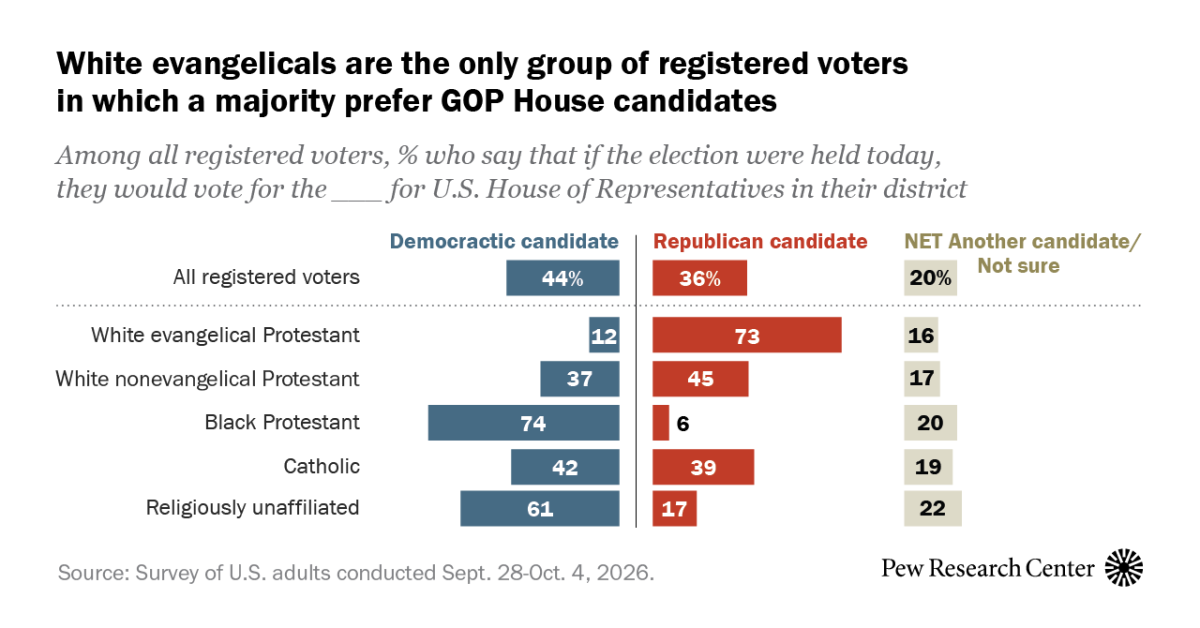
- The Republican Bulwark: White evangelical Protestant registered voters remain the anchor of the modern GOP. Approximately 73% of this group favors the Republican candidate in their local House district, compared to just 12% who back the Democrat.
- The Catholic Split: White Catholic voters also favor the GOP, though by a narrower 50% to 32% margin. Conversely, Hispanic Catholics lean heavily Democratic, preferring Democratic candidates 59% to 19%. Overall, the Catholic electorate remains competitive, splitting 42% for Democrats and 39% for Republicans.
- The Democratic Strongholds: Overwhelming support for Democratic candidates characterizes nearly every other major religious and secular demographic. This includes 74% of Black Protestants, 81% of atheists, 75% of agnostics, and 61% of the broader religiously unaffiliated population. Meanwhile, those who identify their religion as "nothing in particular" favor Democrats 48% to 22%.
- Trump’s Broad Decline: President Trump’s approval ratings have plummeted across every religious group since the start of his second term. Today, White evangelical Protestants are the solitary religious demographic where more individuals approve (58%) than disapprove (40%) of his job performance. In every other group, disapprovers outnumber approvers—frequently by staggering margins.
Chronology: The Slide in Presidential Approval (2025–2026)
To fully understand the current political climate, political analysts must examine the steady downward trajectory of President Trump’s approval ratings over the course of his second term. The Pew Research Center’s longitudinal tracking reveals a consistent erosion of confidence across almost all religious demographics, punctuated by key economic and legislative headwinds over the past twenty-two months.
- January–February 2025 (The Honeymoon Period): At the outset of his second term, Trump enjoyed relatively robust support among traditional allies. Among all Protestants, approval stood at 58%, while a commanding 78% of White evangelical Protestants backed his leadership. Even among groups typically critical of the administration, baseline numbers showed higher relative marks, with 47% of all Catholics and 59% of White Catholics expressing approval.
- April–September 2025 (Early Erosion): As initial legislative agendas met legislative hurdles and debates over inflation and government spending intensified, cracks began to form. By April 2025, overall Protestant approval slipped to 50%, and White evangelical support dipped to 72%. By the autumn of 2025, temporary plateaus gave way to a broader realization that public satisfaction was hardening into dissatisfaction, particularly as cost-of-living concerns persisted.
- January–April 2026 (Mid-Term Slump): Entering the election year, cumulative pressures—ranging from global economic uncertainties to domestic policy disputes—accelerated the slide. By April 2026, Trump’s approval among all Protestants fell to 45%, while White evangelical backing dropped to 65%. Among White Catholics, approval dipped below the majority threshold to 49%.
- July–October 2026 (The Pre-Election Trough): In the weeks immediately preceding the midterm surveys, Trump’s approval reached historic lows for his second term. Among all U.S. adults, overall approval settled at 30%, with 68% disapproving. White evangelical approval dropped to 58%—the lowest point of his term—while Black Protestant approval hit a microscopic 7%. Unaffiliated voters and mainline Protestants similarly registered deep-seated skepticism, setting the stage for a highly polarized electoral showdown.
Supporting Data: Detailed Breakdown of Voter Preferences and Approval
The statistical architecture of the Pew Research Center survey highlights the deep polarization defining the 2026 midterms. Below is a detailed look at how various religious communities intend to vote in their local congressional districts alongside their appraisal of the executive branch.
House Midterm Preferences by Religious Group
(Among registered voters, % who say they would vote for the U.S. House candidate)
| Religious Demographic | Democratic Candidate (%) | Republican Candidate (%) | Another / Not Sure (%) |
|---|---|---|---|
| All Registered Voters | 44 | 36 | 20 |
| Protestant (All) | 32 | 49 | 19 |
| – White Evangelical Protestant | 12 | 73 | 16 |
| – White Protestant (Non-evangelical) | 37 | 45 | 17 |
| – Black Protestant | 74 | 6 | 20 |
| Catholic (All) | 42 | 39 | 19 |
| – White Catholic | 32 | 50 | 18 |
| – Hispanic Catholic | 59 | 19 | 21 |
| Religiously Unaffiliated (All) | 61 | 17 | 22 |
| – Atheist | 81 | 9 | 10 |
| – Agnostic | 75 | 13 | 11 |
| – Nothing in particular | 48 | 22 | 29 |
Presidential Job Approval by Religious Group
(% of U.S. adults who approve vs. disapprove of Donald Trump’s job performance)
| Religious Demographic | Approve (%) | Disapprove (%) | Net Sentiment |
|---|---|---|---|
| All U.S. Adults | 30 | 68 | -38 |
| Protestant (All) | 39 | 58 | -19 |
| – White Evangelical Protestant | 58 | 40 | +18 |
| – White Protestant (Non-evangelical) | 38 | 60 | -22 |
| – Black Protestant | 7 | 90 | -83 |
| Catholic (All) | 30 | 67 | -37 |
| – White Catholic | 39 | 59 | -20 |
| – Hispanic Catholic | 18 | 78 | -60 |
| Religiously Unaffiliated (All) | 17 | 82 | -65 |
| – Atheist | 8 | 92 | -84 |
| – Agnostic | 12 | 87 | -75 |
| – Nothing in particular | 21 | 77 | -56 |
Official Responses and Campaign Reactions
As the survey findings reverberate through Washington corridors and campaign war rooms, political strategists from both sides of the aisle are interpreting the numbers through distinct strategic lenses.
National Democratic campaign committees seized on the findings regarding voter enthusiasm and the broader electorate’s sour mood. In a statement addressing the data, Democratic strategists emphasized that the persistent economic dissatisfaction among Americans—combined with high motivation levels among progressive and moderate base voters—provides a viable pathway to defending and expanding congressional seats.

"Voters across America are demanding accountability, and the energy on the ground clearly favors candidates who are focused on lowering costs and protecting democratic institutions," a senior Democratic campaign official noted, pointing to the high engagement metrics among secular and minority religious voters.
Conversely, Republican strategists caution against writing off the power of core conservative coalitions, particularly in rural and suburban districts where White evangelical and traditional Catholic voters hold disproportionate sway. GOP spokespersons emphasized that while presidential approval numbers fluctuate in response to midterm economic headwinds, legislative races often pivot on hyper-local issues, border security, and cultural values.
"The bedrock of our movement remains intensely focused on the issues that matter most: economic freedom, traditional values, and legislative oversight," a Republican National Committee spokesperson remarked. "When voters enter the ballot box, the contrast between conservative principles and progressive governance will drive our base to the polls, regardless of mid-term polling noise."
Religious leaders and faith-based advocacy organizations have also weighed in on the data. Interfaith coalitions noted that the persistent divide between white evangelicals and other faith groups mirrors broader cultural and racial polarization within the United States. Many faith leaders have expressed concern over the increasing conflation of partisan politics with religious identity, urging congregants to look beyond party lines toward community cohesion and moral stewardship.
Implications: What This Means for the 2026 Midterms and Beyond
The implications of the Pew Research Center study extend far beyond the immediate arithmetic of the 2026 House races. They point to structural shifts in how Americans integrate their spiritual lives with their civic duties.
1. The Paradox of Evangelical Solidarity vs. Broader Isolation
While White evangelical Protestants remain remarkably unified in their support for Republican candidates and the Trump administration, their political isolation from the rest of the religious landscape has grown more pronounced. In an increasingly pluralistic and secularizing America, where the share of religiously unaffiliated citizens continues to climb, a political strategy that relies overwhelmingly on a single, shrinking demographic cohort faces long-term arithmetic challenges. Nevertheless, because evangelical voters historically exhibit exceptionally high voter turnout rates, their localized power in key swing districts remains formidable.

2. The Enthusiasm Gap as a Decisive Factor
Elections are rarely won solely on preference; turnout is the ultimate arbiter. The survey’s finding that Democratic-leaning voters are significantly more engaged and motivated to vote than Republican-leaning voters could prove pivotal in tight congressional races. If this enthusiasm differential translates into actual ballot-box participation, it could offset traditional midterm penalties typically faced by the party holding the White House.
3. The Catholic Vote as a Microcosm of America
The deep internal divisions within the Catholic community—where White Catholics lean Republican and Hispanic Catholics lean heavily Democratic—underscore the inadequacy of treating broad religious categories as monoliths. Candidates seeking to win competitive suburban and industrial districts must navigate these crosscurrents with care, addressing the nuanced economic and social concerns of working-class Catholic families without alienating either wing of the church.
4. The Secular Surge
Perhaps the most enduring trend highlighted by the data is the political potency of the religiously unaffiliated—often referred to as the "nones." Comprising atheists, agnostics, and those with no formal religious affiliation, this bloc now constitutes a massive voting block that overwhelmingly rejects conservative governance and overwhelmingly supports Democratic candidates. As secularism continues to expand across younger generations, both political parties will be forced to adapt their messaging to an electorate that is increasingly skeptical of traditional religious authority in the public square.
As the final weeks of the campaign unfold, candidates across the country will continue to court these vital religious and secular constituencies. Whether the high enthusiasm among Democratic-leaning faith groups can overcome the deeply entrenched loyalty of the conservative evangelical base remains the central question of the 2026 midterms—an election cycle that will help define the political trajectory of the nation for years to come.
 Ammar Sabilarrohman
  Ali Ikhwan
  Iffa Jayyana