
 By Ammar Sabilarrohman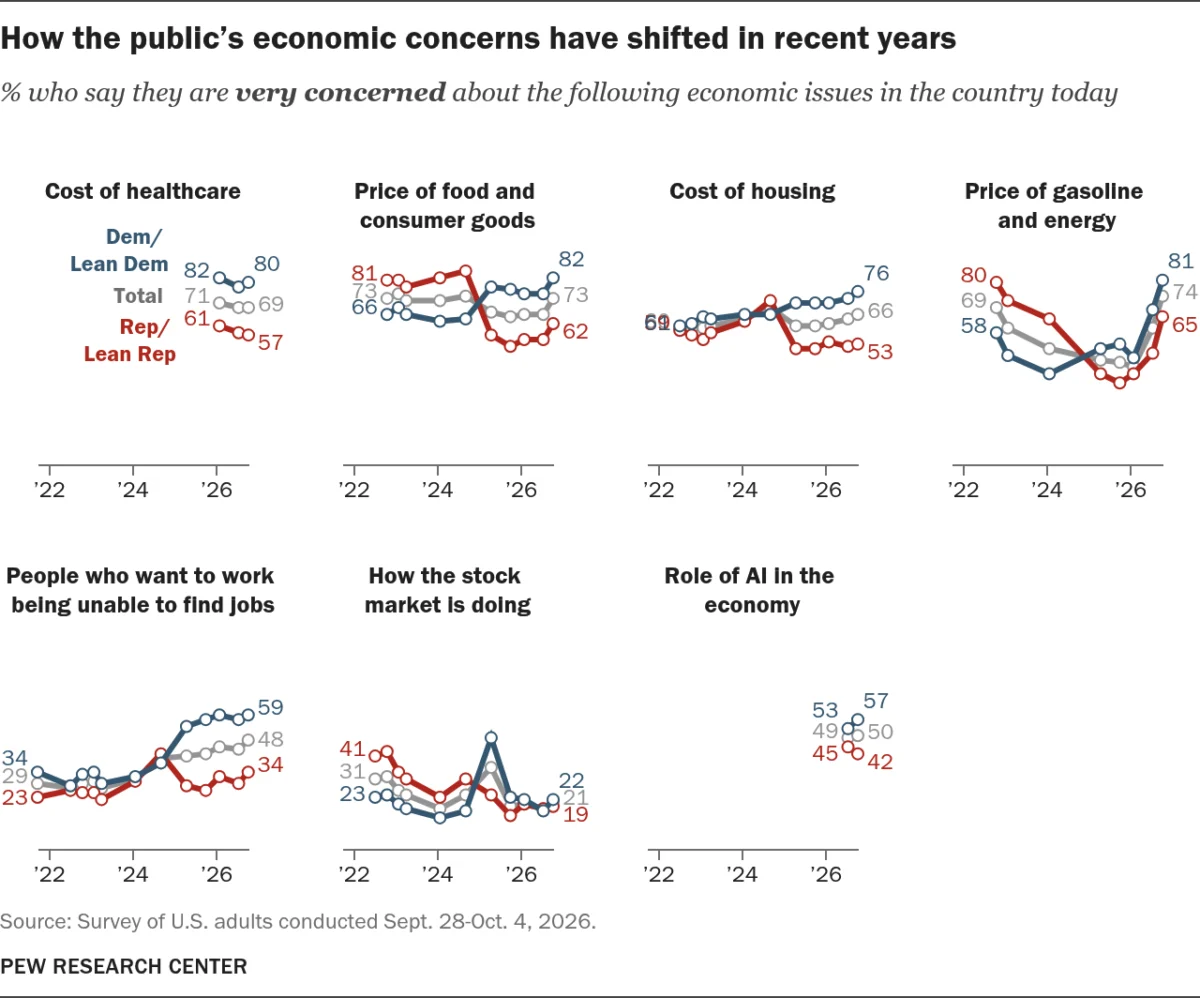
WASHINGTON — As the United States sits precisely one month away from high-stakes congressional midterm elections, a dark and anxious mood has settled over the American electorate. According to a comprehensive new nationwide survey conducted by the Pew Research Center, soaring costs for household essentials, fuel, and energy have surged to the forefront of voters’ minds, eclipsing nearly all other political and economic issues.
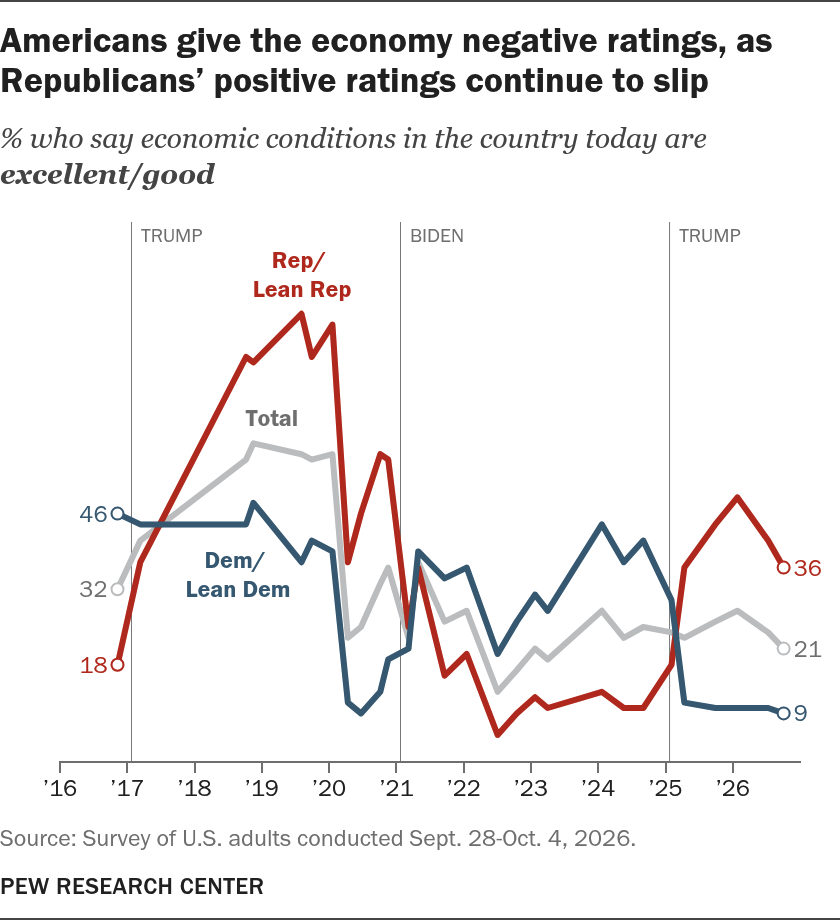
The survey, which polled 5,062 U.S. adults between September 28 and October 4, 2026, reveals that public ratings of national economic conditions have tumbled to some of the lowest points recorded during either term of President Donald Trump. Only 21% of Americans currently describe national economic conditions as either "excellent" or "good"—a notable decline from the 28% who felt similarly at the start of the year. Meanwhile, 37% view the economy as only "fair," and a significant 42% label conditions as outright "poor."
With inflation anxiety, international energy shocks, and rapid technological shifts weighing heavily on households, the intersection of kitchen-table economics and electoral politics has created a volatile landscape for candidates on both sides of the aisle.

Chronology of Economic Sentiment: How the Public Mood Slipped
To understand the current economic anxiety, policy analysts look back at the trajectory of public sentiment throughout President Trump’s second term. The timeline of economic evaluations demonstrates a gradual erosion of confidence, catalyzed by a combination of domestic price pressures and volatile international events.
- Early 2025 (The Opening Months): Optimism initially held ground following the administration’s early months. In February 2025, 40% of Americans expected economic conditions to improve over the subsequent year, driven largely by high enthusiasm among Republican voters who anticipated pro-growth policies.
- Late 2025 (The Reality of Costs): By the autumn of 2025, cracks began to show. As cost-of-living pressures persisted, optimism waned. In September 2025, only 29% expected conditions to improve, while 46% expected them to worsen.
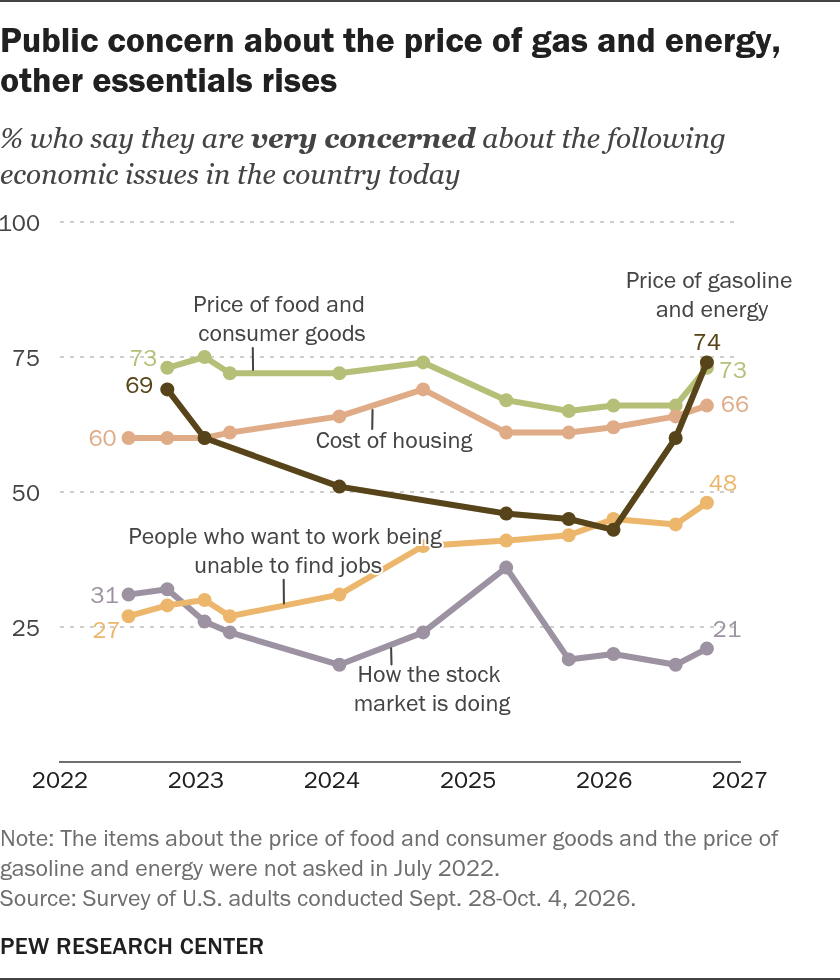
- Early 2026 (The Iran Conflict and Energy Shocks): A major inflection point occurred in early 2026. Following a military conflict with Iran that severely disrupted global energy markets, the price of gasoline and utilities spiked. While just 43% of Americans reported being "very concerned" about energy prices in January 2026, that sentiment changed drastically as the year progressed.
- Summer to Fall 2026 (The Midterm Approach): By July 2026, concerns over gasoline and energy prices shot up to 60%, and by the time of the October survey, a staggering 74% of Americans reported being very concerned about energy costs. This mounting pressure directly dragged down overall economic ratings, bringing the share of Americans giving the economy a positive score down to 21% on the eve of the midterms.
Supporting Data: What Worries Americans Most?
The Pew Research Center data underscores that while the macroeconomic indicators like the stock market continue to perform detached from daily hardships, Main Street remains gripped by anxiety over direct out-of-pocket expenses.
When asked to identify the economic issues causing them the most concern, respondents highlighted several critical pressure points:
1. Energy and Fuel Costs
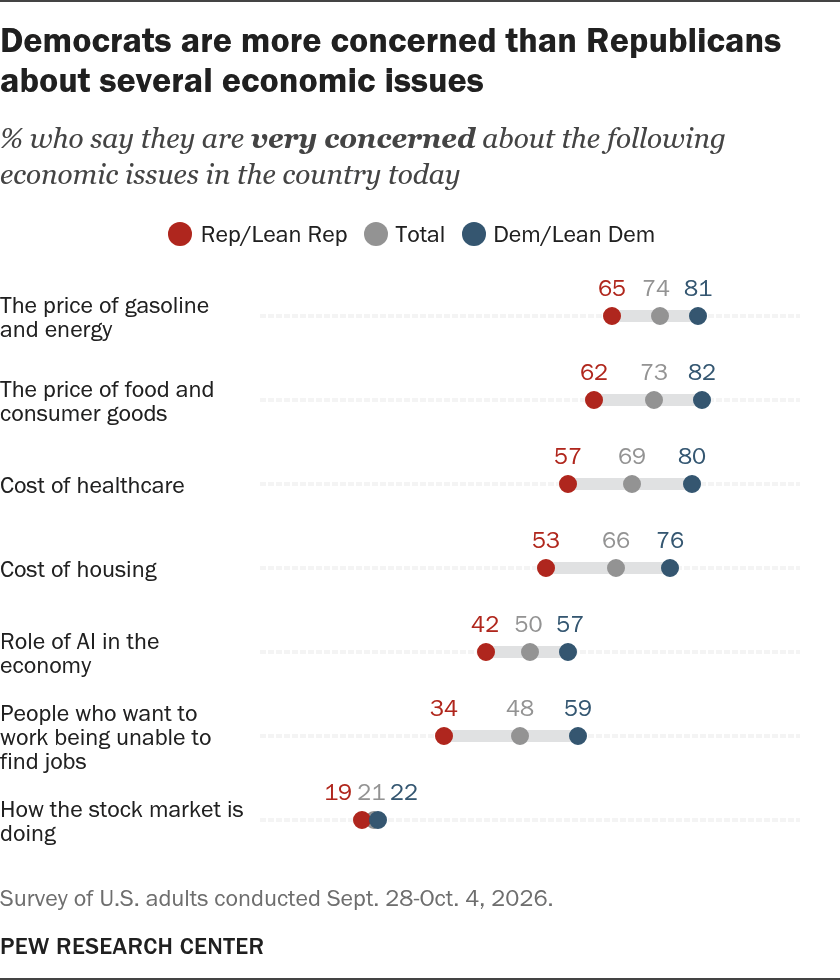
At the top of the list is the price of gasoline and energy. Currently, 74% of U.S. adults are "very concerned" about this issue, a massive leap from the 43% recorded in January before the U.S.-Iran conflict. While anxiety is universal—spanning political boundaries—it is currently felt most acutely by Democrats and Democratic-leaning independents (81% very concerned) compared to Republicans and Republican leaners (65%).
2. Food and Consumer Goods
The cost of daily groceries and retail items remains a persistent burden. Fully 73% of Americans report high levels of concern regarding food prices. This mirrors the high anxiety levels recorded during the peak inflation cycles of 2022 and 2024. Partisan breakdowns reveal that 82% of Democrats and 62% of Republicans view the price of food and consumer goods as a major crisis point.
3. Healthcare and Housing
Housing affordability continues to choke household budgets, with 66% of the public expressing deep concern over housing costs (up from 60% in mid-2022). Additionally, 69% of adults are highly concerned about the escalating cost of healthcare.
4. Employment and the Labor Market
While widespread joblessness was not the dominant fear during the immediate post-pandemic years, anxieties surrounding employment have steadily crept upward. Nearly half of the public (48%) now report being very concerned about individuals who want to work being unable to find jobs—up significantly from 29% in October 2022.
5. The Emergence of Artificial Intelligence
Reflecting the changing nature of the modern economy, half of all Americans (50%) report being very concerned about the economic role and disruptive potential of artificial intelligence (AI). Anxiety over AI is slightly higher among Democrats (57%) than among Republicans (42%).
6. The Stock Market Disconnect
In stark contrast to everyday consumer costs, only 21% of Americans say they are very concerned about how the stock market is doing. This low figure highlights a persistent disconnect between Wall Street benchmarks and the lived financial realities of ordinary citizens.
Official Responses and Policy Appraisals: The Trump Agenda Under Fire
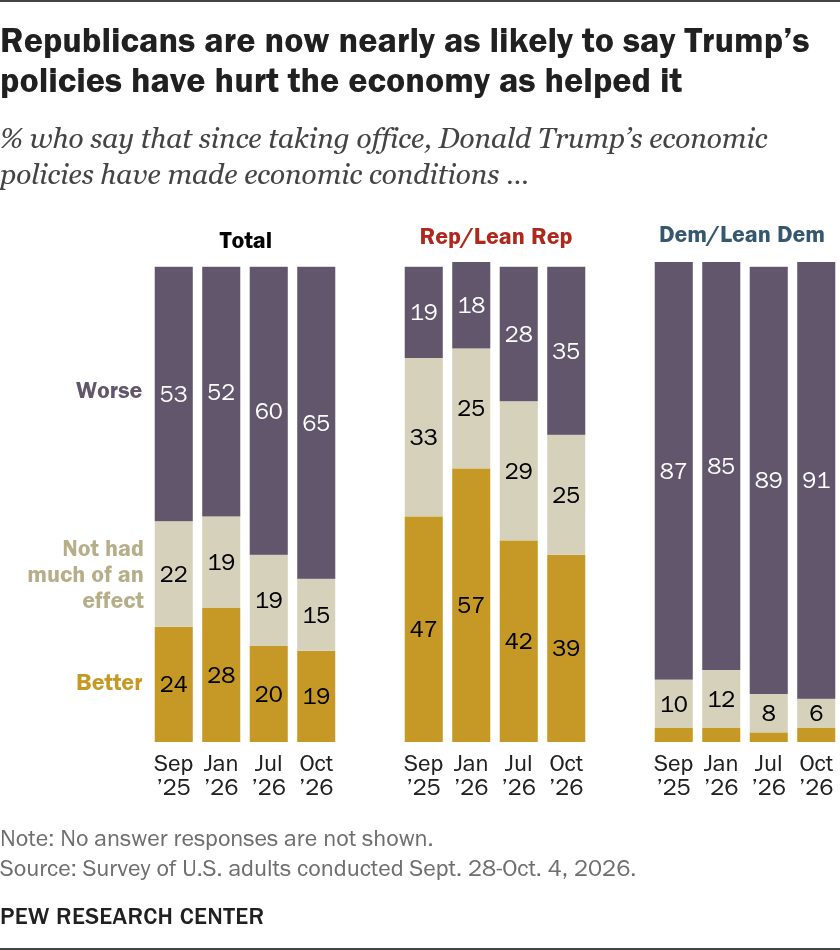
As voters prepare to cast their ballots, public assessment of President Trump’s economic stewardship has turned increasingly critical. The survey data reveals that a solid majority of Americans—65%—now believe that Donald Trump’s economic policies have made conditions in the country worse since he took office. Only 19% say his policies have made conditions better, while 15% believe they have had no major effect.
These numbers reflect a sharp deterioration from earlier in his term; in September 2025, 53% said his policies had worsened conditions, meaning dissatisfaction has grown by 12 percentage points over the past year.
The Fracturing of Republican Support
Perhaps the most notable political finding in the Pew survey is the shifting sentiment within the president’s own base. While Republicans historically rally behind their party’s leader, cracks have begun to appear in how the GOP views the administration’s economic management:
- Mixed Reviews on General Policies: Today, 39% of Republicans and Republican leaners say Trump’s policies have improved the economy, but a nearly matching 35% now say his policies have hurt the economy, with 25% saying they have made little difference. This represents a substantial shift from January 2026, when 57% of Republicans praised the administration’s economic impact and only 18% criticized it.
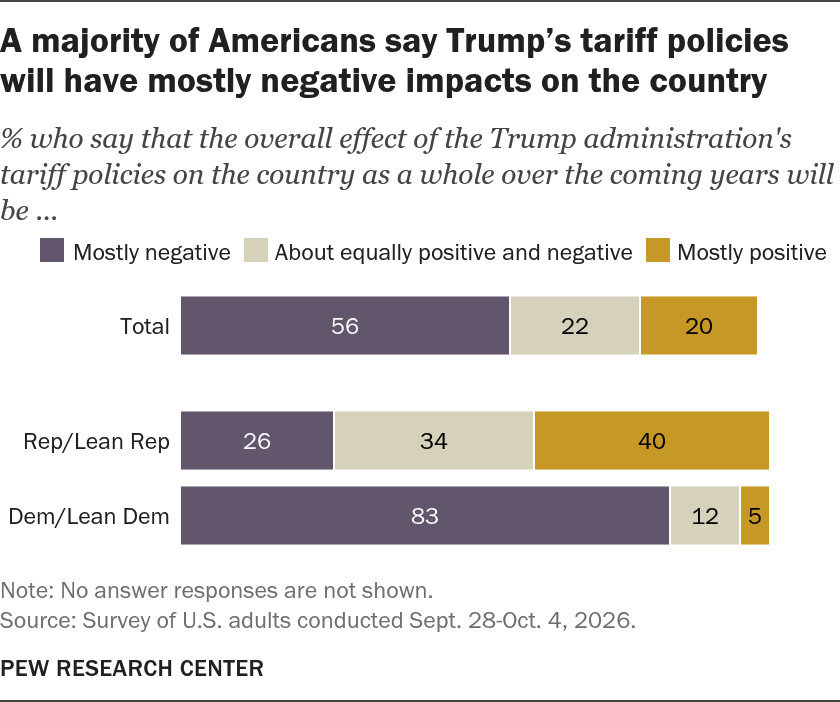
- Deepening Skepticism Over Tariffs: The administration’s aggressive tariff policies have drawn particularly harsh reviews from the broader public, while losing some of their luster among Republicans. Overall, 56% of Americans view the administration’s tariffs as having a mostly negative effect on the country over the coming years, compared to just 20% who view them as mostly positive.
- Even among Republicans, enthusiasm for protectionist trade measures is waning. While 52% of Republicans viewed tariffs positively in August 2025, that figure dropped to 49% in January 2026, and sits at just 40% in the latest October 2026 survey. Meanwhile, 26% of Republicans now categorize the tariffs as "mostly negative" (up from 21% last year), and 34% view their impact as a mix of positive and negative.
- Democrats, by contrast, remain unshakeable in their opposition: 91% say Trump’s overall economic policies have hurt the country, and 83% view his tariff agenda as a negative development.
Implications for the Midterm Elections
The convergence of negative economic ratings, persistent inflation anxiety, and a fractured public outlook on presidential policies carries profound implications for the upcoming midterm elections.
Historically, midterm elections serve as a referendum on the sitting administration, and voters experiencing financial strain frequently use the ballot box to register their discontent. The data indicates that economic pessimism is driving heightened political engagement—particularly among Democratic voters who, despite their sour mood regarding the economy, are showing high levels of motivation heading into November.
Furthermore, the erosion of economic confidence among political independents and a softening of support among rank-and-file Republicans suggest that candidates running on the administration’s economic record may face a difficult uphill battle. Campaigns focusing heavily on the soaring costs of energy, groceries, housing, and healthcare are likely to resonate most powerfully with an electorate demanding immediate relief from financial pressures.
As the final month of campaigning gets underway, the message from the American public is clear: despite broader national indicators, the day-to-day cost of living remains the ultimate metric by which voters judge their leaders and shape their political futures.
 Evan Lee Salim
  Ali Ikhwan
  Iffa Jayyana