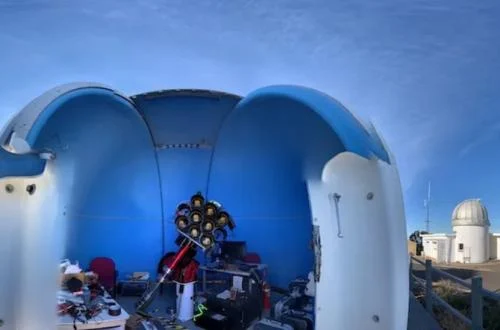
JAKARTA – For centuries, the science of optical astronomy has been tethered to the cycle of the sun. Astronomers have long operated under a strict nocturnal mandate: wait for the sun to set, wait for the atmosphere to settle, and hope for a clear sky. However, a groundbreaking development from Macquarie University in Australia is effectively shattering this chronological limitation. By integrating sophisticated light-filtering technology with the innovative Huntsman Telescope, researchers have successfully demonstrated that the cosmos can be observed with precision even in the middle of the day.
This leap in technology not only opens a new window for stellar research but also provides a critical infrastructure solution for the increasingly congested orbital environment surrounding Earth.
The Breakthrough: Redefining Optical Observation
The Huntsman Telescope, situated at the prestigious Siding Springs Observatory in Coonabarabran, New South Wales, was originally engineered for high-sensitivity nocturnal monitoring. Its architecture is unconventional; rather than a single, massive mirror, it utilizes an array of ten high-performance Canon 400mm lenses working in parallel. This multi-lens configuration, paired with astro-mechanical focusing equipment, allows the system to capture thousands of short-exposure images per second.
The primary obstacle to daylight astronomy has always been the overwhelming luminosity of the sun, which effectively "drowns out" the faint light signatures of distant stars, planets, and satellites. To overcome this, the team at Macquarie University developed specialized broadband filters. These filters are designed to act as a sophisticated gatekeeper, blocking the vast majority of solar radiation while allowing specific, distinct wavelengths from celestial objects to pass through to the telescope’s sensors.
Sarah Caddy, a key architect in the design and construction of the Huntsman array, noted that while the concept of daylight observation has been attempted for centuries, it has historically been plagued by insurmountable noise-to-signal issues. "Our tests show that Huntsman can achieve remarkable results during daylight hours," Caddy stated in a university press release.
Chronology of Development: From Concept to Reality
The journey to achieving viable daylight astronomy was not an overnight success but a methodical process of iterative testing and calibration.
- Initial Conceptualization: The Huntsman project began with the goal of creating a highly sensitive, modular telescope array capable of tracking transient astronomical events.
- The Pathfinder Phase: Before applying the technology to the full Huntsman array, the team spent months utilizing a "mini-Huntsman"—a single-lens pathfinder telescope. This phase was critical for refining the filter methodology. Researchers used this period to calculate optimal exposure times, calibrate observation windows, and develop software capable of tracking targets through the intense atmospheric turbulence typical of daytime heat.
- Refining the Filter Tech: The transition from the mini-pathfinder to the full 10-lens array required significant adjustment. The team had to ensure that all ten lenses could work in perfect synchronization, essentially creating a "super-sensor" that could maintain focus despite the heat shimmer and atmospheric distortions common in daytime conditions.
- The Breakthrough Publication: Following successful validation, the team’s findings were formally documented and published on May 20, 2024, in the Publications of the Astronomical Society of Australia, marking the official entry of the Huntsman into the realm of daytime capability.
Supporting Data and Technological Architecture
The effectiveness of the Huntsman Telescope lies in its unique "Fly’s Eye" design. By utilizing ten lenses that monitor the same area of the sky simultaneously, the system accumulates a massive amount of data in high-frequency bursts.
Key Technical Components:
- Broadband Filtering: The proprietary filter system is the "secret sauce" that suppresses solar background noise. It targets the specific light spectra emitted by stars or reflected by man-made orbital objects.
- Astro-mechanical Focusing: Because the daytime sky is dynamic, the telescope utilizes advanced mechanical focusers that adjust in real-time to compensate for thermal expansion and atmospheric refractive changes.
- High-Frequency Exposure: The system captures thousands of images per second. This is vital because, unlike the steady light of the night, daytime observations are subject to rapid, flickering atmospheric interference. By taking thousands of short exposures, the computer processing system can "stack" or select the clearest frames, effectively "de-blurring" the image of the target.
Official Responses and Scientific Context
The scientific community has reacted with significant interest to the Macquarie team’s success. Sarah Caddy, the lead author of the study, emphasized that this is not merely a novelty but a necessity for modern space management.
"Astronomy is entering a new era," Caddy noted. "With advancements in camera sensors, precision filters, and computational power, we are seeing dramatic improvements in the sensitivity and precision we can achieve, even under bright, clear skies."
The team’s primary test target, the red supergiant star Betelgeuse, serves as a testament to the telescope’s capability. Located 650 light-years away, Betelgeuse became a global focus in 2019 when its luminosity began to fluctuate wildly. Scientists believe these fluctuations were caused by massive ejections of material, forming dust clouds that obscured the star. Being able to track such stars during the day allows for continuous, 24-hour monitoring of these "dying" stars, providing data that was previously lost during the daylight hours at standard observatories.
Implications: The Future of Space Traffic Management
Perhaps the most pragmatic application of the Huntsman’s daylight capability lies in the burgeoning sector of Space Situational Awareness (SSA).
The Orbital Congestion Crisis
Currently, there are approximately 10,000 active satellites orbiting Earth. However, this number is projected to skyrocket, with plans to launch an additional 50,000 satellites into Low Earth Orbit (LEO) over the next decade. As the orbital environment becomes increasingly crowded, the risk of collisions between operational satellites and dangerous space debris grows exponentially.
The Role of Daytime Monitoring
Standard ground-based telescopes are effectively blind for nearly half of the day. This "blind spot" is a significant vulnerability for space agencies and private operators who rely on precise tracking to maneuver their assets.
- Collision Avoidance: Daylight tracking allows for a continuous "chain of custody" for satellites, ensuring that if a potential collision path is identified, operators have the data required to perform evasive maneuvers immediately.
- Pace of Detection: With a network of daytime-capable telescopes, the time between a new piece of debris being created and its detection is significantly shortened.
- Strategic Security: For nations concerned about orbital security, the ability to monitor the movement of objects in real-time—regardless of the sun’s position—is a critical defense capability.
Conclusion: A New Horizon
The success of the Huntsman Telescope project at Macquarie University is a milestone that bridges the gap between theoretical potential and operational reality. By proving that daylight astronomy is not only possible but highly accurate, the research team has provided a new tool for both fundamental astrophysics and the pressing needs of the modern space age.
As the team continues to refine their filtering algorithms and expand the capabilities of the Huntsman array, the scientific community expects to see a broader adoption of these techniques. The sky, it seems, is no longer the limit—not even when the sun is at its brightest. The future of monitoring the stars and the man-made objects orbiting our planet is now a 24-hour endeavor, ensuring that our eyes remain fixed on the heavens, day or night.