
 By Raul Delapena Setiawan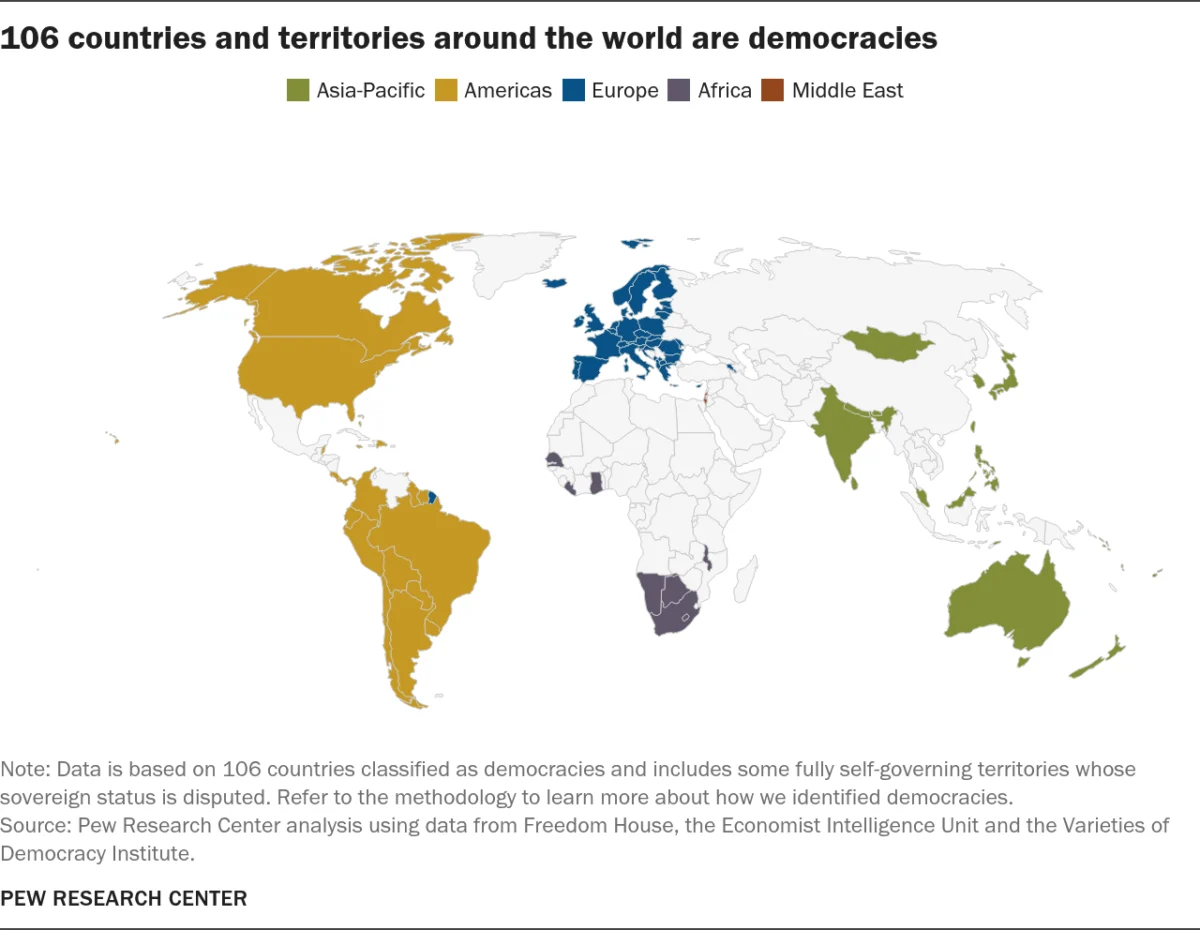
As the United States approaches the historic 250th anniversary of the Declaration of Independence, the nation finds itself in a period of intense self-reflection. While more than 100 nations across the globe are classified as democracies, the U.S. political architecture remains a singular outlier. A recent comprehensive analysis by the Pew Research Center, evaluating 106 democratic nations and territories, reveals that the American system is not just distinct—it is, in several critical functional areas, entirely unique.
Whether through the extreme difficulty of amending its founding document, the singular nature of its Electoral College, or the massive scale of its legislative representation, the U.S. has maintained a system that resists the modernization seen in many of its peer nations.

The Weight of History: A Chronology of Constitutional Stasis
The United States Constitution, ratified in 1788, is the oldest written national constitution still in force. However, its longevity is partly a byproduct of its rigidity.
- 1789–1791: The Bill of Rights (the first 10 amendments) is added, establishing the core civil liberties of the nation.
- 1865–1870: The Reconstruction Amendments (13th, 14th, and 15th) are passed, marking a rare period of significant constitutional expansion following the Civil War.
- 1920: The 19th Amendment guarantees women’s suffrage.
- 1971: The 26th Amendment lowers the voting age to 18.
- 1992: The 27th Amendment, originally proposed in 1789, is finally ratified, capping the number of times the Constitution has been amended at just 27 in 237 years.
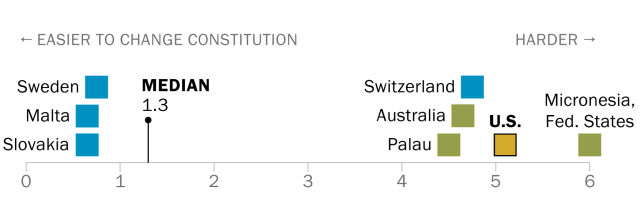
This slow pace of change stands in stark contrast to global trends. Using the scoring system developed by political scientist Donald S. Lutz, the U.S. Constitution ranks as the second-most difficult to amend among all democratic constitutions analyzed. Only the Federated States of Micronesia possesses a more onerous process. While many nations treat their constitutions as living documents that evolve through parliamentary procedures or national referenda, the U.S. requires a supermajority of both federal houses and ratification by 38 of 50 states—a hurdle that has become increasingly insurmountable in an era of intense partisan polarization.

Supporting Data: Where the U.S. Stands Apart
The data provided by the Pew Research Center highlights several structural anomalies that define the American experience:
1. Birthright Citizenship
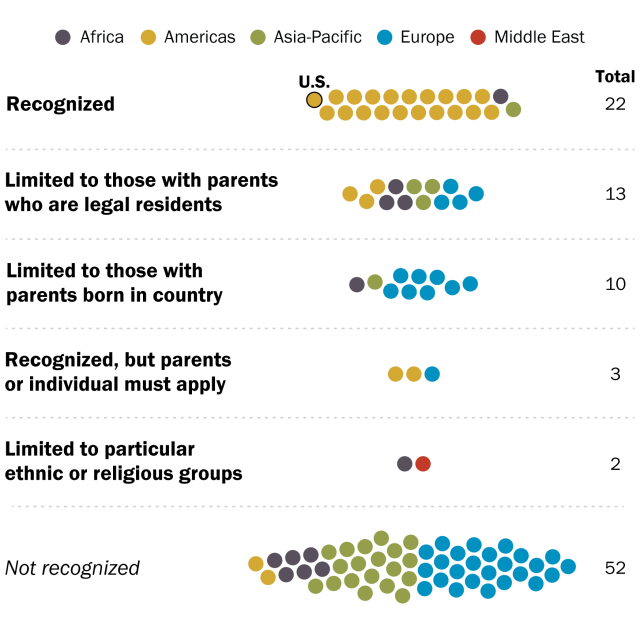
The United States remains one of only 22 democracies that offer "birthright citizenship" in its most expansive form, where almost every child born on domestic soil is granted citizenship regardless of parental status. While this is common in the Americas, it is the exception globally. Nearly half of the 106 democracies surveyed do not recognize birthright citizenship at all, requiring at least one parent to be a citizen for the child to inherit the status.
2. The Electoral College
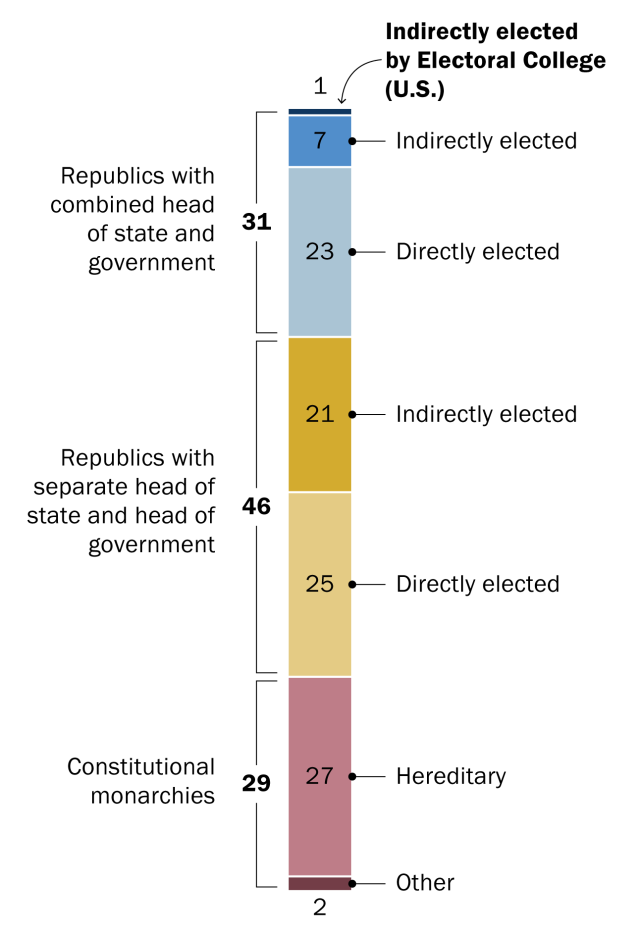
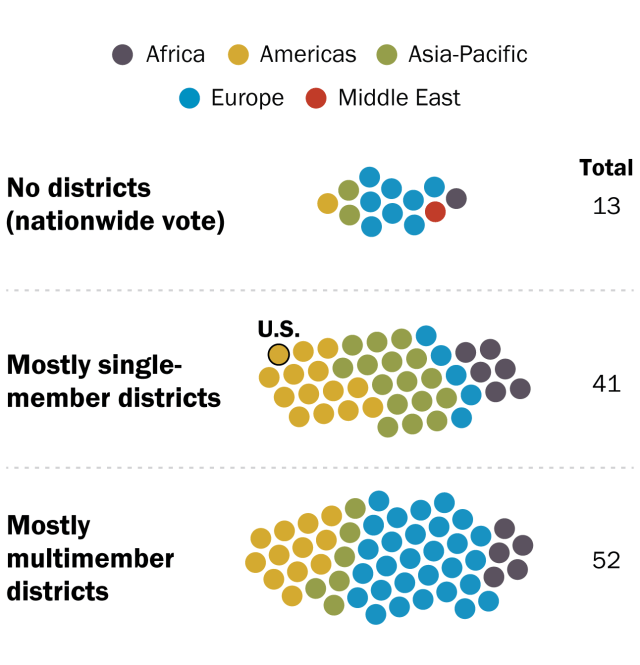
The U.S. is the only democracy where the popular vote for the head of state and government is mediated by an Electoral College. In other republics with combined heads of state and government, the leader is either directly elected by the people or chosen by the national legislature. This creates the periodic possibility of a "mismatch," where a candidate secures the presidency while losing the national popular vote—an outcome that has occurred four times since 1828.
3. Legislative Representation
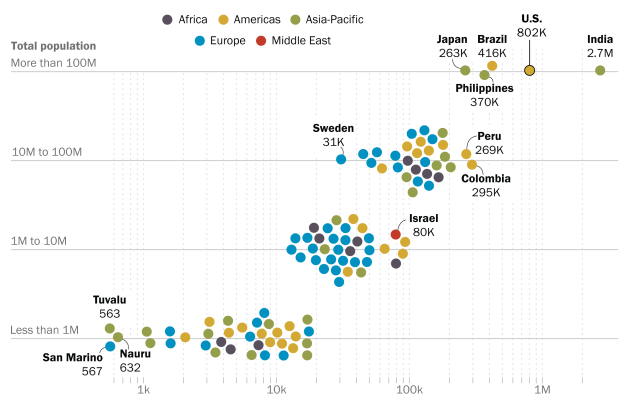
The U.S. House of Representatives has remained at 435 voting members for over a century, despite the nation’s population more than tripling. Consequently, the average U.S. representative serves approximately 802,000 constituents. Only India, with its vastly larger population and different parliamentary structure, features a higher ratio. By comparison, the median representation ratio for the democracies studied is roughly 31,000 people per lawmaker.
Official Perspectives and Public Sentiment
The divergence between the American system and those of its peers has become a focal point for both lawmakers and the public.
Regarding the Electoral College, public opinion is clear: over 63% of Americans support a move to a national popular vote system. However, institutional resistance remains high. Proponents of the current system argue that it protects the interests of smaller states and ensures geographic diversity in presidential campaigns. Critics, conversely, point to the potential for democratic stagnation.
On the issue of the debt ceiling, the U.S. also occupies a lonely position. While 70 other democracies have debt limits, most are linked to a percentage of GDP, allowing them to scale naturally with economic growth. The U.S. utilizes an absolute dollar cap, which has increasingly been weaponized as a bargaining chip in fiscal negotiations. This practice has led to multiple near-defaults and government shutdowns, prompting international concern regarding the stability of the U.S. economy.
Implications for the Future of American Democracy
The unique features of the U.S. system present a paradox: the same mechanisms that were designed to create "checks and balances" and prevent the "tyranny of the majority" are now frequently cited as the primary causes of legislative gridlock.
The Capital Problem
Perhaps the most glaring discrepancy is the status of Washington, D.C. It is the only national capital among democracies where residents lack voting representation in the national legislature. While other capitals (such as Canberra or Berlin) have special status, their residents are still granted full legislative participation. The 694,000 residents of D.C. remain in a state of "taxation without representation" that persists because resolving it would require constitutional change—a task, as established, that is nearly impossible under current rules.
The Efficiency of Governance
The U.S. approach to Election Day also highlights a disconnect between the 19th-century agrarian roots of the system and modern life. By holding elections on a Tuesday, the U.S. creates a hurdle for the working class that most other democracies have bypassed by holding elections on weekends or designating the day as a national holiday.
Conclusion
As the United States marks its 250th year, the data indicates that the "American Experiment" is becoming an increasingly lonely one. The structures that allowed the U.S. to stabilize in the 18th and 19th centuries now operate in a global environment where democratic peer nations have opted for more flexible, representative, and accessible models. Whether these structural differences represent a "preservation of core values" or a "failure to adapt" remains the central question for American policymakers as they look toward the next quarter-century.
The stability of the U.S. system is its greatest strength, but as the world around it changes, the rigidity of its institutions may well become its greatest challenge.
 Pevita Pearce
  Neng Nana