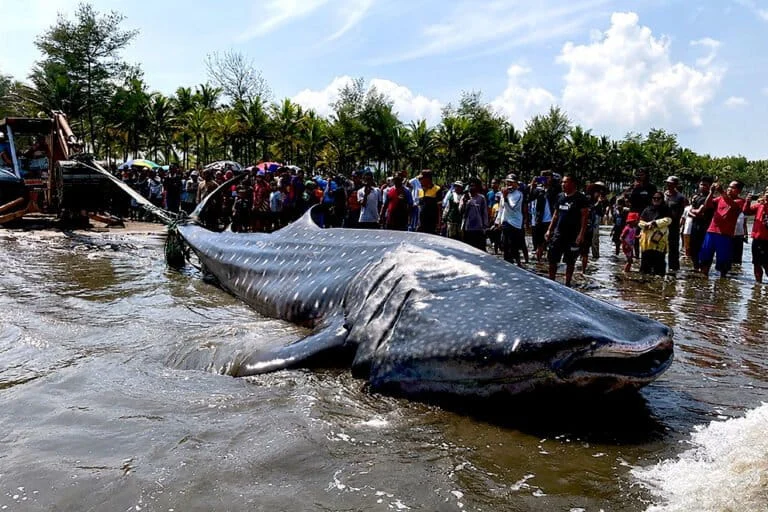
CILACAP, Central Java – The coastline of Cilacap, usually known for its tranquil waves and its vital role as a sanctuary for sea turtles, has recently become the backdrop for a recurring and distressing ecological phenomenon. In late May 2026, the local community and conservationists were once again confronted with the heartbreaking sight of a massive whale shark (Rhincodon typus) struggling against the inevitable pull of the shore.
For Jumawan, a 33-year-old dedicated conservationist and head of the Nagaraja Sea Turtle Conservation Group, the sight was all too familiar. Having spent years patrolling the sands of Cilacap to protect fragile turtle eggs, Jumawan has become an unofficial guardian of the coast. Yet, on Saturday, May 23, 2026, his mission shifted from preservation to a desperate, ultimately futile, rescue attempt.
The Chronology of a Tragedy
The incident began in the early hours of May 23. Upon receiving reports of a stranded marine giant at Banjarsari Beach, in the Nusawungu District, Jumawan immediately mobilized. This incident followed closely on the heels of another stranding just one week prior—on May 17—at Pagubugan Beach, Desa Binangun, where a four-meter whale shark had been found. The two locations, separated by only six kilometers, signaled a troubling pattern of activity along the southern coast of Central Java.
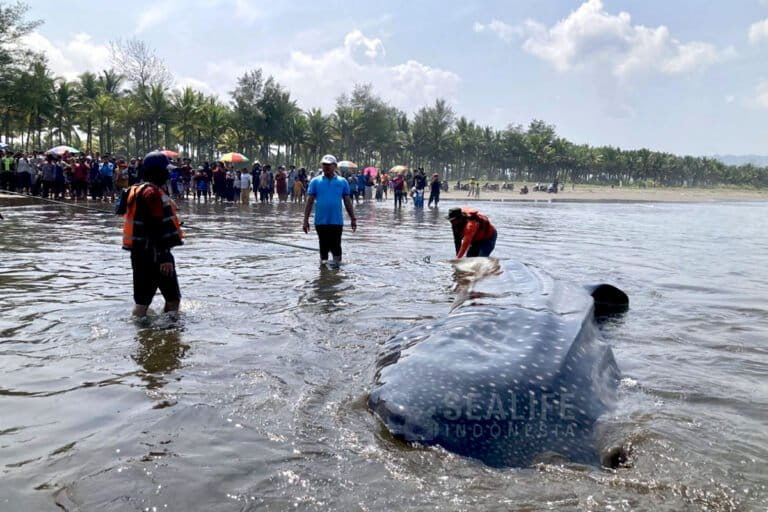
"I rushed to the scene at Banjarsari at around 05:30 WIB," Jumawan recalled. "The whale shark was still alive when we arrived. Together with local residents, we made every effort to push the massive creature back into deeper waters. Despite our collective strength and the urgency of the moment, the shark was too exhausted and weighed down by the shallows. The world’s largest fish eventually succumbed to its fate."
The sheer scale of the operation required heavy machinery. An excavator had to be brought in to maneuver the 8.36-meter-long carcass, which measured a staggering 3.71 meters in diameter. The logistical challenges were immense; Arief Nugroho, Site Coordinator for the DIY and Central Java region of the Sealife Indonesia Foundation, noted that the intensity of the recovery process was evidenced by the fact that thick tow ropes snapped multiple times under the pressure of moving the animal.
A Pattern of Despair: Why Cilacap?
The recurring nature of these strandings has prompted experts to ask: why is this specific stretch of coastline becoming a graveyard for the gentle giants of the ocean?
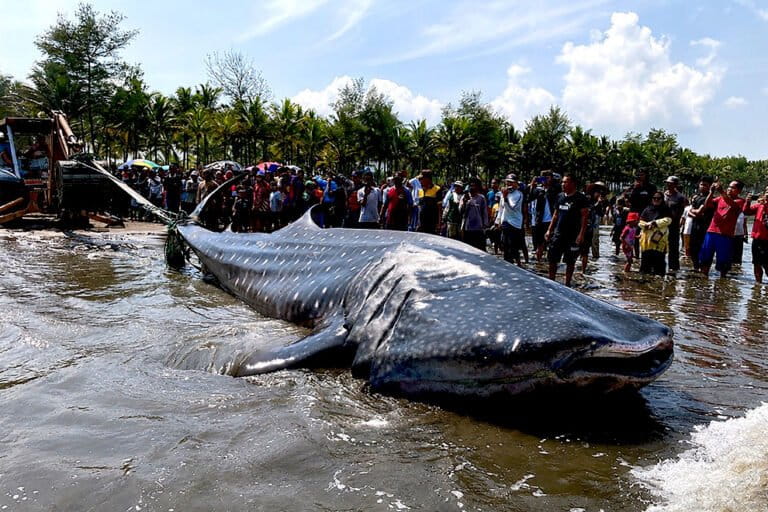
Darmawan, a representative from the Pontianak Marine Management Center (Semarang working area), emphasized that this is not an isolated occurrence. "We have seen similar clusters of strandings before, notably in late 2022, when events occurred in rapid succession throughout October and November," he explained.
Scientific investigations are currently underway to decode the environmental stressors at play. Mukti Trenggono, a marine expert from the Faculty of Fisheries and Marine Sciences at Jenderal Soedirman University (Unsoed), Purwokerto, pointed to satellite data from MODIS Aqua. The imagery revealed that the waters off Cilacap and Kebumen were in a highly productive phase during May 2026.
"We recorded chlorophyll-a concentrations as high as 1–3 mg/m³, with sea surface temperatures ranging from 29 to 30 degrees Celsius," Trenggono noted. "This is a recipe for a massive bloom in plankton and small nekton. For a whale shark, these waters were essentially an all-you-can-eat buffet. They were following the food chain, specifically schools of teri nasi (anchovies) and rebon (krill), directly into the shallower, coastal zones."
Forensic Insights: The Hidden Toll of Human Activity
The investigation into the cause of death went beyond environmental observations. A necropsy performed by a team of experts provided grim evidence of the dangers these creatures face in modern oceans.
Inside the shark’s stomach, researchers found a mass of undigested teri nasi, confirming that the animal had been actively feeding until its final moments. However, the physical examination also revealed five deep lacerations, each between 5 and 10 centimeters long. Experts suspect these wounds were caused by a collision with a ship’s propeller.
"These injuries underscore the grave risk to megafauna when they aggregate in areas that overlap with busy shipping lanes," Trenggono explained.
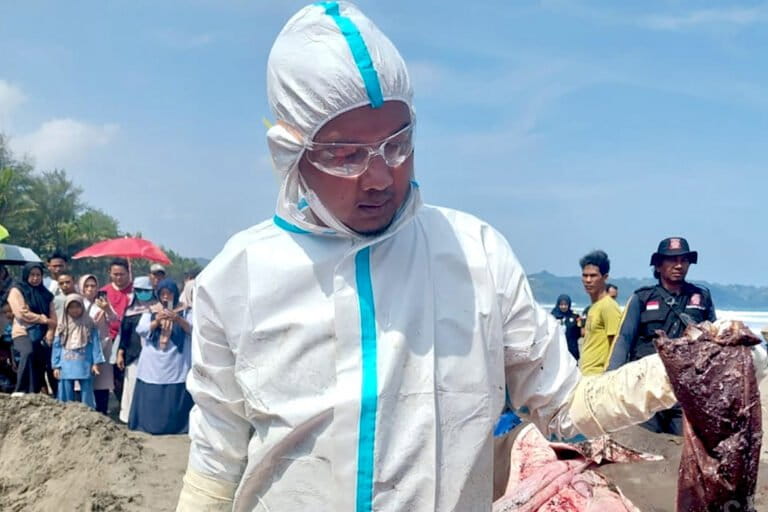
Furthermore, the team discovered plastic debris within the shark’s digestive tract. While researchers stopped short of identifying plastic as the sole cause of death, its presence is a damning indicator of the "plastic soup" that has become of the Indonesian seas. As filter feeders, whale sharks are uniquely susceptible to ingesting microplastics that mimic the size of their natural prey. While the plastic might not have killed this specific shark instantly, it serves as a silent, mounting threat to the long-term health of the species.
The Invisible Threat: Pollution and Physiology
Beyond the visible trauma of propeller strikes and plastic ingestion, experts are concerned about the unseen chemical stressors affecting these animals. Nuning Vita Hidayati, a researcher at Unsoed, suggests that environmental pollution may be causing subtle, yet fatal, physiological damage.
"The decline in water quality, including the accumulation of heavy metals, can severely impact a whale shark’s immune system, metabolic functions, and even its internal navigation," Hidayati explained. "When a shark experiences high levels of stress from pollution or chemical toxicity, it can suffer from disorientation. This explains why they might wander into hazardous, shallow coastal waters from which they cannot easily retreat."
Official Responses and Future Implications
Dwi Suprapti, a Marine Megafauna Specialist with the Sealife Indonesia Foundation, is leading the effort to synthesize these findings. Following the necropsy, the team is leaning toward a diagnosis of "acute intoxication" or poisoning, though they emphasize that this is a working hypothesis pending laboratory confirmation.
"We have sent samples of organ tissues and stomach contents to laboratories in Yogyakarta for histopathology and heavy metal analysis," Suprapti stated. "Concurrently, the team at Unsoed is conducting water quality assessments and genetic studies. We need to determine if this is a byproduct of natural oceanographic dynamics, human-induced environmental pressure, or a tragic combination of both."
The implications of these findings extend far beyond the coast of Cilacap. Whale sharks are migratory species, capable of traveling thousands of miles across oceans. Their presence—and their subsequent death—serves as a biological "canary in the coal mine." If these animals are failing to navigate the waters of Central Java, it suggests a broader, systemic collapse in the quality of their habitat.
As the scientific community awaits the final lab results, the residents of Cilacap remain vigilant. For people like Jumawan, the death of these sharks is a somber reminder of the delicate balance between human development and marine preservation.
The question that remains is whether the international community and local authorities will use these tragedies as a catalyst for stricter shipping regulations, better plastic waste management, and more rigorous monitoring of industrial runoff. Until such measures are taken, the giants of the deep will continue to follow their ancient migratory paths into an increasingly hostile environment, leaving the shores of Indonesia with a burden that the local communities are struggling to bear alone.
As the data from this incident is finalized, it will be added to the global database of whale shark research, helping scientists worldwide understand how to better protect these magnificent, vulnerable creatures. For now, the beaches of Cilacap remain a site of both scientific inquiry and quiet reflection, mourning the loss of a visitor that traversed the world only to be claimed by the hazards of a changing ocean.