
 By Laily UPN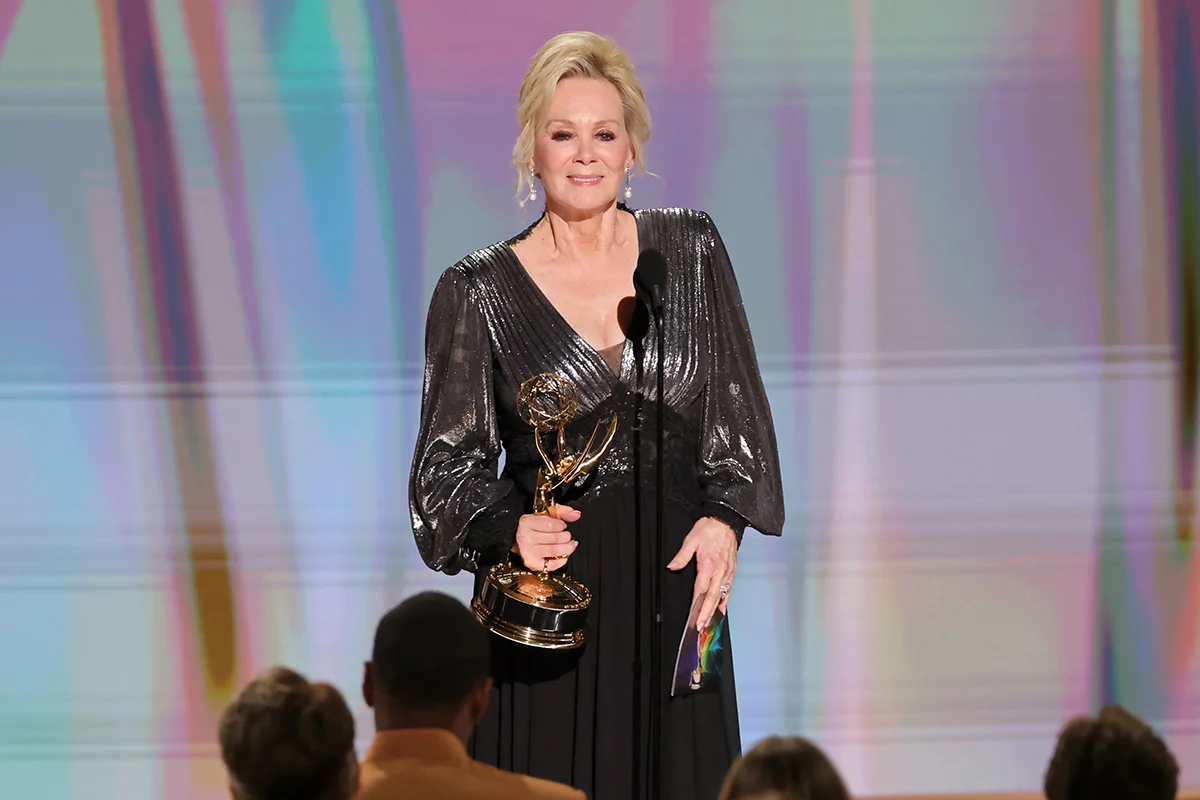
In a career defined by impeccable range and undeniable screen presence, Jean Smart has officially etched her name into the bedrock of television history. At the latest Emmy Awards ceremony, Smart secured the prize for Outstanding Lead Actress in a Comedy Series for her masterful portrayal of the acerbic, legendary comedienne Deborah Vance in HBO’s Hacks. This victory was not merely another trophy for the mantle; it represented a milestone that had remained elusive for over half a century.
With this win, Smart became the first female performer to sweep the Emmys for every season of a single show, having now claimed the lead comedy actress trophy for all three seasons of Hacks. This accomplishment places her in a rarified tier of television icons, joining only Bill Cosby—who achieved a similar feat for all three seasons of I Spy between 1966 and 1968—as the only actors to maintain a perfect winning streak across the entirety of a show’s run.
The Chronology of a Masterclass: From Designing Women to Hacks
To understand the magnitude of Smart’s current triumph, one must look at the decades of labor that preceded it. Smart first entered the national consciousness as the lovable Charlene Frazier Stillfield on the CBS hit Designing Women, a role she inhabited from 1986 to 1991. While that role established her as a reliable and gifted comedic force, it was merely the opening act for a career characterized by a restless pursuit of challenging, complex characters.
Her journey toward becoming an Emmy juggernaut began in earnest at the turn of the millennium. In 2000 and 2001, she secured consecutive wins for Outstanding Guest Actress in a Comedy Series for her unforgettable turns as Lana Gardner in Frasier. These wins demonstrated her ability to elevate even the most brief appearances into scenes of high-octane comedy. In 2008, she expanded her repertoire, winning the Emmy for Outstanding Supporting Actress in a Comedy Series for her work on Samantha Who?, proving that her talent was not confined to lead roles.
Between those milestones, Smart became a fixture of prestige television. Her resume reads like a map of the most acclaimed series of the last twenty years: The District, 24, Harry’s Law, Fargo, Watchmen, and Mare of Easttown. Each nomination served as a testament to her versatility, proving she could transition seamlessly from the suburban menace of Fargo to the haunting, grounded realism of Mare of Easttown.
However, it is her work as Deborah Vance that has truly redefined her legacy. In Hacks, Smart plays a veteran Las Vegas stand-up comic forced to modernize her act under the tutelage of a younger, socially conscious writer. It is a performance of immense vulnerability, vanity, and ferocity. Winning for every season of this show acknowledges that Smart is not just playing a character; she is evolving alongside it, providing a masterclass in longevity and artistic growth.
Supporting Data: The Elite Company of Eight
Jean Smart’s latest win pushes her total Emmy count to eight, an achievement that ties her with legends Julia Louis-Dreyfus and Cloris Leachman for the most Emmy wins by an actor of any gender in history. The company she keeps is telling:
- Cloris Leachman: An icon of character acting whose career spanned decades, setting a high bar for dramatic and comedic versatility.
- Julia Louis-Dreyfus: A titan of television comedy, whose record-breaking run for Veep and Seinfeld set the standard for the modern sitcom era.
- Ed Asner: The late, great actor whose seven wins established him as a pioneer of the medium, bridging the gap between dramatic gravitas and comedic timing.
Smart’s rise to this level of recognition is a slow-burn success story. Unlike performers who peak early and fade, Smart’s trajectory has been one of consistent acceleration. The data shows that her acclaim has intensified as she has taken on increasingly complex roles, moving away from the sitcom archetypes of her early career into the morally ambiguous and emotionally fraught landscapes of modern prestige dramas and dramedies.
The Competitive Landscape: A Field of Titans
The victory for Hacks was far from a foregone conclusion. The category of Outstanding Lead Actress in a Comedy Series this year was a gauntlet of immense talent, featuring some of the most lauded performers working in the industry today.
The competition included:
- Lisa Kudrow: A comedic icon in her own right, nominated for her meta-exploration of fame in The Comeback.
- Quinta Brunson: The visionary creator and star of Abbott Elementary, a show that has redefined the network sitcom.
- Elle Fanning: Recognized for her work in the highly anticipated Margo’s Got Money Troubles.
- Ayo Edebiri: A rising superstar whose performance in The Bear has captured the cultural zeitgeist and critical acclaim in equal measure.
That Smart emerged victorious in this field is a reflection of the Academy’s respect for her ability to command the screen. While the younger generation of stars like Edebiri and Brunson represent the future of the medium, Smart’s win signals that the industry continues to value the depth of experience and the seasoned precision that only a veteran of her caliber can provide.
Official Responses and Industry Implications
The industry response to Smart’s win has been one of universal celebration. Peers, critics, and showrunners alike have taken to social media and press outlets to laud the actor. During her acceptance speech, Smart remained humble yet visibly moved, acknowledging the collaborative nature of Hacks and the writers who continue to provide her with material that allows for such profound exploration of character.
"Deborah Vance is a gift," Smart remarked during a press conference following the ceremony. "But more than that, she is a mirror. I think we are both women who have survived in an industry that didn’t always know what to do with us. Getting to explore that frustration, that resilience, and that humor together has been the joy of my professional life."
The implications of this win are significant for the broader television landscape. First, it reinforces the trend of "legacy acts" continuing to dominate in an era of rapid technological change. As streaming platforms like HBO Max (now Max) shift the business models of television, the need for "anchor" performances—actors who can carry a show with singular authority—has become more pronounced.
Second, Smart’s success challenges the industry’s historical tendency to sideline female performers as they age. By winning consistently in her late 60s and early 70s, she has effectively dismantled the myth that a performer’s "prime" is a limited window. She has turned the "difficult older woman" archetype into a gold standard for critical success, effectively creating a new template for how to manage a long-term television career.
Looking Toward the Future
As the dust settles on this year’s Emmy Awards, the conversation naturally turns to what comes next. For the producers of Hacks, the challenge will be to maintain the momentum that has allowed Smart to secure three consecutive wins. For the industry, the question is whether other networks and studios will follow the Hacks model: investing in character-driven narratives that allow legendary performers to inhabit roles that grow and evolve over several seasons.
Jean Smart’s achievement is not just a personal victory; it is a signal of the current state of television. In an age where content is often criticized for being disposable, Smart’s work stands as a bulwark of quality and permanence. She has shown that when an actor is paired with a character that demands everything from them, the result is nothing short of legendary.
As we look at the list of eight wins—from the lighthearted guest spots on Frasier to the heavy-hitting drama of Mare of Easttown and the searing wit of Hacks—it is clear that we are witnessing the career of an actor who is not just participating in television history, but actively shaping it. Jean Smart is no longer just a working actor; she is an institution. And if her current trajectory is any indication, there is likely more history to be written.
More to come as the industry continues to analyze the ripple effects of this historic Emmy season.
 Siti Muinah
  Iffa Jayyana
  Ammar Sabilarrohman