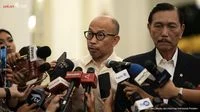
JAKARTA – In the corridors of the Indonesian Presidential Palace, rumors often move faster than policy. This week, speculation reached a fever pitch regarding a potential shake-up in the nation’s economic cabinet, specifically centering on the position of the Minister of Finance. However, Chatib Basri, a prominent member of the National Economic Council (DEN), has firmly moved to quell reports suggesting he is being groomed to replace the incumbent, Purbaya Yudhi Sadewa.
The Context: A High-Stakes Meeting
On Tuesday, June 9, 2026, the presidential complex saw a flurry of activity as key members of the National Economic Council (DEN) were summoned for a closed-door consultation. Among those spotted entering the palace grounds were DEN Chairman Luhut Binsar Pandjaitan, alongside council members Septian Hario Seto and Firman Hidayat.
The high-profile nature of the gathering—and the presence of several economic heavyweights—naturally drew the attention of the media, who were stationed outside to monitor potential shifts in the cabinet. Rumors had been circulating in political circles that President Prabowo Subianto was contemplating a cabinet reshuffle to address evolving economic challenges, with names like Chatib Basri and Minister of Health Budi Gunadi Sadikin frequently cited as potential candidates for the Finance portfolio.
When approached by reporters following the session, Chatib Basri, a former Minister of Finance himself, was direct in his dismissal of the rumors. "There is no such thing. Please, we are here discussing the economy," he stated, effectively closing the door on the speculation regarding his potential appointment.
Chronology of the Speculation
The narrative of a cabinet reshuffle is not a new phenomenon in the current administration. For weeks, analysts and political insiders have debated the stability of the economic team, particularly as the government navigates complex fiscal reforms and the rollout of major social programs.
- The Rise of the DEN: Following the establishment of the National Economic Council, the body has become a central hub for policy formulation, often working in tandem with, or at times appearing to oversee, traditional ministerial functions.
- The "Finance Minister" Narrative: Given Chatib Basri’s extensive academic and ministerial track record, his name has consistently appeared on the "shortlist" whenever a change in the finance ministry is discussed. Similar speculation has surrounded Budi Gunadi Sadikin, whose tenure as Health Minister has been marked by significant structural reforms.
- The Tuesday Summit: The arrival of the DEN leadership at the palace on June 9 served as the catalyst for the latest wave of rumors. Reporters noted the presence of Minister of Health Budi Gunadi Sadikin in the vicinity, fueling reports that a broader cabinet discussion was underway.
- The Denial: By mid-afternoon, as the meetings concluded, Chatib Basri clarified that the agenda was strictly focused on technical economic policy, rather than personnel changes. He further clarified that Budi Gunadi Sadikin was not part of the DEN-led consultation, emphasizing that their meetings were separate and unrelated.
The Agenda: What Was Actually Discussed?
While the media focused on the "who," the "what" of the meeting was arguably more significant for the nation’s economic trajectory. According to sources within the DEN, the delegation provided the President with a comprehensive briefing on several critical pillars of the government’s economic agenda:
The Makan Bergizi Gratis (Nutritious Meals) Program
A cornerstone of the current administration’s social policy, the Makan Bergizi Gratis program requires meticulous fiscal management to ensure it reaches its target demographics without straining the state budget. The DEN provided an update on the logistics, funding mechanisms, and the potential impact of the program on domestic food security and local agricultural markets.
GovTech Implementation
The digital transformation of government services, or "GovTech," remains a high priority. The council discussed the roadmap for integrating bureaucratic processes into a unified digital ecosystem, aimed at increasing transparency and reducing the "cost of doing business" in Indonesia.
PT Danantara Sumberdaya Indonesia
The status of the newly conceptualized state investment entity, PT Danantara, was a focal point of the discussion. The entity is intended to act as a sovereign wealth vehicle to manage state assets more efficiently. The DEN briefed the President on the implementation strategy, legal frameworks, and the anticipated transition of assets into this new structure.
The Bali International Financial Center and Family Office
Perhaps the most ambitious item on the agenda was the progress of the International Financial Center and the regulatory framework for "Family Offices" in Bali. The government aims to position Indonesia as a regional hub for global capital, offering tax incentives and streamlined regulations to attract ultra-high-net-worth individuals and international investment firms to set up shop on the island.
Analyzing the Implications of the Rumors
The persistent rumors surrounding the Finance Minister’s position reflect a broader anxiety regarding Indonesia’s fiscal navigation in a volatile global market.
Economic Stability vs. Reform
Purbaya Yudhi Sadewa, the current Minister of Finance, has been tasked with balancing the need for massive infrastructure spending and social welfare programs against the imperative of maintaining fiscal discipline. Any suggestion of a change in leadership is viewed by the markets as a potential signal of a shift in economic philosophy—from conservative fiscal management to a more aggressive, growth-oriented spending strategy.
The Influence of the DEN
The role of the National Economic Council is increasingly seen as a "shadow cabinet" or a strategic steering committee. By having the council handle policy implementation reports, the administration is effectively bypassing some of the traditional ministerial bottlenecks. However, this creates a unique power dynamic where cabinet ministers may feel their autonomy is being challenged, leading to the friction that often births rumors of reshuffles.
Market Sensitivity
The Indonesian Rupiah and the Jakarta Composite Index (JCI) are highly sensitive to political news. Speculation about the Finance Ministry is particularly volatile because the international investor community views the stability of that office as a guarantee of macroeconomic consistency. Chatib Basri’s swift denial was likely intended to prevent unnecessary market jitters and to maintain confidence in the current fiscal roadmap.
Expert Perspectives
Financial analysts suggest that while a reshuffle is always a possibility in any administration, the timing of such a move would be critical.
"The government is currently in the middle of several high-stakes projects, including the transition to the new capital and the implementation of the Danantara structure," says a senior economist at a regional investment bank. "Replacing the Finance Minister now would be perceived as a high-risk move that could disrupt the momentum of these reforms. Investors prefer continuity over uncertainty, especially when the current policy direction is generally aligned with market expectations."
Furthermore, the involvement of the DEN suggests that the President is leaning toward a collaborative decision-making model. By relying on a council of advisors, the President is insulating his policy agenda from the potential failures of any single minister, while also ensuring that key initiatives receive cross-departmental support.
Conclusion: Business as Usual
As the dust settles on the Tuesday meetings, the message from the Palace is clear: the focus remains on the implementation of the economic program, not on a change of personnel. Chatib Basri’s firm denial, coupled with the detailed nature of the agenda discussed, suggests that the administration is prioritizing the delivery of its flagship programs—the Nutritious Meals program, GovTech, and the establishment of the Bali financial hub—over political maneuvering.
For now, the rumors of a cabinet reshuffle have been placed on the back burner. However, in the dynamic world of Indonesian politics, the question of who leads the Finance Ministry will likely remain a point of intrigue. Until the President issues a formal decree, the current team continues to steer the ship, tasked with the monumental challenge of maintaining economic growth amidst a global environment that is anything but certain.
The government’s ability to execute the plans discussed this week will ultimately serve as the true barometer for the stability and success of the current economic cabinet. If these programs—particularly the Danantara investment vehicle and the Bali financial center—succeed, the need for a reshuffle may vanish entirely. If they falter, the whispers of change are sure to return, louder than ever.