
 By Lina Hope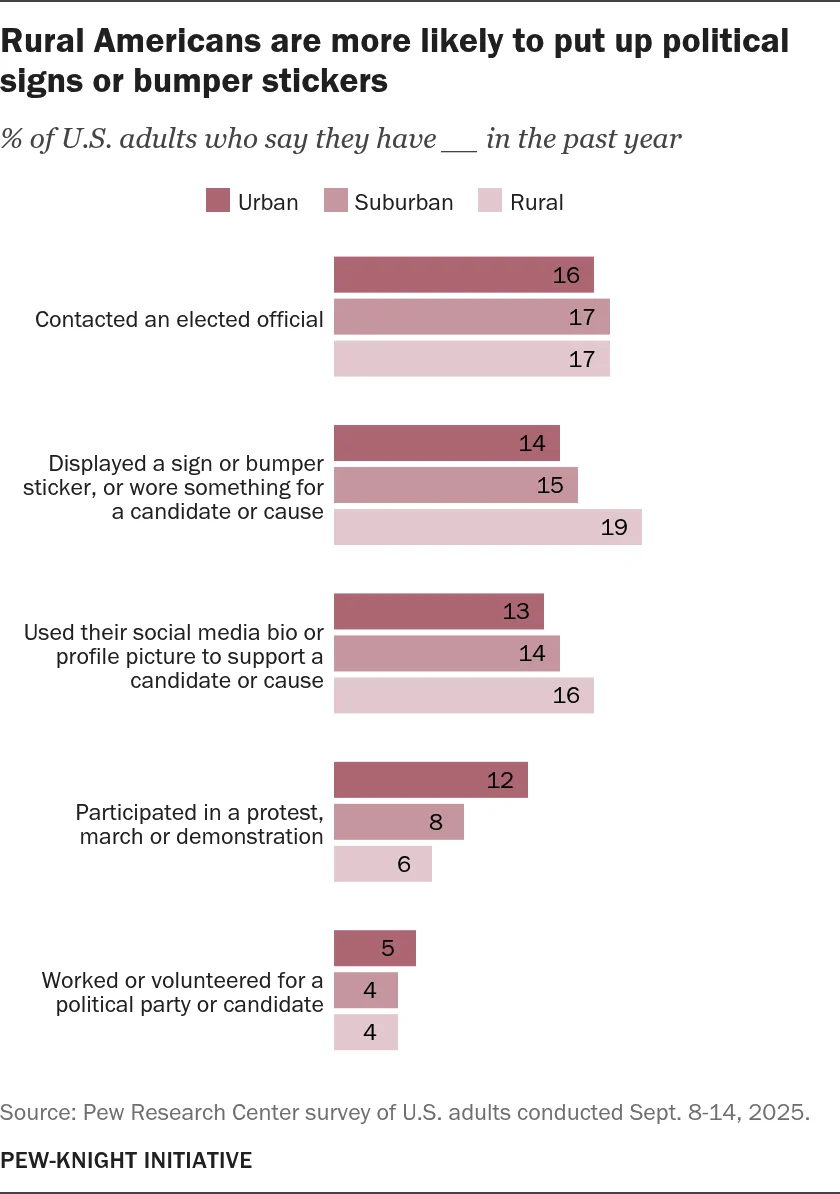
WASHINGTON — When researchers look at the map of the United States, traditional political and sociological wisdom often divides the country neatly into distinct silos: the deep-blue, fast-paced urban centers; the reliably purple, sprawling commuter suburbs; and the fiercely independent, deeply traditional rural heartlands. Yet, a groundbreaking comprehensive study released by the Pew Research Center, in collaboration with the Pew-Knight Initiative, reveals a more nuanced and surprising reality.
While urban, suburban, and rural Americans engage with their communities at broadly comparable overall rates, the ways they participate in public life vary significantly. From the format of local club meetings to the methods residents use to display political allegiance, geography quietly shapes the texture of civic engagement in modern America.

The findings are derived from a robust multi-survey research framework, including data from Wave 179 of the American Trends Panel—which surveyed 5,195 U.S. adults—and the extensive Cross-Sectional Engagement Survey, which captured responses from 5,393 adults between July and December 2025.
Main Facts: The Four Pillars of American Engagement
To understand how citizens interact with society, Pew researchers segmented American adults into four distinct "engagement groups" based on their responses to 19 targeted questions concerning political activity, civic involvement, religious attendance, and news consumption:
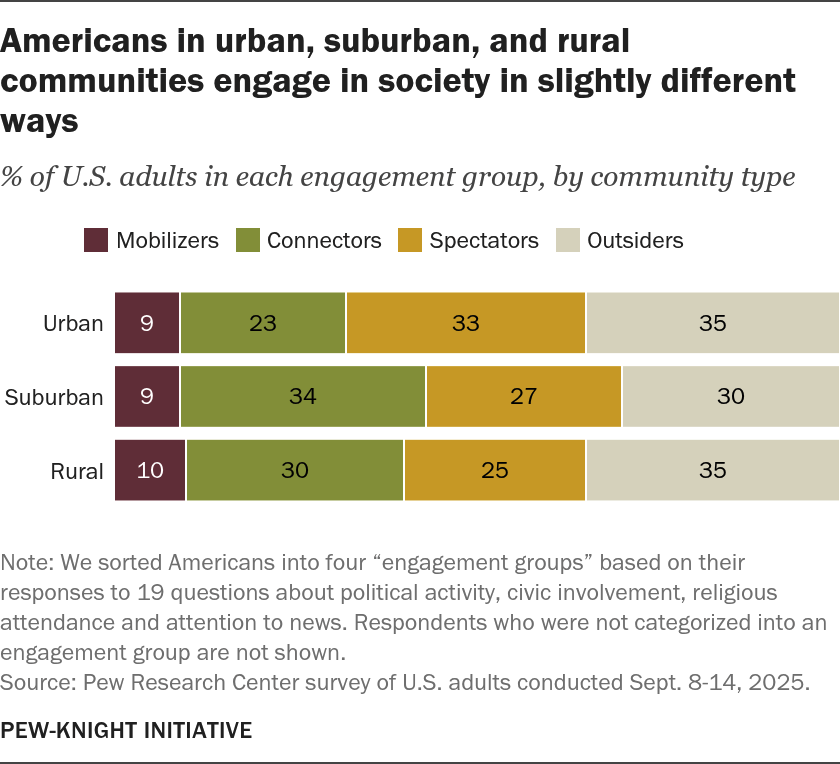
- Mobilizers (9% to 10% nationwide): This small, hyper-active vanguard participates deeply across nearly every measured category of public life, serving as the connective tissue for local political campaigns, religious institutions, and civic boards. Their presence is remarkably uniform across geographies, making up 9% of urban residents, 9% of suburbanites, and 10% of rural Americans.
- Connectors (23% to 34% nationwide): Highly engaged in community life—frequently volunteering, making charitable donations, and joining local clubs—these individuals are notably less focused on direct political action. Connectors are most heavily concentrated in the suburbs, where they make up 34% of the population, compared to 30% in rural areas and 23 in cities.
- Spectators (25% to 33% nationwide): Primarily defined by their heavy consumption of news rather than active community participation, Spectators keep a close eye on current events without stepping into leadership or organizing roles. They are most prevalent in urban centers, accounting for 33% of city dwellers, compared to 27% in suburbs and 25% in rural areas.
- Outsiders (30% to 35% nationwide): This group reports the lowest levels of civic, political, and news engagement, sitting largely on the sidelines of public life. Outsiders form a substantial segment across all regions: 35% in urban areas, 30% in the suburbs, and 35% in rural communities.
Chronology: Unpacking the Research Initiative
The path toward these findings unfolded through a carefully structured investigative timeline designed to bridge the gap between fragmented studies on public participation:
- Late 2024 to Mid-2025: Researchers observed that while voting statistics, volunteer rates, and news habits are frequently studied in isolation, little was known about how these behaviors synthesize in everyday life. The Pew-Knight Initiative set out to design a holistic metric of civic participation.
- July to December 2025: Pew launched the Cross-Sectional Engagement Survey, gathering responses from 5,393 adults. Recognizing that traditional polling often misses marginalized or politically detached populations, researchers deployed a multi-modal approach—accepting responses online, via paper questionnaires, and through telephone interviews with repeated follow-ups.
- September 8–14, 2025: Wave 179 of the American Trends Panel was fielded, surveying 5,195 adults nationwide. This phase captured baseline data on contemporary attitudes toward community organizations, religious attendance, and active political participation—a period falling roughly a year after the 2024 presidential election cycle and shortly following widespread national demonstrations.
- July 2026: Pew published its foundational methodological framework, "How we measured Americans’ engagement in public life," detailing the cluster analysis used to establish the four engagement groups.
- September 2026: The final comparative breakdown examining urban, suburban, and rural civic behavior was officially published, offering a detailed statistical map of how geography impacts societal involvement.
Supporting Data: Breaking Down Regional Differences
While broad engagement tiers remain relatively stable across geographic lines, looking closer at specific activities reveals clear divergences between city, suburb, and countryside.

Social and Religious Participation
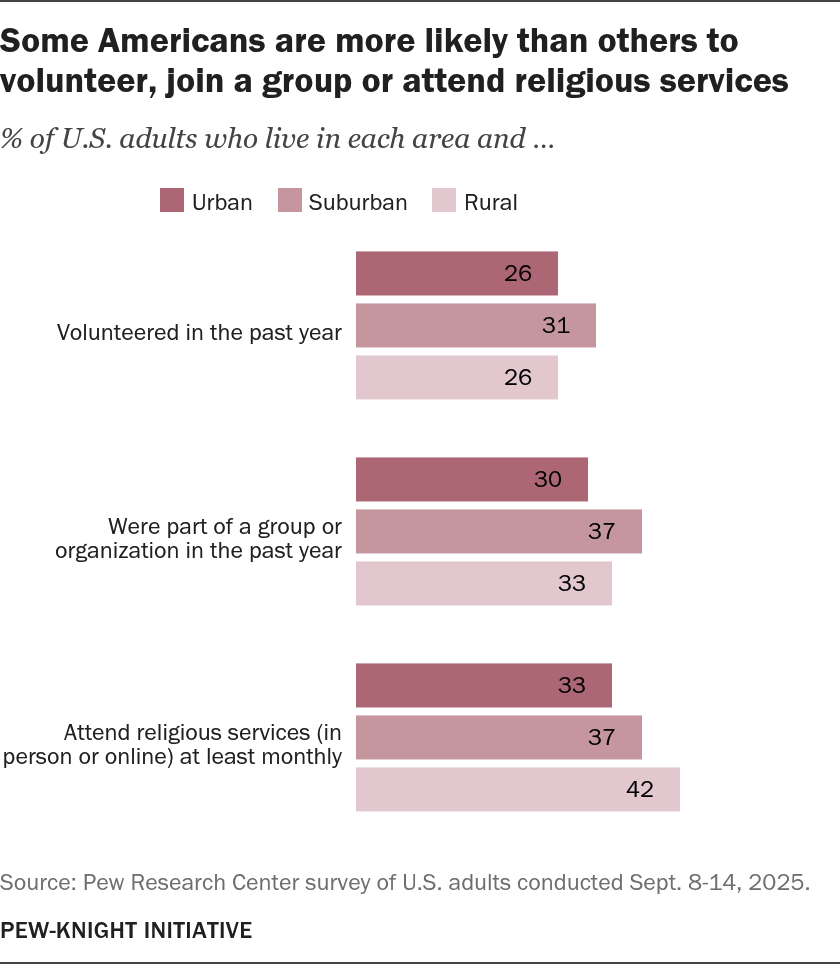
Suburban Americans edge out both urban and rural residents when it comes to formal community integration. According to survey data, 31% of suburbanites volunteered in the past year, compared to 26% of both urban and rural residents. Similarly, 37% of suburban adults belonged to a group or organization, outpacing rural respondents (33%) and urban residents (30%).
However, the nature of these group interactions changes dramatically depending on population density:

- In-Person vs. Online: Among those who belong to a group or club, 63% of rural members report that their groups interact mostly in-person. This figure drops to 57% in the suburbs and 47% in cities. Conversely, urban group members are significantly more likely to state that their organizations operate primarily online (22%, compared to 20% in the suburbs and just 14% in rural areas).
- Religious Engagement: Rural Americans outpace their urban and suburban counterparts in religious devotion. 42% of rural adults attend religious services (either in person or online) at least monthly, compared to 37% of suburbanites and 33% of urban residents. Rural Americans also report higher frequencies of daily prayer.
Political Expression and Activism
Overall political participation rates are remarkably consistent: roughly one-third of adults in urban, suburban, and rural areas have engaged in at least one of five major political actions over the past year. Contacting an elected official, for instance, stands uniform at 16% to 17% across all three regions.
Yet, the methods of political expression diverge sharply:

- Yard Signs and Bumper Stickers: Rural Americans are notably more outward with physical displays of support. 19% of rural adults reported displaying a sign, bumper sticker, or wearing candidate merchandise in the past year, compared to 15% in the suburbs and 14% in cities—a trend that holds true regardless of political affiliation.
- Protests and Demonstrations: In contrast, urban residents are more likely to take to the streets. 12% of city dwellers participated in a protest, march, or demonstration during the surveyed timeframe, compared to 8% in the suburbs and 6 in rural areas. Pew analysts attribute this urban skew partly to partisan demographics, noting that Democrats—who lean heavily toward urban residency—demonstrated higher rates of protest participation during periods of heightened political friction, such as the wave of "No Kings" demonstrations that swept parts of the country in mid-2025.
Official Responses and Expert Perspectives
Sociologists and researchers behind the Pew-Knight Initiative emphasize that while geography matters, it is rarely the sole predictor of human behavior.
"Differences between Americans living in cities, suburbs, and rural areas are often subtle in empirical research," study authors noted in the report’s framing. "Demographic traits such as age, income, race, ethnicity, and partisan identity are distributed across all three types of settings and frequently provide a sharper lens into how people think and behave than community type alone."

Nevertheless, the findings challenge the assumption that physical isolation in rural communities translates to civic decay. While rural areas may lack the dense organizational infrastructure of the suburbs, their reliance on face-to-face community groups and higher rates of religious participation point to robust, localized social capital. Conversely, urban environments foster high informational consumption and digital connectivity, creating a populace heavily skewed toward monitoring public events as Spectators.
Implications for the Future of American Communities
The implications of the Pew-Knight Initiative’s findings stretch far beyond academic sociology, offering vital insights for local policymakers, non-profit organizers, and political strategists:
- Tailoring Civic Outreach: Organizations attempting to boost voter turnout or community volunteering cannot rely on a one-size-fits-all geographic strategy. Rural engagement efforts benefit immensely from traditional, face-to-face relational organizing and faith-based networks. In contrast, urban outreach must navigate a media-saturated landscape where citizens often act as passive observers rather than active participants.
- The Evolution of Social Infrastructure: As remote work and digital platforms reshape society, the divide between online and offline community interaction is widening. While rural groups stubbornly maintain a face-to-face culture, urban and suburban networks increasingly lean into hybrid or digital-first models. Local leaders must consider how these virtual spaces compensate for—or detract from—traditional community cohesion.
- Bridging the Partisan Expression Gap: The visibility of political beliefs—manifested through rural yard signs versus urban protests—underscores how geographic culture dictates public discourse. Understanding these divergent avenues of expression can help mitigate misperceptions between rural and urban populations regarding civic health and political passion.
Ultimately, the study paints a portrait of a nation where civic engagement is neither dying nor uniform. Instead, Americans continue to adapt their participation to the unique demands, limitations, and opportunities of the places they call home.
 Dwi Wanna
  Basiran