
 By Raul Delapena Setiawan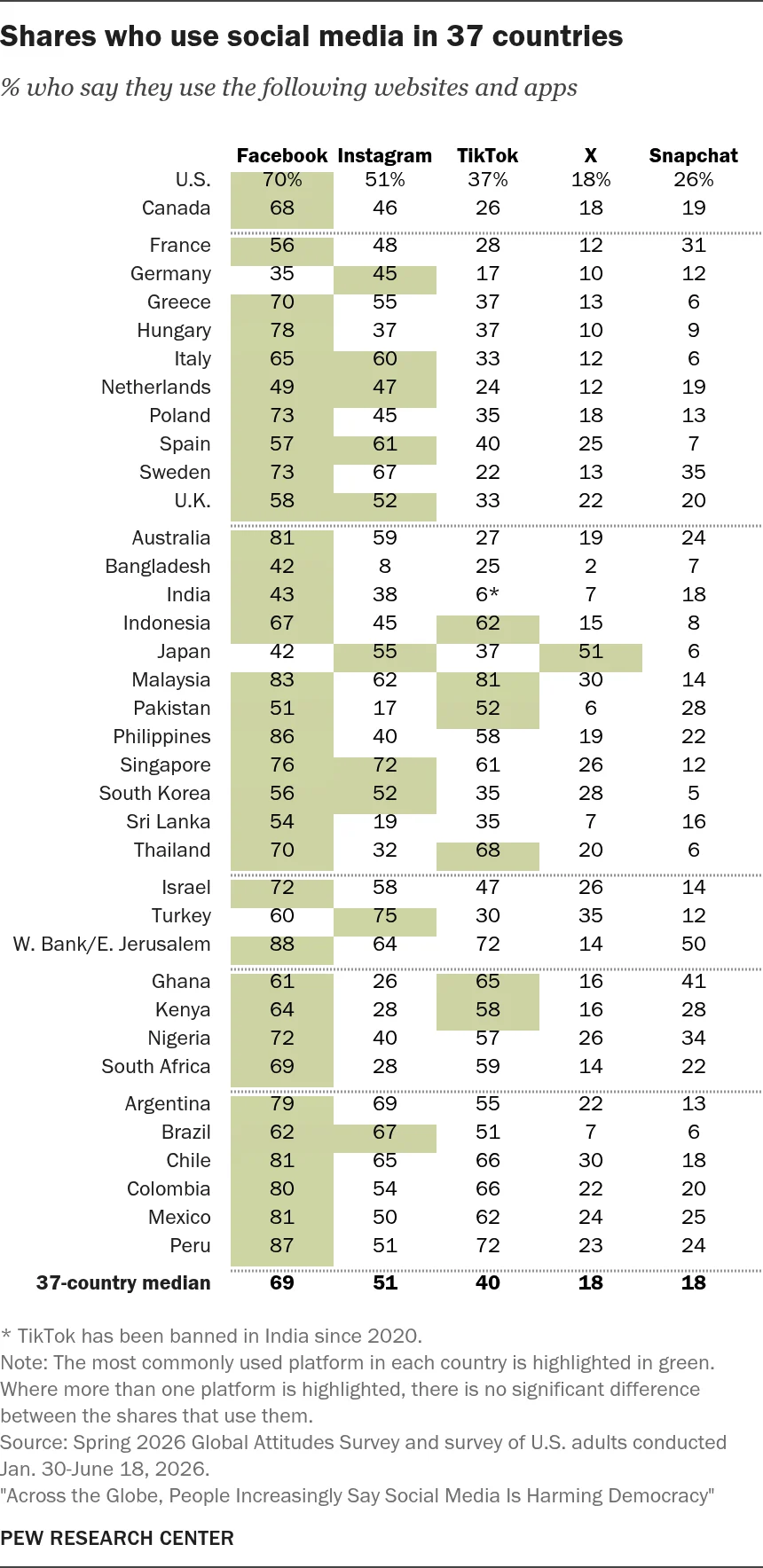
WASHINGTON — As digital platforms continue to weave themselves into the fabric of daily life worldwide, a landmark multi-country study published by the Pew Research Center reveals shifting paradigms in how populations access, consume, and multi-thread their social media experiences. Released in October 2026, the comprehensive global survey maps out digital habits across 37 nations, capturing a snapshot of platform dominance, generational divides, and the rapid expansion of emerging apps against a backdrop of increasing public anxiety regarding democracy.
While Facebook retains its crown as the most universally utilized platform across the 37 surveyed countries, challenger applications—most notably TikTok—are experiencing explosive growth, particularly across the Global South and middle-income economies. Simultaneously, deep demographic fractures along lines of age, education, and political ideology dictate who wields these digital tools and who remains entirely offline.
Main Facts: The Global Footprint of Social Media
At its core, the Pew Research Center’s Spring 2026 Global Attitudes Survey—supplemented by dedicated domestic tracking in the United States—paints a picture of a hyper-connected planet, albeit with glaring regional disparities. The research evaluates user habits concerning five primary platforms: Facebook, Instagram, TikTok, X (formerly known as Twitter), and Snapchat.
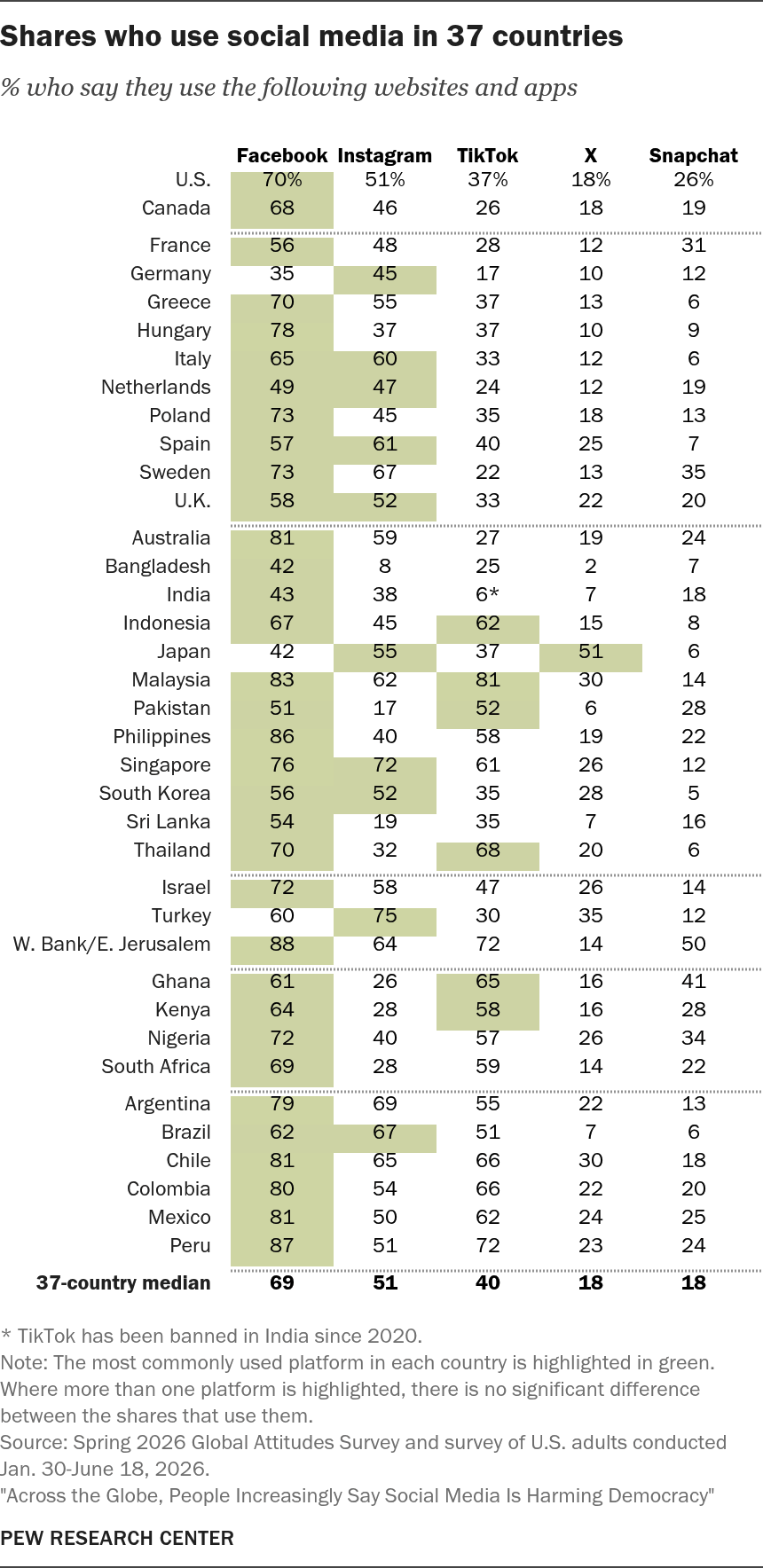
Across the 37 countries examined, Facebook commands a 37-country median of 69% usage among adults, followed by Instagram at 51%. TikTok has cemented itself as a major contender, capturing a 40% median share, while X and Snapchat lag behind at matching medians of 18%.
However, looking strictly at national medians masks profound local realities. Multi-platform engagement—defined as regular utilization of three or more of the tracked apps—is remarkably pronounced in middle-income nations, outstripping several advanced Western economies. Countries like Malaysia, the West Bank and East Jerusalem, Chile, Peru, Colombia, and Singapore boast majorities where 50% or more of the adult population juggle three or more platforms simultaneously.
Conversely, non-use remains stubbornly high in select regions. Nations such as India (48% non-use), Bangladesh (55%), Sri Lanka (37%), Pakistan (35%), and Japan (33%) register significant portions of their populations who do not engage with any of the five major networks at all. In Europe, Germany stands out with 39% of adults reporting zero interaction with these digital ecosystems.
Chronology: The Evolution of Platform Dominance
To fully understand the current digital terrain, analysts must look backward to contextualize how rapidly consumer preferences shift. In 2023, the Pew Research Center surveyed a targeted cohort of eight middle-income nations—Argentina, Brazil, India, Indonesia, Kenya, Mexico, Nigeria, and South Africa—to establish baseline metrics for platform penetration.
- The 2023 Baseline: Three years ago, legacy platforms like Facebook and WhatsApp (the latter of which was omitted from the 2026 tracking alongside Telegram) anchored the digital experience in developing regions. While TikTok was expanding, its footprint in emerging markets was largely secondary to established meta-ecosystems. X (then Twitter) still held localized value for political discourse in several Latin American and African states.
- The Intervening Years (2023–2026): Regulatory interventions, localized internet infrastructure developments, and shifting youth culture radically transformed platform shares. Most notably, India maintained its sweeping 2020 ban on TikTok, forcing a localized divergence from global growth trends. Meanwhile, regional infrastructure projects and smartphone affordability drove massive digital onboarding across Sub-Saharan Africa and Southeast Asia.
- The 2026 Survey Window: Between February 8 and May 13, 2026 (supplemented by U.S. tracking extending from January to June 2026), researchers deployed standardized instruments to 42,151 respondents across 36 international countries, alongside parallel U.S. panels. The resulting data captures the post-pandemic stabilization of remote connectivity and the hyper-acceleration of short-form video consumption.
Supporting Data: Winners, Losers, and Regional Anomalies
The 2026 dataset provides concrete figures on which platforms are surging and which are plateauing or facing steep declines.
TikTok’s Meteoric Rise in Middle-Income Nations
Nowhere is the digital shift more visible than in the explosive growth of TikTok across the eight middle-income countries with trend data. In virtually every tracked developing nation, TikTok usage rates have climbed by double digits since 2023:
- Nigeria: Surged from 25% in 2023 to 57% in 2026.
- Indonesia: Climbed from 35% to 62%.
- South Africa: Rose from 37% to 59%.
- Mexico: Grew from 41% to 62%.
- Argentina: Jumped from 31% to 55%.
- Kenya: Increased from 37% to 58%.
Instagram’s Steady Expansion
Instagram has quietly built upon its user base across the developing world. Significant double-digit gains were recorded in Nigeria (+17 percentage points), Argentina (+15 points), Indonesia (+14 points), and India (+12 points).
The Stagnation and Retreat of X
Unlike its video-first competitors, X has experienced flatlining or contraction across a majority of trend-tracked countries. Most strikingly, in Brazil, reported usage of X plummeted from 22% in 2023 to just 7% in 2026, reflecting shifting regulatory landscapes, local platform preferences, and changing corporate moderation policies. Counter-trends existed in Indonesia and Nigeria, where X managed modest gains.
Multi-Platform Clustering
When categorized by total platform adoption:
- High Multi-Platform Nations: Malaysia leads the globe with 59% of adults using three or more apps, closely followed by the West Bank and East Jerusalem (61%), Chile (56%), Peru (53%), and Singapore (51%).
- High Non-Use Nations: Bangladesh (55% use none), India (48%), Germany (39%), Sri Lanka (37%), and Pakistan (35%) record the highest percentages of digitally detached populations, driven in some cases by state-imposed internet blackouts during political unrest or strict regulatory censorship.
Demographic Divides: Age, Education, and Ideology
The data reveals that platform adoption is deeply stratified by human characteristics—most notably age, educational attainment, and, in select nations, political orientation.
The Generational Chasm
Globally, youth dominate the digital sphere, though generational dynamics shift depending on economic development:
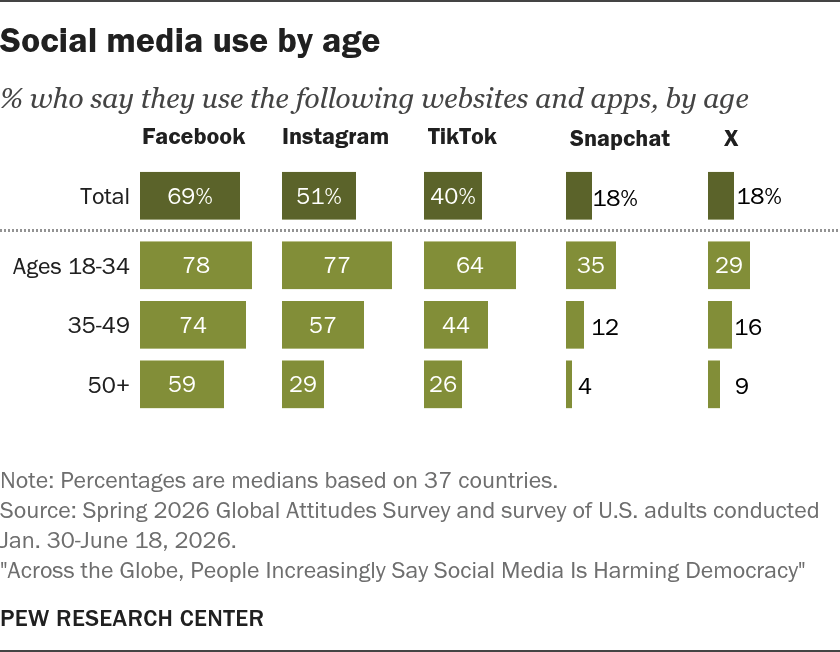
- Facebook’s Demographic Paradox: In high-income countries, Facebook finds its primary stronghold among middle-aged adults (ages 35 to 49). However, in middle- and lower-income nations, Facebook skews heavily young, proving most popular among adults aged 18 to 34.
- Instagram and TikTok: Across 36 of the 37 countries surveyed, young adults (18–34) dwarf older cohorts in Instagram usage. For TikTok, the generational gap is staggering; in several nations, young adults are roughly 50 percentage points more likely to use the app than those aged 50 and older.
- Snapchat: Snapchat remains deeply entrenched among the youngest demographics. In the United Kingdom, for example, 58% of 18- to 34-year-olds use Snapchat, compared to a negligible 2% among those aged 50 and older.
The Education Factor
Education generally correlates positively with multi-platform usage. In many developing nations, more educated citizens are at least twice as likely to use three or more apps compared to their less-educated peers. However, this trend inverts in select advanced economies (such as Germany, Italy, the Netherlands, and Sweden), where higher educational attainment occasionally correlates with a lower propensity for multi-platform clutter.
The Ideological Split
Political polarization also manifests in digital habits. In a handful of countries, citizens identifying with the ideological left are significantly more likely to maintain multi-platform profiles than those on the right. In Turkey, roughly half of self-identified left-leaning respondents use three or more platforms—nearly double the share of right-leaning respondents. Similar ideological skews appear in Australia, Colombia, Israel, and Thailand.

Implications: Social Media, Governance, and Democratic Health
The release of these usage metrics is tied directly to a broader, more alarming global finding: across the surveyed countries, public sentiment increasingly frames social media as a corrosive force operating against the health of democratic institutions.
As populations in developing and middle-income countries rapidly onboard multiple platforms—swapping text-based information ecosystems for lightning-fast, algorithmic video feeds via TikTok and Instagram—policymakers face compounding challenges. The concentration of digital discourse within a handful of private, foreign-owned applications introduces profound vulnerabilities to misinformation, foreign election interference, and radicalization.
Furthermore, the stark contrast between hyper-connected urban youth in nations like Malaysia or Colombia and digitally disenfranchised populations in rural South Asia or internet-restricted zones underscores a widening digital divide. Governments responding to social unrest with sudden internet blackouts—as observed in Bangladesh and parts of South Asia—not only disrupt local commerce but actively sever citizens from the modern public square.
Ultimately, the 2026 Pew Research data signals that social media is no longer an emerging technological novelty; it is the primary infrastructure of human communication. How societies navigate the demographic divides of this infrastructure—and mitigate the perceived democratic harms accompanying its growth—will define the political and social stability of the decade to come.
 Suro Senen
  Basiran
  Lina Hope