
 By Lina Hope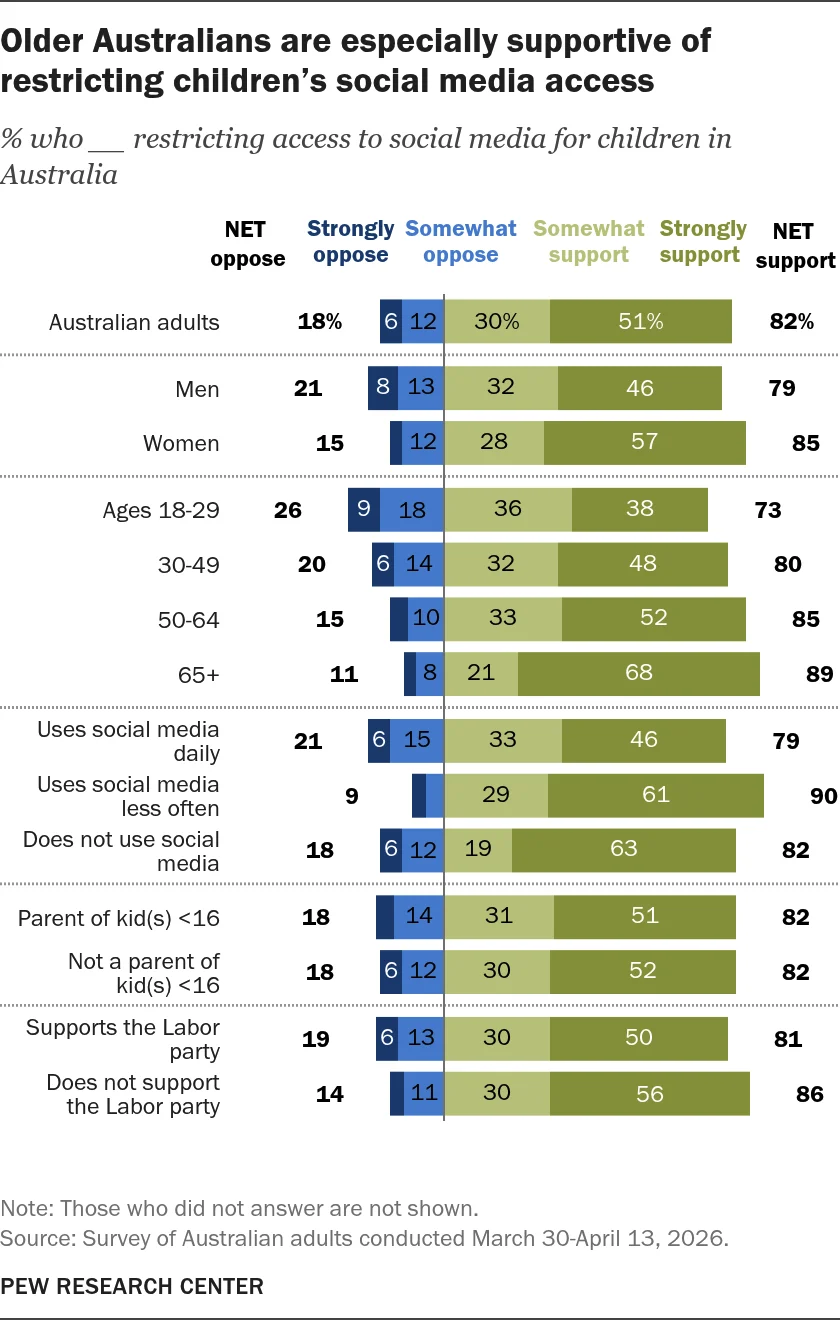
SYDNEY — In a policy move that has reverberated across international tech and legislative spheres, Australia officially enacted a first-of-its-kind law on December 10, 2025, restricting children under the age of 16 from accessing mainstream social media platforms. The legislation, which mandates that digital giants like TikTok, Instagram, and Snapchat implement rigorous age-verification measures and purge underage accounts, has fundamentally reshaped the digital landscape Down Under.
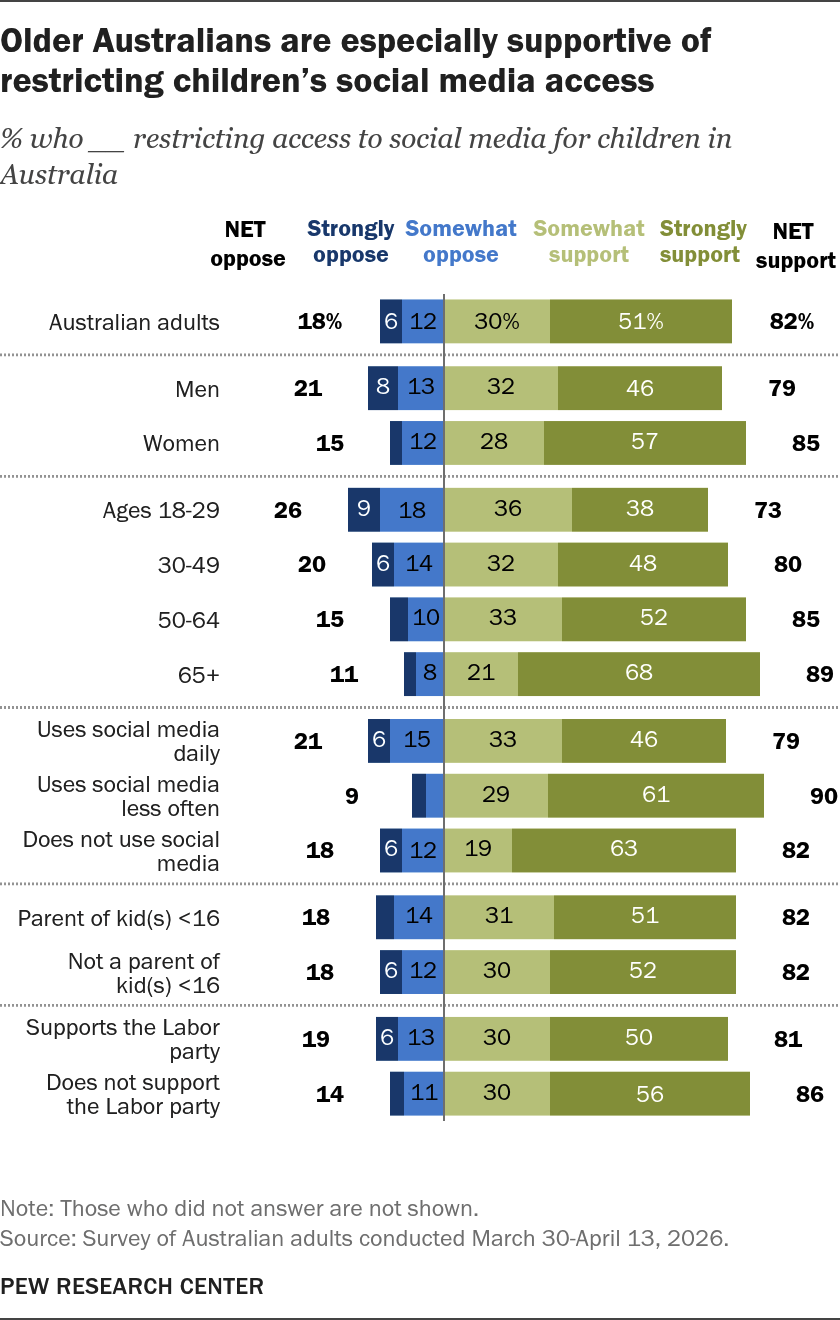
Months after the law’s implementation, a comprehensive Pew Research Center survey reveals that 82% of Australian adults strongly or somewhat support restricting children’s access to social media. This overwhelming consensus transcends partisan lines and parental status, illustrating a profound societal anxiety regarding the influence of big tech on developing minds. As governments worldwide grapple with youth mental health crises and online safety, Australia’s pioneering experiment has become the benchmark for a global legislative movement.
Chronology of a Regulatory Revolution: From Debate to Enforcement
The path to Australia’s sweeping social media restrictions was forged through years of mounting public pressure, political maneuvering, and corporate resistance.
- Late 2023 – Mid 2024: Public debate intensifies across Australia regarding the addictive nature of algorithms and cyberbullying. Lawmakers face mounting pressure from parent advocacy groups, educators, and mental health professionals who link excessive social media consumption to rising rates of adolescent anxiety, depression, and body dysmorphia.
- November 2024: Prime Minister’s administration formally tables a sweeping legislative package aimed at banning children under 16 from holding social media accounts, bypassing voluntary industry codes in favor of mandatory enforcement.
- December 10, 2025: The historic law officially takes effect. Major technology conglomerates are given a strict compliance window to introduce ironclad age-verification mechanisms or face catastrophic financial penalties.
- Early 2026: Implementation challenges surface. Tech companies express concern over user privacy and technical feasibility, while digital rights advocates question the efficacy of age-gating technologies. Concurrently, high-profile teen influencers and their families voice concerns over lost livelihoods and creative suppression.
- March 30 – April 13, 2026: Pew Research Center conducts a nationally representative survey of 2,064 Australian adults via the Social Research Centre’s Life in Australia panel, capturing the domestic mood in the wake of the rollout.
- June 2026: Recognizing early loopholes and corporate foot-dragging, the Australian government aggressively strengthens the legal framework. Most notably, Canberra doubles the maximum financial penalties for non-compliant social media firms, signaling a zero-tolerance approach to regulatory evasion.
- September – October 2026: Global data reveals a cascading effect. Countries from Latin America to Europe accelerate their own legislative drafts, looking to replicate or adapt the Australian model.
Supporting Data: What the Numbers Tell Us About Public Sentiment
While the Australian public is broadly unified behind the policy, a granular analysis of the Pew Research Center’s data reveals fascinating nuances across demographics, generational lines, and digital habits.
Generational Divide: Age and Enthusiasm
Support for the ban increases predictably with age. While younger cohorts are intimately familiar with the utility and social necessity of digital networks, older populations view them through a lens of profound skepticism:

- Ages 18–29: 73% support the restrictions (36% somewhat, 38% strongly), making this the demographic with the lowest—though still a clear majority—backing. 26% are opposed.
- Ages 30–49: 80% support the policy.
- Ages 50–64: 85% support the policy.
- Ages 65 and Older: A staggering 89% of seniors support the ban, with 68% registering strong support and only 11% opposed.
The Paradox of Digital Usage
Interestingly, personal use of social media does not breed leniency toward underage access—though frequency matters.
- Daily Users: 79% support the restrictions.
- Moderate/Less Frequent Users: 90% support the restrictions.
- Non-Users: 82% support the restrictions.
This indicates that even those deeply embedded in the digital ecosystem recognize the harms unvetted platforms pose to children, though light users harbor the most uncompromising views on keeping youth offline.
The Parental Perspective
Intriguingly, the survey found no statistical difference in overall support between adults who have children under 16 and those who do not (both stand at 82%). However, a closer look at household dynamics reveals that mothers of children under 16 show significantly stronger support for the ban than fathers do. Furthermore, parents with children aged 10 and under are markedly more in favor of restrictions than parents navigating the turbulent teenage years of 11- to 15-year-olds, likely reflecting early anxieties about future digital exposure.
Official Responses and Corporate Friction
The implementation of the ban has been anything but smooth behind the scenes. Big tech firms, while publicly cooperating to avoid catastrophic fines, have continually raised red flags regarding the technological hurdles of age verification. Industry associations argue that enforcing strict age-gating threatens user data privacy, forcing platforms to collect sensitive biometric or governmental identification data from millions of innocent adult users.
Conversely, federal regulators and health ministers have remained steadfast. By doubling the maximum penalties for non-compliance in mid-2026, the Australian government communicated a clear message: the burden of safeguarding children rests squarely on the shoulders of the corporations profiting from their attention.
Child advocacy groups have largely championed the government’s resolve. Prominent Australian mental health coalitions argue that voluntary corporate self-regulation has failed entirely over the past decade, making heavy-handed government intervention an absolute necessity to combat what they term a public health crisis driven by algorithmic addiction.
Global Implications: A Domino Effect Across Continents
Australia’s willingness to stare down Silicon Valley has triggered a paradigm shift in international technology governance. What was initially dismissed by tech lobbyists as an unworkable populist stunt has rapidly morphed into an emerging global standard.
International Momentum
- Latin America: In March 2026, Brazil became the first nation in the region to enact comprehensive social media restrictions for minors, mandating parental consent for all users under 16.
- Southeast Asia: Indonesia initiated parallel rolling restrictions in early 2026, targeting predatory algorithmic feeds and compulsive usage patterns among school-aged youth.
- The European Union: Ursula von der Leyen, President of the European Commission, pledged a bloc-wide push toward strict safety frameworks, including a potential continent-wide push to limit access for children under 13.
- The United States: While the U.S. federal government lacks a unified nationwide ban, domestic pressure is skyrocketing. A separate Pew Research Center survey conducted in mid-2026 revealed that 56% of American adults support banning social media for children under 16. This shift coincides with aggressive state-level litigation, highlighted by a landmark legal settlement between 47 U.S. states and Meta over youth addiction and mental health damages.
The Road Ahead
As Australia continues to refine its enforcement mechanisms—balancing privacy rights against child protection—the eyes of the world remain fixed on Melbourne and Sydney. Will age-verification technologies prove robust enough to withstand evasion, or will tech companies find ways around the mandate? More importantly, will early data confirm an improvement in youth mental health outcomes?
However these operational questions resolve, one reality is now indisputable: the era of the unregulated digital playground for children is coming to a close. Australia has drawn a hard line in the digital sand, and nations across the globe are eagerly stepping across it.
 Siti Muinah
  Asep Darmawan
  Ali Ikhwan