
 By Raul Delapena Setiawan
For the modern marketing team, the transition from a single-market influencer campaign to a global, multi-territory initiative is often treated as a creative victory. When a skincare brand successfully activates twenty-two creators across six countries—spanning the US, UK, Brazil, the Philippines, Poland, and South Africa—the marketing lead typically considers the job done. The content is live, the KPIs are met, and the team moves on to the next product launch.
However, the "Friday the payouts are due" moment often reveals a systemic fragility. Suddenly, the finance department is asking questions that were left unanswered during the creative frenzy: Who gets paid this week? In which currency? Against what specific paperwork? Why are there missing tax forms for three creators? Why are two creators owed partial payments due to a reshoot, and why has another requested a last-minute change to their banking details?
These are not anomalies; they are the growing pains of scaling influencer programs. As brands move from boutique operations to global juggernauts, the manual processes that once sufficed become major liabilities.
The Contractor Paradox: Navigating Employment Classification
At the heart of the influencer payment crisis lies a fundamental legal misunderstanding: the classification of the influencer as an independent contractor. Unlike traditional employees, influencers are not on the payroll, do not receive benefits, and the brand does not withhold income tax.
The Substance Over Form Rule
Authorities globally are increasingly scrutinizing the "substance" of the working relationship rather than the label on the contract. If a brand dictates precise posting schedules, requires the exclusive use of brand-provided equipment, or treats a creator as a de facto staff member, they risk reclassification.
The tests for employment vary by region, but they generally hinge on:
- Operational Control: Who determines the method and timing of the work?
- Economic Dependency: How much of the creator’s income is tied to this single brand?
- Integration: How deeply is the creator embedded in the brand’s daily internal operations?
When a brand blurs these lines, they risk significant tax liabilities, penalties, and administrative headaches. Misclassifying an influencer as a contractor when they are effectively an employee can lead to demands for backdated payroll taxes and social security contributions.
Essential Components of the Creator Brief
A common error is confusing an influencer brief with a binding contract. While a brief outlines the creative vision, it lacks the legal weight required for cross-border transactions. To protect the brand, every agreement must explicitly address four pillars:
- Deliverables: A granular description of the content, including formats, length, and platform-specific requirements.
- Usage Rights: Explicit definitions of where, how long, and for what purposes the brand may repurpose the creator’s content.
- Exclusivity: Clear boundaries regarding competitors and the duration of non-compete clauses.
- Payment Terms: Definitive schedules for payment, including triggers for milestones and contingencies for reshoots or rejections.
Tax Compliance: The Global Minefield
For US-based brands, the collection of tax forms is non-negotiable. The distinction between a W-9 (for US taxpayers) and a W-8BEN (for international creators) is a critical compliance checkpoint.
Many brands fall into the "pay first, ask later" trap. This approach is catastrophic. If a brand releases funds before collecting the necessary tax documentation, they lose their leverage to obtain it. This forces the brand to retroactively apply "backup withholding"—a complex process that often leads to friction with the creator and potential fines from the IRS or local tax authorities.
The Economics of Cross-Border Payouts
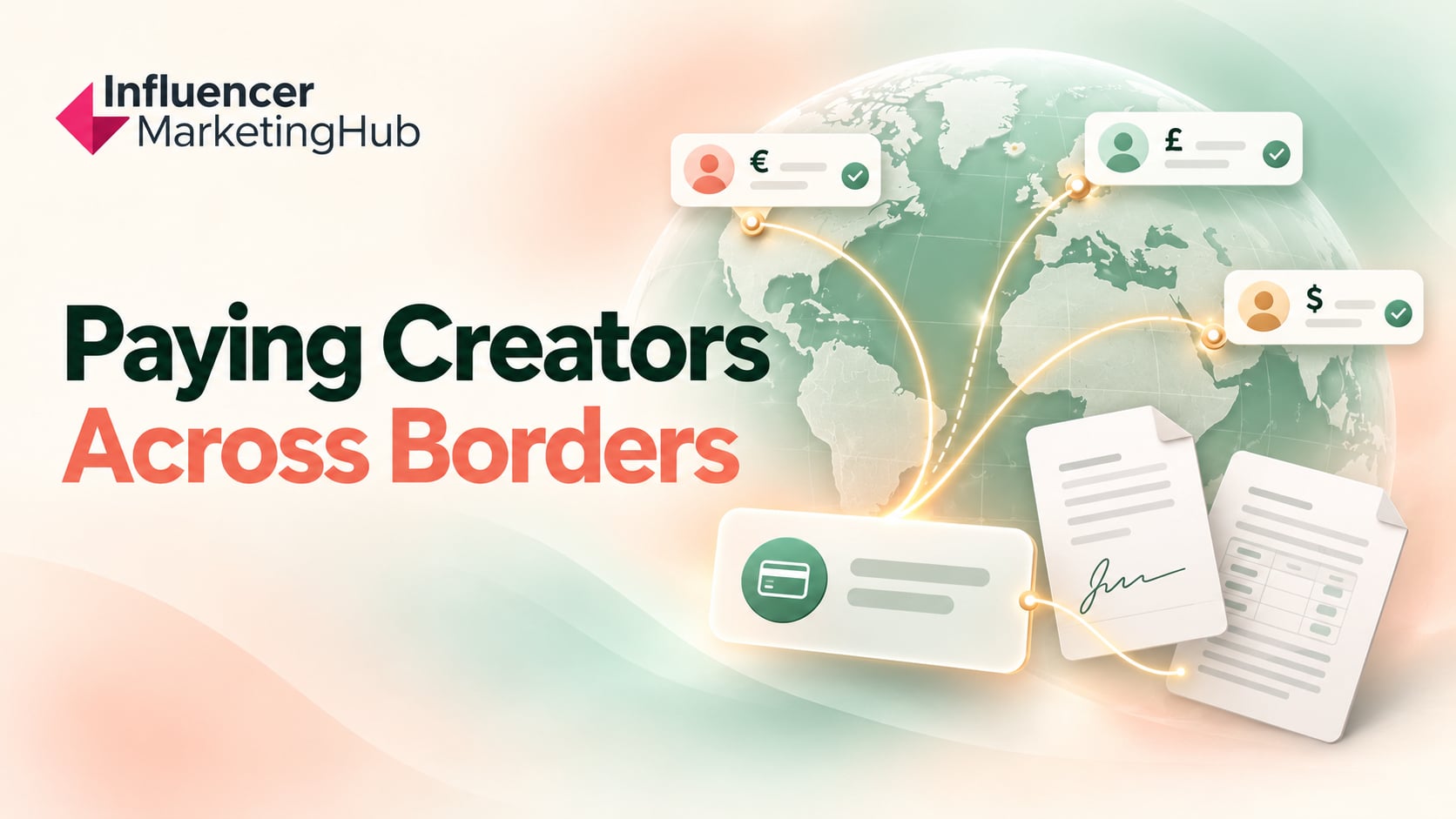
Moving money across currency borders is an exercise in hidden costs. Brands generally utilize one of three payment routes, yet few understand the true "all-in" cost.
The Illusion of "Free" Transfers
Marketing departments often prioritize speed, but the financial reality is dictated by the exchange-rate margin. Industry data suggests that the average cost of a cross-border business payment is approximately 1.6% of the transaction value. Crucially, seven-eighths of that cost—roughly 1.4 percentage points—is buried in the exchange-rate margin rather than explicit fees.
- Regional Variance: While payment costs in Europe may hover around 1%, they can soar to 3.5% in parts of sub-Saharan Africa.
- Transparency: A payment route that refuses to disclose its exchange rate is, by definition, opaque. Brands must realize that the "spread" over the interbank rate is a cost, regardless of how it is labeled on an invoice.
Creators, meanwhile, prioritize predictability. They want to know exactly how much will land in their local bank account. A "zero-fee" transfer that hits their account with a poor exchange rate is often viewed by the creator as a lack of transparency or fairness, damaging the long-term influencer relationship.
Scaling Beyond the Spreadsheet: The Operational Shift
When a brand grows from twenty-two creators to fifty or more, the spreadsheet method shifts from a tool to a liability. At this scale, the risks become exponential:
- Data Fragmentation: Important documents are buried in email threads.
- Compliance Drift: Tracking tax status for fifty individuals across different jurisdictions becomes impossible to monitor in real-time.
- Payment Latency: Manual processing inevitably leads to delays, which can tarnish the brand’s reputation within the creator community.
The Solution: Automated Lifecycle Management
Modern brands are increasingly adopting platforms such as 4dev.com to centralize the influencer lifecycle. These platforms move the operational burden away from the brand’s internal team:
- Self-Service Onboarding: Creators provide their own tax details and bank information.
- Unified Contracting: The brand signs a master agreement, while the platform handles the individual compliance checks.
- Real-Time Visibility: Marketing leads can see exactly who is ready to be paid and where there are gaps in documentation, all in one dashboard.
Five Critical Mistakes Brands Make with Creator Payouts
To ensure smooth operations, brands must audit their current processes against these five common failures:
- Ignoring Local Tax Nuances: Assuming a one-size-fits-all tax form works for every country.
- Delayed Onboarding: Waiting until the day of payment to collect necessary banking and tax data.
- Ignoring Hidden FX Costs: Focusing on transfer fees while ignoring the exchange-rate margin.
- Inconsistent Payment Terms: Using different terms for different creators, creating administrative complexity.
- Failure to Automate Documentation: Relying on email-based workflows that create "single points of failure" within the team.
Implications for Future Growth
The professionalization of influencer marketing is no longer optional. As the creator economy continues to mature, brands that treat payments as an afterthought will find themselves unable to recruit top-tier talent.
When a brand successfully automates its payout infrastructure, it does more than save time—it builds a reputation for reliability. In the competitive world of global influencer marketing, being known as the "brand that pays on time and with total transparency" is perhaps the most significant competitive advantage a company can cultivate.
By shifting from manual, error-prone spreadsheets to integrated, automated platforms, companies can focus on what they do best: creating high-impact campaigns that resonate across borders, secure in the knowledge that the operational backbone is as robust as the creative strategy.
 Asep Darmawan
  Siti Muinah
  Dwi Wanna