
 By Ali Ikhwan
In the ever-evolving landscape of digital creativity, the grip of industry giants like Adobe has long seemed unbreakable. For decades, the Creative Cloud suite—Photoshop, Premiere Pro, Lightroom, and their siblings—has functioned as the de facto operating system for professional designers, photographers, and video editors. Yet, as we move through 2026, the environment is shifting. Driven by rising subscription costs and a growing fatigue with "locked-in" ecosystems, a new wave of alternatives is emerging.
The latest and perhaps most audacious entrant is ArtCraft, an open-source, AI-generated suite that seeks to replicate the functionality of Adobe’s entire Creative Cloud ecosystem. Built using the Rust programming language and conceptualized through the capabilities of Anthropic’s Claude Opus 5.5, ArtCraft represents a radical experiment: can a comprehensive professional design suite be "vibe-coded" into existence?
The Genesis of ArtCraft: A Response to Industry Friction
The project was spearheaded by software engineer Brandon Thomas, whose motivation was born from a frustration shared by many in the creative community: the mounting pressure of Adobe’s subscription-based pricing models and the often-penalized process of attempting to cancel those services.
Thomas’s solution was to leverage modern generative AI to build a clean-room reimplementation of creative software. By writing the code from the ground up in Rust—a language prized for its memory safety and performance—ArtCraft aims to strip away the "digital bloat" that has plagued legacy applications built on decades of inherited C++ code. While Adobe’s apps often weigh in at several gigabytes, ArtCraft’s individual modules are remarkably lightweight, frequently clocking in at around 50MB.
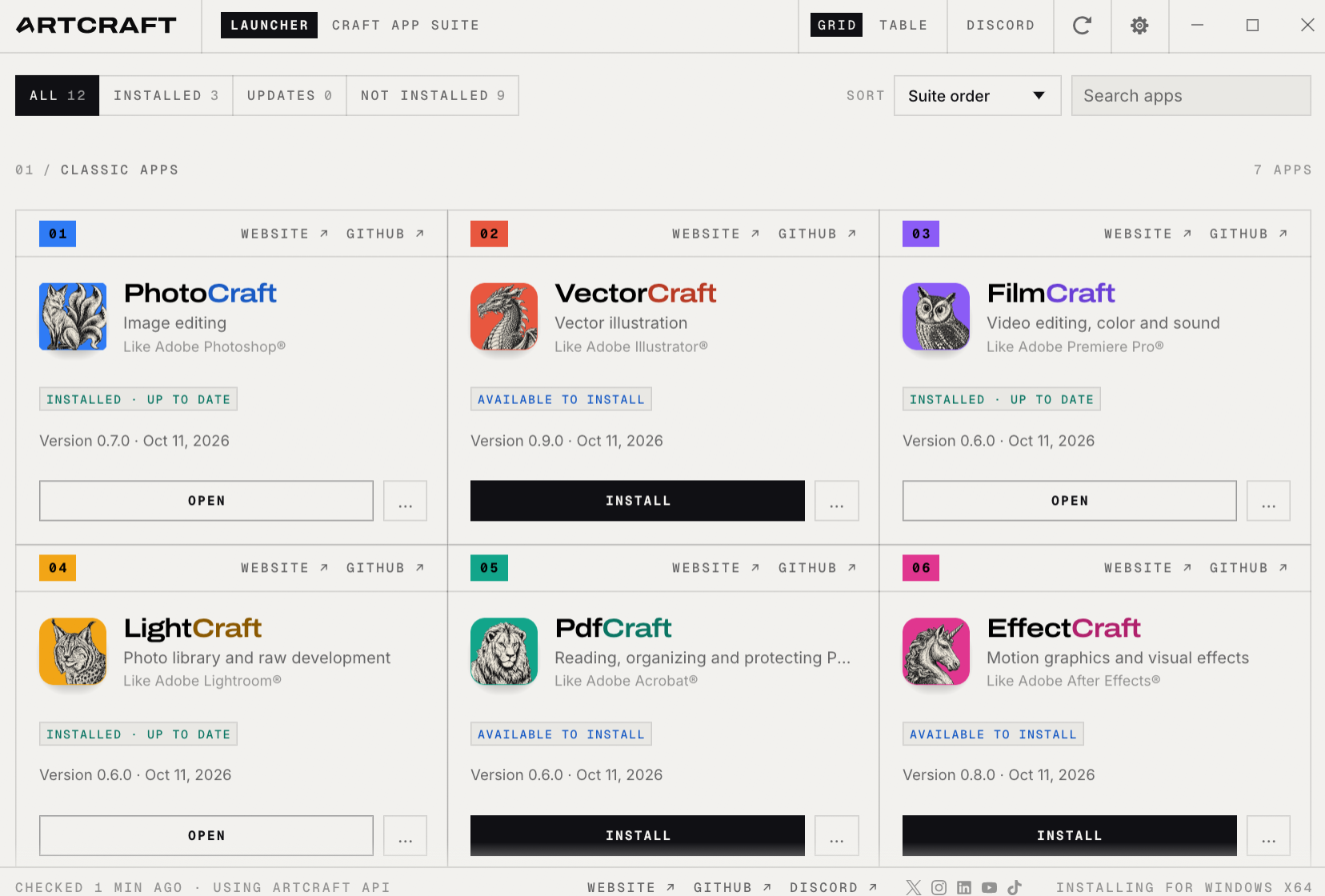
The suite is expansive in its ambition, offering:
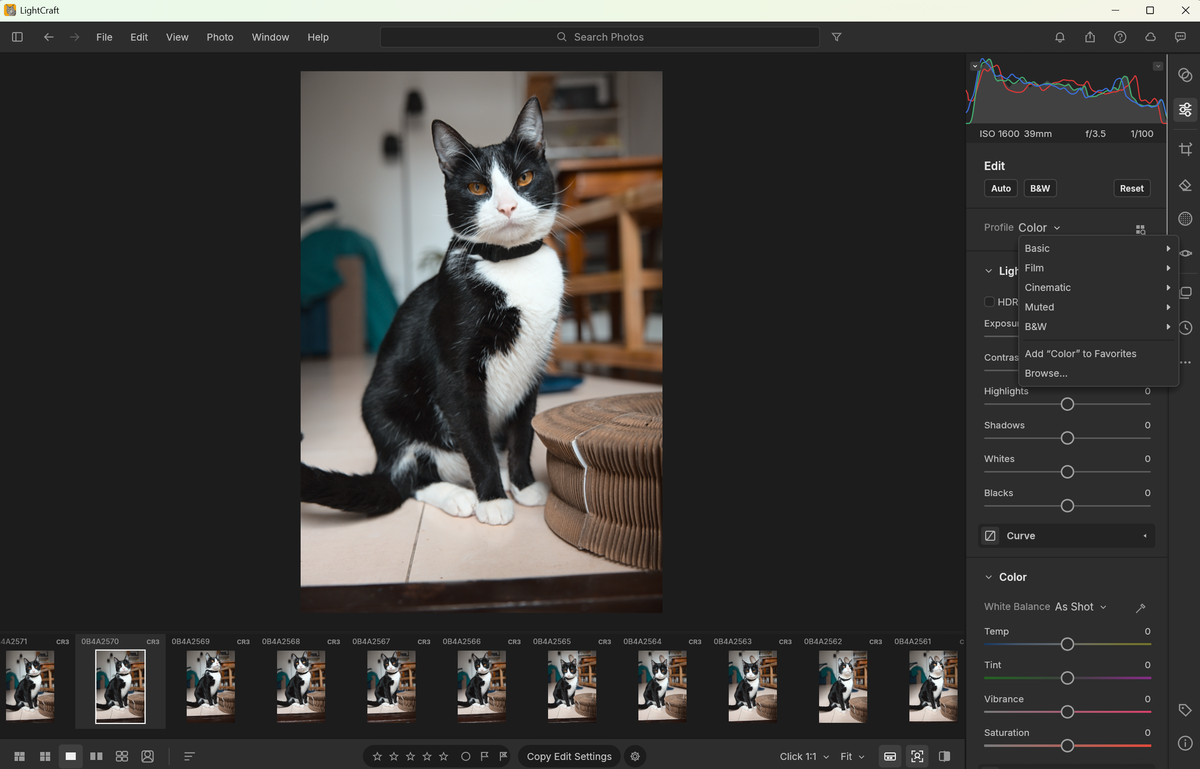
- LightCraft: A Lightroom-equivalent for raw image processing.
- PhotoCraft: A Photoshop-style raster image editor.
- FilmCraft: A video non-linear editor (NLE) mirroring Premiere Pro.
- EffectCraft, DesignCraft, VectorCraft, and PrintCraft: Replicating After Effects, InDesign, Illustrator, and Acrobat respectively.
The developer has even expanded this "Craft" methodology to office productivity, launching WordCraft, GridCraft, and DeckCraft as AI-coded alternatives to Microsoft Office staples.
Chronology and Current State: From Alpha to Utility
ArtCraft is currently in its early alpha stage. While the project is functionally available for PC, Mac, and Linux, it is a work in progress. Unlike the monolithic, installer-heavy experience of Creative Cloud, ArtCraft uses a centralized, account-free installer that avoids the data-harvesting practices that characterize much of the modern software industry.
However, the "early alpha" designation is significant. During a hands-on test using a high-end Windows rig (Intel Core i7, Nvidia RTX 5070) and Canon EOS R5 raw footage, the limitations of this "AI-coded" approach became immediately apparent.
Testing the Workflow
In LightCraft, the lack of native camera-matched profiles proved to be a significant barrier. While the interface mimics the familiar layout of Lightroom—with Clarity, Texture, and HSL controls positioned logically—the software struggled with basic raw file imports (specifically Canon CR3 files). Furthermore, manual optical corrections for chromatic aberration were required, a task that feels archaic in the era of automated profiles.
PhotoCraft felt the most stable of the bunch, capable of handling PSD and TIFF files with relative ease. Yet, it lacked the refinement of its industry counterpart. Automated masking and object selection tools, which are essential for modern workflows, felt less precise. Advanced features like Generative Fill, which have become central to the professional Adobe workflow, are entirely absent in the current build.
FilmCraft faced the most significant hurdles. Attempting to edit 4K footage at 25 and 100 fps resulted in a crash course in transcoding; without support for 10-bit 4:2:2 or optimized proxy media creation, the software struggled with high-bitrate files. While it works for basic trimming and cutting, it is not yet a viable replacement for professional NLEs like DaVinci Resolve or Premiere Pro.
The Competitive Landscape: Why Now?
The rise of ArtCraft comes at a time when the market is more crowded than ever. Users are no longer limited to a binary choice between Adobe and nothing.
- Affinity (Canva): With its robust suite of one-off purchase applications, Affinity has successfully captured a massive segment of the professional market that prioritizes ownership over subscriptions.
- DaVinci Resolve: Blackmagic Design’s professional-grade NLE has become the gold standard for color grading and, with the addition of raw photo editing, is encroaching on the Lightroom/Photoshop territory.
- Open Source Stalwarts: Tools like Krita (for painting) and various Blender-integrated plugins continue to provide high-level functionality for free.
ArtCraft’s unique selling point is its "clean-room" nature. By avoiding legacy code, it promises better performance and a smaller footprint. However, the legal and ethical questions surrounding AI-generated code remain. While Thomas claims no copyrighted material has been used, industry analysts suggest that both Adobe and Microsoft are likely keeping a close eye on the project to ensure that their proprietary intellectual property hasn’t been "replicated" through derivative training sets.
Implications for the Creative Industry
The existence of ArtCraft highlights a profound paradox in the software industry. Adobe, having pivoted heavily toward AI to bolster its own suite, is now facing a threat born from that very same technological paradigm.
The Reliability Gap
The primary takeaway from the current state of ArtCraft is that software is more than just a collection of features; it is an ecosystem of reliability, compatibility, and community support. For a freelance creative, the risk of a project-crashing bug in an alpha-stage, AI-coded application is a non-starter. Reliability is the silent feature that users only notice when it disappears.
The "Vibe-Coding" Phenomenon
ArtCraft represents the rise of "vibe-coding"—a development methodology where natural language prompts to AI models replace traditional, manual coding cycles. While this allows for rapid prototyping, the result, as seen in the artifacting during sharpening in LightCraft or the lack of HEIC support in PhotoCraft, shows that AI still struggles with the "last mile" of professional-grade precision.
What This Means for Adobe
Adobe is not currently at risk of being toppled by ArtCraft in the enterprise or high-end creative market. However, the company is under immense pressure to justify its subscription costs. If a "vibe-coded" replica can achieve even 60% of the functionality of Creative Cloud for free, it forces Adobe to reconsider the value proposition of its smaller, quality-of-life updates.
Conclusion: A Cautionary Tale or a Glimpse of the Future?
ArtCraft is an impressive technical achievement that showcases the power of LLMs in software development. Yet, for the professional user, it is not a replacement for industry-standard tools. The gaps in color science, raw processing, and file compatibility are too wide to bridge with current AI-coding capabilities.
For now, the project serves as a wake-up call to the industry. The barrier to entry for building complex software is lower than it has ever been. While ArtCraft may not be the "Adobe Killer" today, it highlights a future where proprietary software silos may face competition from agile, open-source, AI-generated alternatives. Whether that leads to a more competitive, user-friendly market or a fragmented landscape of buggy, "good-enough" tools remains to be seen.
As the developers continue to iterate, the creative community will be watching—not just to see if ArtCraft succeeds, but to see if this new model of software creation can ever truly meet the rigorous demands of professional production. For now, the safest bet remains the proven, albeit expensive, tools we rely on every day.
 Raul Delapena Setiawan
  Lina Hope
  Reynand Wu