
 By Neng Nana
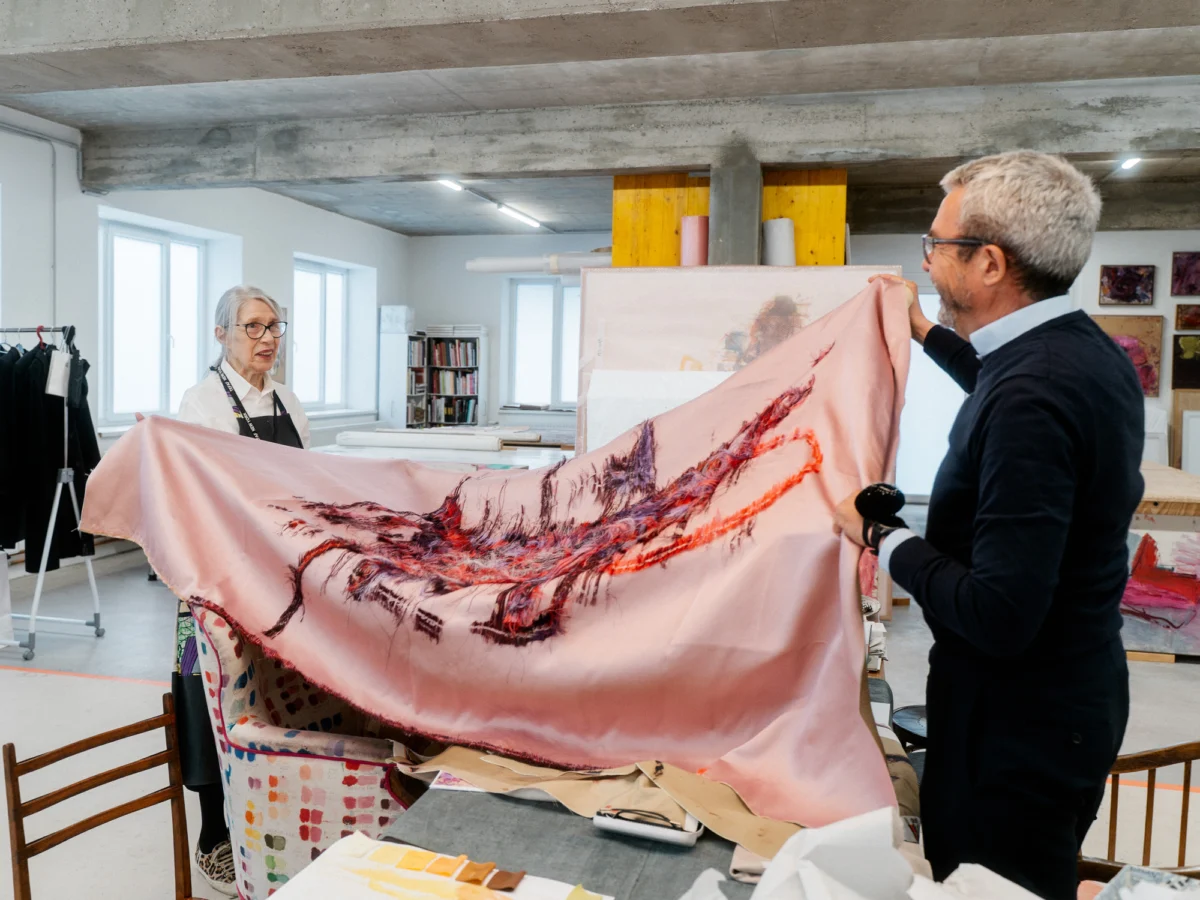
For Albert Kriemler, the creative director of the storied Swiss fashion house Akris, the runway has never been merely a platform for hemlines and silhouettes. It is a gallery, a dialogue, and an ongoing experiment in cross-disciplinary synergy. Since taking the helm of his family’s business in 1980, Kriemler has transformed Akris from a quiet, high-quality Swiss manufacturer into a global beacon of intellectual fashion—a brand that treats the textile as a canvas and the garment as a curated exhibition.
His upbringing was steeped in this synthesis. As a teenager, Kriemler traveled alongside his family to international fabric fairs, but he also found himself gravitating toward the high-art theatricality of Yves Saint Laurent. He watched with fascination as Saint Laurent brought the brushstrokes of Vincent van Gogh, Georges Braque, and Piet Mondrian into the three-dimensional realm of haute couture. It was a foundational lesson: fashion could be more than clothing; it could be a medium for cultural commentary and aesthetic innovation.
The Evolution of a Creative Vision: A Chronology
Kriemler’s trajectory from a fashion apprentice to an art-world tastemaker did not happen overnight. It was a deliberate, steady climb that mirrors the precision of the Swiss heritage he represents.
The Formative Years (1980–2000): Upon assuming leadership at Akris, Kriemler focused on establishing the brand’s technical prowess. During these two decades, he honed the "luxurious understatement" that would become the house’s signature. However, the urge to push beyond the boundaries of traditional garment construction was always present.
The Pivot to Art (2004): The direct lineage between Akris and fine art was solidified during the brand’s first Paris runway show in 2004. Inspired by the evocative, often moody color palettes of Swiss-French painter Félix Vallotton, Kriemler demonstrated that he wasn’t just "printing" art onto fabric; he was translating the emotional resonance of a painting into the structure of a coat or a dress.

The Technological Leap (2014): In a defining moment of his career, Kriemler’s fall 2014 collection featured LED-equipped tailoring. Inspired by the "Stars" series by German photo artist Thomas Ruff, the collection wasn’t just a nod to aesthetics—it was a deep dive into the intersection of light, physics, and fabric. By collaborating with the St. Gallen-based fabric house Forster Rohner, Kriemler proved that electronic-enabled embroidery could be as elegant as it was futuristic.
The Present Era (2020–2026): In recent years, Kriemler has doubled down on intimate collaborations. His work with Colombian artist Olga de Amaral for the fall 2026 collection marked a turning point, pushing him away from his comfort zone and into a realm of gold-leaf textures and sculptural forms.
Supporting Data: The Anatomy of a Collaboration
Kriemler’s process is not a superficial "brand tie-in." It is a rigorous, often lengthy engagement with the artist’s methodology. He does not seek out the most famous names; he seeks out those whose work challenges his own understanding of proportion, light, and material.
The Methodology of Inspiration
Kriemler notes that when he embeds himself in an artist’s practice, he gains a "broader base for inspiration." This was evident in his deep-dive research with 94-year-old Olga de Amaral. By spending days at her home in Bogotá, Kriemler didn’t just look at her art; he learned how she perceived light and how she manipulated horsehair—a material he already utilized in Akris handbags. This intellectual exchange transformed his fall 2026 collection from mere "fashion" into a tactile study of metallic light and structural density.
The "Under-the-Radar" Strategy
While many luxury houses chase the "blue-chip" artist of the moment, Kriemler prefers the on-the-cusp or the historically overlooked. Consider his work with:

- Reinhard Voigt: His pixelated oil paintings provided the blueprint for Akris collections that played with digital abstraction long before "pixel-art" became a trend.
- Carmen Herrera: Her sharp, abstract color planes allowed Kriemler to experiment with color-blocking in a way that felt architectural rather than merely decorative.
- Rodney Graham: His multimedia approach encouraged Kriemler to incorporate a sense of humor and intellectual irony into the construction of his garments.
Official Perspectives: The Philosophy of the Atelier
In conversation, Kriemler often speaks of the studio as a "playground." When asked about the integration of new technologies, he is clear: "It’s always interesting when you can infuse new technologies into the workmanship process, because you create a new appearance. It’s like a new playground."
His recent focus on the Austrian artist Martha Jungwirth for the spring 2027 collection reveals his obsession with the "natural" side of the artistic process. He was drawn not only to her expressive brushwork but to her specific use of natural linen as a canvas. "What I loved always is that she works not on white canvas like a lot of artists," he explains. "She uses a natural linen canvas always, and that’s always part of her work." This attention to the substrate—the foundation—is what sets Akris apart from competitors who treat fabric as a passive surface.
Implications for the Future of Luxury Fashion
Kriemler’s model of artistic collaboration has significant implications for the future of the luxury industry. In an era where digital consumption often flattens the experience of art, Kriemler’s work insists on materiality.
The Shift Toward Intellectual Curation
As the industry moves away from logo-centric design, the "curated" collection—one rooted in specific cultural or artistic research—is becoming the new standard for luxury. Kriemler has proved that consumers are hungry for a narrative that goes beyond "seasonal trends." By grounding his work in the history of art, he provides the Akris customer with an experience that feels timeless, educated, and deeply personal.
The Democratization of the Gallery
Kriemler’s habit of visiting museums—often sneaking in an hour before closing to avoid the crowds—has informed his strategy for how his clothes should be perceived. He views the retail environment and the runway as extensions of the museum space. For the Akris wearer, a coat is not just a garment; it is a piece of art that has been refined through a rigorous, high-level creative process.

The Tech-Art Convergence
Looking ahead, the success of the 2014 Ruff collaboration and his ongoing work with St. Gallen’s textile innovators suggests that the future of Akris lies in the "invisible" integration of technology. By keeping his research local—staying connected to the traditional embroidery houses of his hometown while looking toward the global avant-garde—Kriemler ensures that his brand remains a hybrid of Swiss reliability and global visionary art.
Conclusion: A Living Legacy
Albert Kriemler remains one of fashion’s most consistent yet surprising figures. His ability to maintain the "luxurious understatement" of the Akris brand while simultaneously pushing into the territory of avant-garde art is a rare balancing act. Whether it is through the pixelated landscapes of Voigt, the metallic, horsehair-laden tapestries of de Amaral, or the raw, linen-based expressions of Jungwirth, Kriemler ensures that every season, the Akris runway is a place where one might learn something new.
In a fast-paced fashion cycle, he remains an anomaly: a designer who stops to look, who takes the time to travel, and who treats the act of creation not as a product cycle, but as an ongoing, lifetime exploration of the human aesthetic spirit. His legacy is not written in the trends he followed, but in the artists he brought into the light and the way he forever altered the silhouette of modern, intelligent design.
 Ali Ikhwan
 Lina Hope
 Siti Muinah
