
 By Reynand Wu
In the rapidly evolving landscape of digital media, few platforms have maintained the sheer staying power and adaptive capacity of YouTube. As we navigate through 2026, the platform has transcended its original identity as a video-sharing site to become a multi-faceted ecosystem that functions as the world’s second-largest search engine, a dominant social media network, and the primary alternative to linear television.
With over 2.6 billion monthly active users and a burgeoning short-form video sector, YouTube’s influence on global culture and commerce is unparalleled. This report provides a deep dive into the 40 most critical statistics defining YouTube in 2026, exploring the platform’s chronological evolution, supporting data, and the strategic implications for brands and creators.

Main Facts: The State of the Platform in 2026
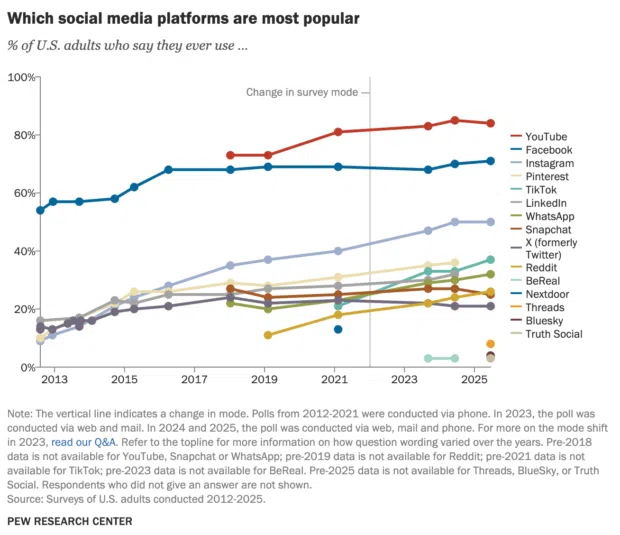
The current state of YouTube is defined by three pillars: global scale, financial resilience, and format diversification. YouTube remains the second most visited website in the world, trailing only its parent company, Google. In the United States, it has solidified its position as the most popular social media platform, outperforming competitors like Facebook, Instagram, and TikTok in terms of total user reach.
Financially, the platform is a juggernaut. In 2025, YouTube generated over $40 billion in advertising revenue alone—an 11% increase from the previous year. Furthermore, the platform has successfully diversified its income streams; YouTube Premium and YouTube Music now boast a combined 125 million paid subscribers, contributing significantly to Alphabet’s bottom line.

Perhaps the most significant shift in 2026 is the success of YouTube Shorts. Averaging over 200 billion daily views, Shorts has transformed from a reactionary feature to TikTok into a core component of the YouTube experience, attracting 175 million users in the U.S. alone.
Chronology: From Video Repository to Streaming Giant
To understand YouTube’s 2026 dominance, one must look at the strategic pivots made over the last several years:
- 2021-2022: The Shorts Pivot. Responding to the meteoric rise of TikTok, YouTube launched Shorts globally. This period marked the beginning of the "multi-format" era, where creators were encouraged to post both long-form and short-form content.
- 2023-2024: The Living Room Land Grab. YouTube focused heavily on its "Connected TV" (CTV) experience. By optimizing the app for smart TVs and gaming consoles, YouTube began to consistently beat Netflix and Disney+ in monthly watch time in the U.S.
- 2025: The Revenue Milestone. YouTube surpassed $40 billion in annual ad revenue, proving that despite the "ad-pocalypse" concerns of previous years, its targeting and reach remained indispensable to marketers.
- 2026: The AI and Integration Era. Integration of advanced AI for content discovery and creator tools has allowed the platform to maintain high engagement levels even as the digital attention span continues to shorten.
Supporting Data: 40 Essential Statistics
General Reach and Accessibility
- Global Ranking: YouTube is the 2nd most visited website globally.
- U.S. Dominance: It is the #1 social media platform in the U.S., beating Facebook and TikTok.
- Paid Ecosystem: 125 million users pay for YouTube Premium or YouTube Music.
- App Popularity: It is the second most popular mobile video app worldwide, narrowly edging out Netflix in downloads.
- Engagement: It is the most-used mobile app by total time spent.
- Linguistic Diversity: Content is available in over 80 languages across 100+ countries.
Demographic Breakdown
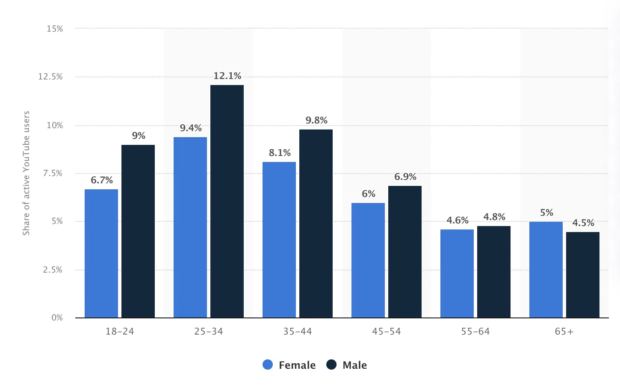
- Gender Split: 54.3% of the audience identifies as male; 45.7% as female.
- Core Age Group: The 25-34 age bracket remains the largest demographic.
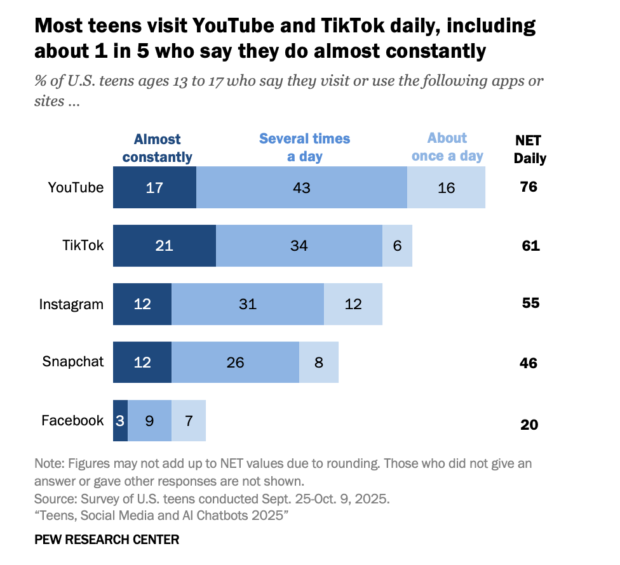
- Youth Engagement: 76% of U.S. teens use the platform daily; 17% describe their use as "almost constant."
- Top Market: India leads the world with 491 million users.
- Secondary Markets: The U.S. (253M), Brazil (144M), and Indonesia (143M) follow India.
- Penetration: The Philippines holds the highest penetration rate relative to its population.
- Education: In the U.S., 89% of college graduates use YouTube, indicating a highly educated user base.
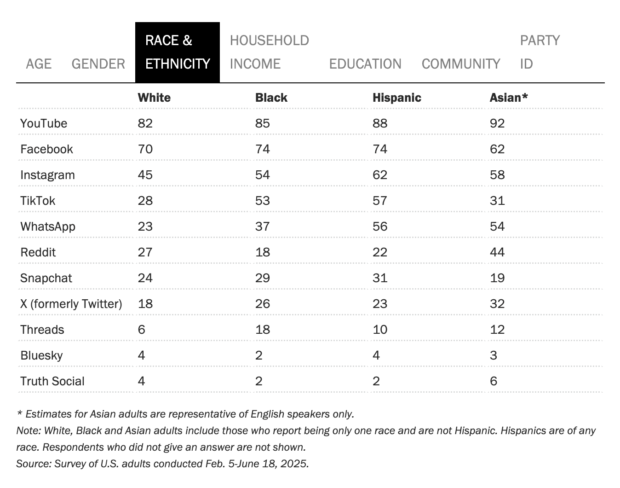
- Ethnicity: Usage is high across all U.S. demographics: 92% of Asian, 88% of Hispanic, 85% of Black, and 82% of White populations.
YouTube Shorts: The Growth Engine
- Daily Views: Shorts now average 200 billion views per day.
- U.S. User Base: 175 million Americans use Shorts regularly.
- Projected Growth: U.S. Shorts users are expected to exceed 192 million by 2027.
- Creator Incentives: YouTube pays creators 45% of ad revenue generated from Shorts.
- Engagement Records: The most-liked video in YouTube history is a Short by MrBeast ("Would You Fly to Paris for a Baguette?"), with 57 million likes.
The Business of YouTube
- Marketing Adoption: 69% of all companies use YouTube for marketing.
- Enterprise Use: 71% of large-scale enterprises utilize the platform.
- ROI Ranking: Marketers rank YouTube as the 3rd highest ROI platform, behind only Instagram and Facebook.
- Commerce: Users watched over 35 billion hours of shopping-related content last year.
- The CTV Shift: Over 40% of users now view YouTube ads on Connected TVs.
- Influencer Marketing: Over 50% of U.S. marketers plan to use YouTube for influencer collaborations in 2026.
- Creator Economy: There are now 87 million creators worldwide.
Content and Channel Performance
- Daily Uploads: Over 20 million videos are uploaded every single day.
- Daily Watch Time: Users consume more than 1 billion hours of video daily.
- The "100M" Club: Only 17 channels globally have surpassed 100 million subscribers.
- Individual Peak: MrBeast is the most-subscribed individual with 492 million followers.
- Corporate Peak: T-Series (312M) and Cocomelon (201M) dominate the brand sector.
- Channel Saturation: There are over 113 million total channels, though only a small fraction are active "creators."
- News Source: 35% of U.S. adults regularly get their news from YouTube, a significant increase from 23% in 2020.
Music and Entertainment
- Music Hub: YouTube Music has over 127 million active users.
- Top Category: 40% of the top 1,000 most-viewed videos are music videos.
- All-Time King: "Baby Shark" remains the most-viewed video with 16 billion views.
- Music Record: "Despacito" remains the most-viewed music video at 9 billion views.
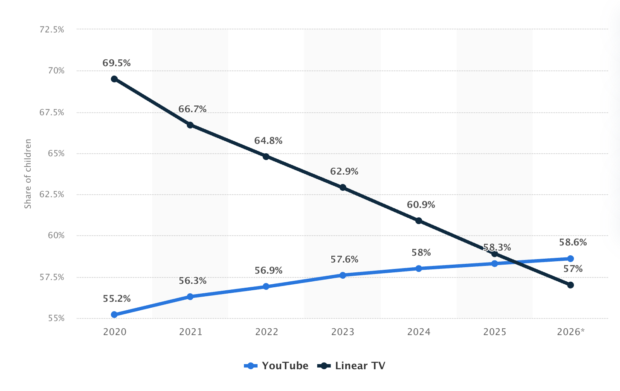
- Childhood Shift: 58% of U.S. children now watch YouTube more than linear TV.
Advertising and Financials
- Revenue Growth: Ad revenue hit $40 billion in 2025, an 11% year-over-year increase.
- Subscription Revenue: Non-ad revenue (Premium/Music) generated $19.64 billion in 2025.
Official Responses and Market Context
The data provided by Nielsen and Alphabet (Google’s parent company) paints a picture of a platform that is successfully cannibalizing traditional media. In recent earnings calls, Alphabet executives have highlighted that YouTube is no longer just a "social" app but a "streaming" leader.
Nielsen’s "The Gauge" report confirms this, noting that YouTube has held the top spot in U.S. streaming watch time for nearly three years, consistently beating out subscription-based services like Netflix. This is largely attributed to the "unlimited" nature of YouTube’s content library and its sophisticated recommendation algorithm, which keeps users on the platform for an average of 1 hour and 25 minutes per day.
Official statements from YouTube leadership also emphasize the "democratization of creativity." By offering a 45% revenue share on Shorts, YouTube has positioned itself as the most financially viable home for creators, contrasting with TikTok’s "Creator Fund" model, which has faced criticism for low payouts.
Implications for Brands and Creators
The 2026 data suggests several critical shifts in strategy:
1. The Death of Linear TV
With 58% of children preferring YouTube over TV and 40% of adults viewing via Connected TVs, brands must treat YouTube as a "prime time" broadcast channel. Ad creative must be high-resolution and optimized for large screens, not just mobile devices.
2. The Multi-Format Necessity
The success of MrBeast, who holds the record for the most-liked Short and the most-subscribed channel, proves that the most successful entities are those that master both 60-second vertical clips and 20-minute horizontal features. Creators cannot afford to ignore either format.
3. Search Engine Optimization (SEO)
As the second-most visited site and a primary news source for 35% of adults, YouTube is where the "discovery" phase of the buyer’s journey happens. Brands must invest in YouTube-specific SEO to ensure their products appear in the 35 billion hours of shopping-related content consumed annually.
4. Global Expansion
With India serving as the platform’s largest market, global brands must consider localized content. The "one-size-fits-all" English-centric approach is no longer sufficient for a platform that operates in 80 languages.
Conclusion
As we look toward the remainder of 2026, YouTube stands as a singular force in the digital world. It has successfully bridged the gap between the "creator economy" and "traditional broadcasting." For marketers, the takeaway is clear: YouTube offers the reach of television with the precision of digital social media. For creators, it remains the most robust platform for building a sustainable, high-revenue business. In the battle for global attention, the numbers show that YouTube is not just participating—it is winning.
 Nila Kartika Wati
  Ammar Sabilarrohman
  Asep Darmawan