
 By Nana Wu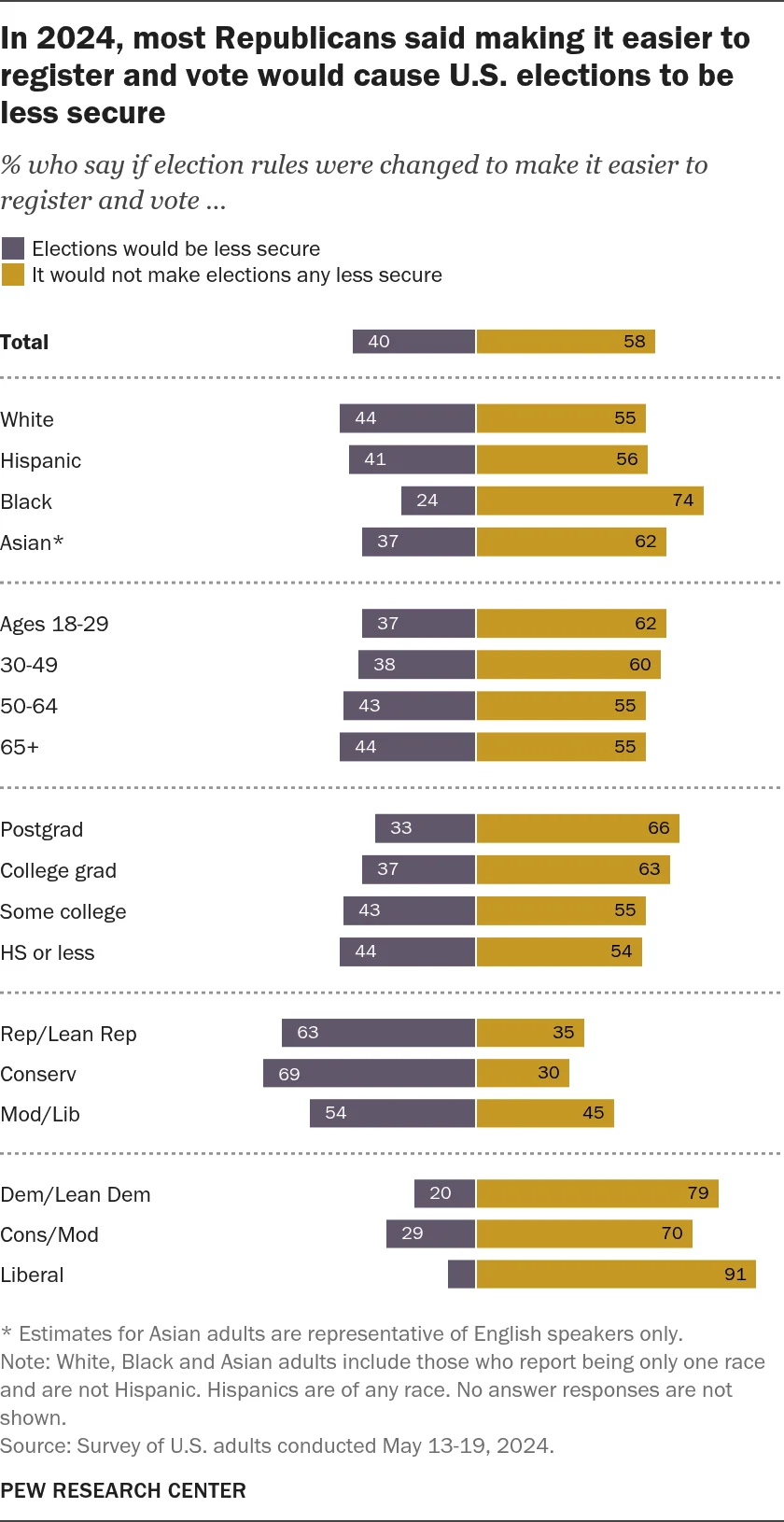
As the American electoral landscape continues to evolve in the wake of the 2024 presidential cycle, a stark divide remains in how the public views the mechanics of democracy. A comprehensive new survey from the Pew Research Center reveals that while a solid majority of Americans—roughly six-in-ten (59%)—support the availability of early or no-excuse absentee voting, the nation remains deeply polarized along partisan lines. This friction highlights a fundamental disagreement over the balance between electoral accessibility and perceived security.
Main Facts: The Current State of Public Opinion
The latest data, gathered through a survey of over 5,000 U.S. adults conducted in April 2026, underscores that voting methods have become a centerpiece of the American culture war. The fundamental question presented to respondents was whether any voter should have the option to vote early or via absentee ballot without the need to provide a documented reason for doing so.
The topline results show a consensus that masks a deeper conflict: 59% of respondents support no-excuse voting access, while 40% maintain that voters should be required to provide a documented justification for opting out of in-person, Election Day voting. However, when the data is disaggregated by political affiliation, the consensus vanishes. A staggering 81% of Democrats and those who lean toward the Democratic Party support no-excuse voting. Conversely, only 34% of Republicans and Republican-leaning independents share that view, with 66% of that cohort insisting that a documented reason should be mandatory for non-traditional voting.

This chasm is not merely a statistical curiosity; it represents a fundamental divergence in how each party perceives the risks associated with the ballot box. While advocates for expanded access argue that early and mail-in voting are essential to modern democratic participation, opponents frequently cite concerns regarding the integrity and security of elections where traditional in-person protocols are bypassed.
A Chronology of Declining Republican Support
The trajectory of these opinions over the last eight years provides critical context for the current climate. In 2018, the partisan gap, while present, was far narrower. At that time, a 57% majority of Republicans supported the expansion of no-excuse early and absentee voting. Since the 2020 presidential election, however, that support has seen a steady, marked decline.
By 2021, Republican support had dipped to 38%, and by 2024, it reached 37%. As of the latest 2026 figures, the number stands at 34%. This represents a significant shift in the internal political consensus of the Republican Party, moving from a majority in favor of broad access to a clear minority.

In stark contrast, Democratic support has remained remarkably stable throughout the same period. Since 2018, consistently about eight-in-ten Democrats have voiced support for no-excuse voting. The stability of the Democratic position, coupled with the downward trend among Republicans, suggests that the "voting access" debate has become increasingly cemented in partisan identity, resistant to the moderate shifts usually observed in public opinion polling.
Supporting Data: The Impact of State Laws
The geography of American voting laws plays a nuanced role in shaping these perspectives. The Pew study analyzed how residents of different states view access, categorized by the stringency of their local laws.
Perhaps unsurprisingly, the data indicates that exposure to specific policies correlates with public approval. In states where universal mail-in ballot access is the norm—meaning ballots are automatically mailed to every voter—support for no-excuse voting is highest, at 67%. In states where no excuse is required to request an absentee ballot, the support level aligns with the national average of 59%. In states where a "valid excuse" is strictly required, public support for expanding access drops to 53%.
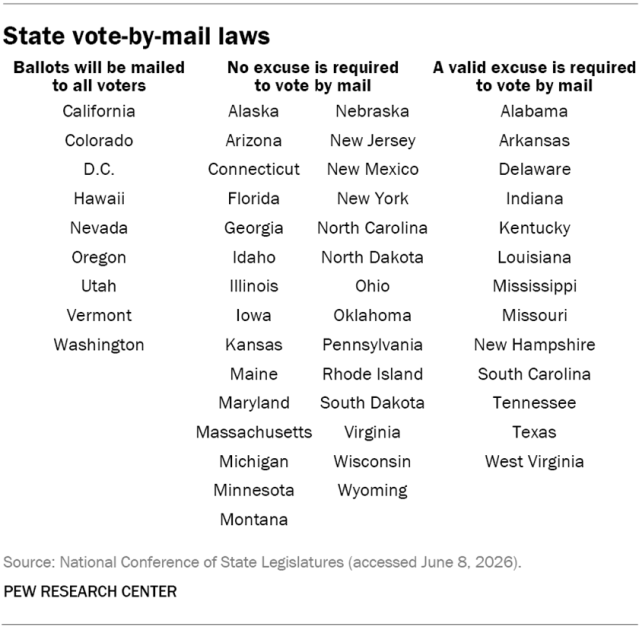
Interestingly, even within these state-based categories, the partisan split remains the dominant predictor of opinion. Even in states with the most liberal mail-in policies, Democrats are far more supportive of the practice than their Republican counterparts. This suggests that while personal experience with a state’s voting system influences views, partisan affiliation remains a stronger determinant of whether a citizen views these methods as a democratic good or a security vulnerability.
Demographic and Educational Divergence
Beyond party lines, the 2026 study reveals significant demographic nuances. Education, for instance, serves as a clear wedge. Two-thirds (67%) of post-graduates support no-excuse voting, while that figure drops to 53% among those with a high school education or less.
Race and ethnicity also play a significant role. Black adults are the most vocal proponents of expanded access, with 76% favoring no-excuse options. Asian and Hispanic adults also show majority support (63% and 62% respectively), while White adults show the lowest level of support among these groups at 55%.

Age further complicates the picture. Younger voters (ages 18-29) are more likely to support flexible voting (62%) compared to those aged 50-64 (55%). This demographic divide may reflect varying levels of reliance on traditional voting infrastructure and different levels of comfort with technological or mail-based administrative processes.
The Security-Accessibility Paradox
The core of the debate is the perceived trade-off between "making it easier to vote" and "keeping elections secure." In 2024, the Pew Research Center directly addressed this by asking respondents if changes to voting rules would make elections "less secure."
The response was a near-mirror image of the political divide on voting access. 58% of the total population believed that easing registration and voting requirements would not compromise security. However, 40% of the public felt that such measures would make the system less secure.

Among Republicans, the skepticism is profound: 63% believe that easier access directly leads to less secure elections. Among Democrats, the sentiment is the inverse, with 79% arguing that expanded access has no negative impact on election integrity. This data point is crucial because it frames the disagreement not as a conflict over what to do, but over the consequences of those actions. One side views expanded access as a barrier to disenfranchisement; the other views it as a degradation of institutional integrity.
Implications for the Future of U.S. Elections
The implications of these findings are far-reaching. As the United States approaches future election cycles, the debate over voting access will likely remain a flashpoint in both state legislatures and federal courts.
- Legislative Stalemate: Because there is such a sharp partisan divide, state legislatures are likely to continue passing divergent laws based on which party holds the majority. This creates a fragmented electoral map where the "right to vote" is defined differently depending on which state line a citizen resides in.
- Trust in Institutions: The fact that a significant portion of the electorate believes that expanded access inherently compromises security poses a challenge to election officials. Even when administrative procedures are proven to be secure, the perception of insecurity among a large segment of the population can erode public confidence in the outcome of elections.
- The Role of Messaging: The steady decline in Republican support for no-excuse voting since 2018 suggests that political rhetoric has been effective in shifting public opinion. As political parties continue to emphasize the importance of "election integrity," it is probable that these numbers will not converge, but rather remain at their current polarized levels.
- Administrative Pressure: Election offices will continue to face the pressure of managing two worlds: one that demands the speed and convenience of mail-in and early voting, and one that demands the rigid, paper-based, in-person accountability of the past. Balancing these competing expectations will be one of the greatest administrative challenges for local government in the coming decade.
Ultimately, the Pew Research Center data suggests that the American electorate is not only divided on the candidates they choose but on the very machinery of the democracy that brings them to power. Until there is a broader, cross-partisan consensus on what constitutes a "secure" and "accessible" election, the debate will continue to define the electoral environment of the United States.

As we look toward the future, the challenge for policymakers will be to reconcile these deeply held, contradictory beliefs. Whether through technological innovation, increased transparency in the ballot-counting process, or a shift in political discourse, the path toward a unified vision of voting remains, for now, obscured by the clouds of partisan polarization.
 Muslim
  Nana Muazin
  Siti Muinah