
 By Layla Zulfa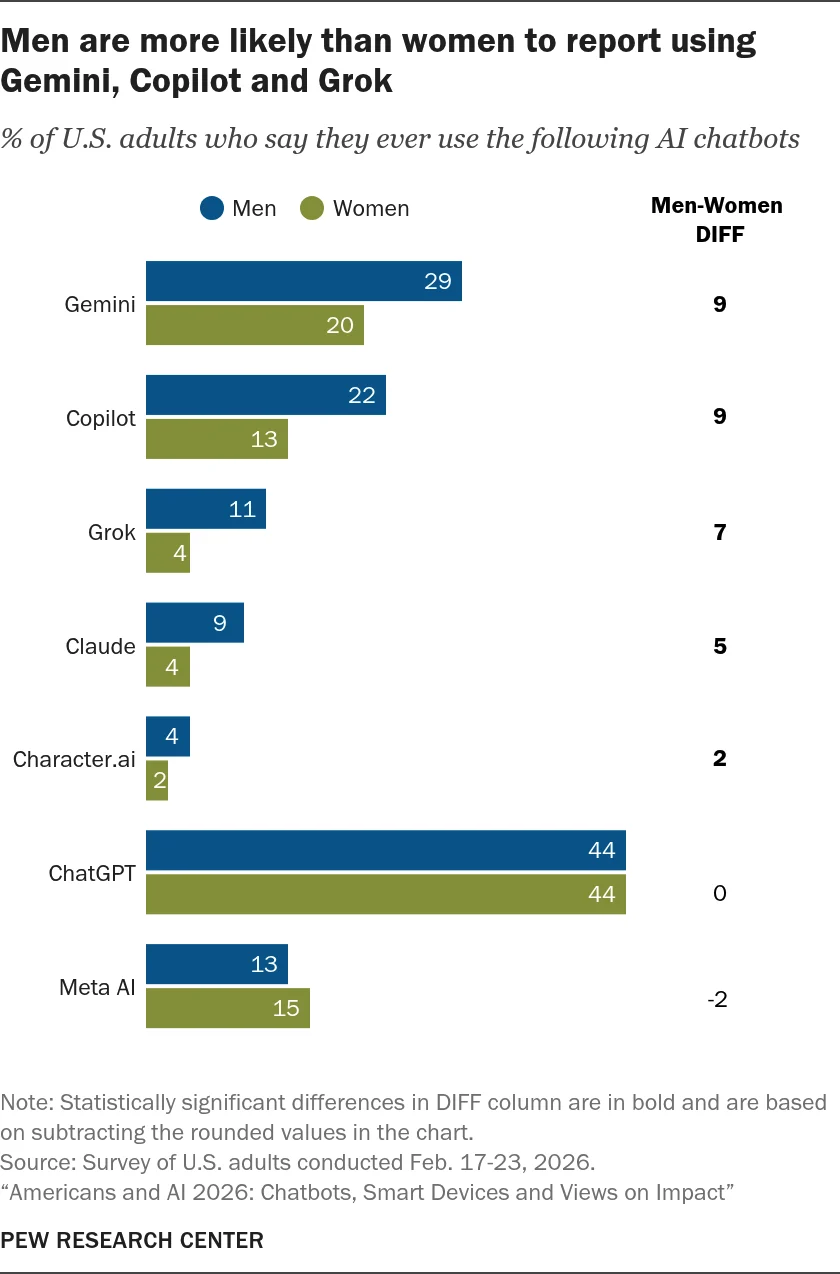
As artificial intelligence (AI) rapidly integrates into the fabric of daily life—from the workplace to the home—a new, detailed study from the Pew Research Center has unveiled a significant gender gap in how Americans engage with and perceive these transformative technologies. While the raw adoption numbers of tools like ChatGPT have begun to equalize, deep-seated differences persist in how men and women utilize, trust, and conceptualize the future of AI.
The study, conducted in February 2026, offers a comprehensive look at the "gendered" experience of the digital revolution, suggesting that while the tools are becoming universal, the societal and psychological response to them remains polarized.
Main Facts: The Evolving Landscape of AI Adoption
The most striking finding of the 2026 research is the convergence in base adoption rates. In 2024, men were significantly more likely to report using AI chatbots than women, with a gap of 11 percentage points (39% for men versus 28% for women). By 2026, that gap has effectively evaporated: 50% of men and 47% of women now report having used an AI chatbot.

However, this surface-level parity hides a much more complex reality. While both genders are equally likely to use the industry-standard "ChatGPT," men demonstrate a significantly higher appetite for exploring a wider ecosystem of tools. When looking at platforms like Gemini, Copilot, Grok, and Claude, men consistently report higher usage rates. For example, 22% of men report using Microsoft Copilot, compared to just 13% of women.
This suggests that while the "entry-level" AI gate has been opened to all, the "power user" segment remains heavily skewed toward a male demographic. This disparity in usage translates directly into the workplace, where men are more likely to leverage AI for professional tasks, potentially creating a secondary digital divide regarding productivity and career advancement.
A Chronological Look at the AI Shift
The timeline of AI adoption over the past two years represents one of the fastest technology migrations in modern history.

- Early 2024: The public discourse was dominated by curiosity and early experimentation. The "gender gap" was highly visible, as tech-forward demographics—predominantly male—drove the initial wave of chatbot adoption. The technology was viewed by many as a novel curiosity rather than an essential utility.
- Late 2024 to 2025: As AI was integrated into everyday applications like search engines and office software, the barrier to entry lowered significantly. This phase saw a surge in usage among women, particularly as these tools became embedded in social media, educational platforms, and administrative workflows.
- February 2026: The current data marks a "maturity" phase. The novelty has worn off, and the public has moved toward a utilitarian view. The focus has shifted from "have you tried this?" to "how much does this help me?" This is where the ideological and practical divergence between men and women has become most pronounced.
Supporting Data: Why the Discrepancy Exists
The Pew data highlights that while men and women prioritize similar baseline tasks—such as information searching and work-related duties—the intent behind the usage differs.
Professional Productivity and Utility
Men are noticeably more bullish on the productivity-enhancing capabilities of AI. Approximately 35% of men report that AI chatbots significantly improve their productivity, a sentiment shared by only 25% of women. This 10-point gap is critical; it suggests that men may be receiving or seeking out more training, or perhaps feeling more empowered to integrate AI into their professional workflows.
Emotional Support and Social Dynamics
Interestingly, while men lead in productivity and technical exploration, women are more likely to turn to AI for emotional support or advice. While the overall numbers remain low for both groups, this data point suggests that AI is beginning to serve as a surrogate for human interaction in specific, intimate contexts—a development that warrants further sociological scrutiny.

The "Speed" Anxiety
Perhaps the most telling data point regarding public sentiment is the concern over the speed of AI development. A staggering 68% of women believe AI is advancing "too quickly," compared to 58% of men. This anxiety is not merely a statistical curiosity; it reflects a fundamental difference in risk assessment. Women are statistically more likely to view the long-term impact of AI on society as negative (43%) compared to men (36%).
Official Responses and Expert Perspectives
Sociologists and technology analysts observing these trends suggest that the gender gap is not merely a matter of "tech-savviness," but rather a reflection of historical trends in technology adoption.
"Historically, whenever a new, disruptive technology emerges, there is an initial period of ‘alpha’ adoption by groups who feel the least amount of institutional friction," says an independent tech policy analyst. "Men have historically been encouraged to tinker and break things in the digital space. When we see women expressing higher levels of skepticism or concern about the speed of development, it is often a rational response to a technology that has historically been developed with little input from diverse stakeholders."

The Pew Research Center’s commitment to this tracking is intended to inform policymakers who are currently drafting the guardrails for AI. The message from the data is clear: regulation and educational outreach cannot be a "one-size-fits-all" endeavor. To ensure equitable access to the benefits of AI, policy must address the specific anxieties and barriers that differ across gender lines.
Implications for the Future
The implications of these findings are far-reaching, affecting everything from workforce development to the future of social interaction.
1. The Professional "Skills Gap"
If men continue to outpace women in the use of specialized AI tools and the belief that these tools improve productivity, we risk a new form of professional inequality. Organizations must ensure that AI literacy training is not just available, but is presented in a way that resonates with all employees. If the perception is that AI is a "masculine" tool for productivity, it will inevitably lead to an underrepresentation of women in roles that require high-level AI proficiency.

2. The Trust Deficit
The fact that women are more skeptical of AI and more concerned about its pace of development is a signal to tech developers. If a large segment of the population—a group that constitutes half the workforce and consumer base—is wary of the product, industry leaders must work to build trust. This includes moving toward more transparent AI models and focusing on "human-centric" design that prioritizes safety and ethical boundaries.
3. Societal Resilience
As AI continues to evolve, the divergent views between men and women on the societal impact of the technology will influence political and legislative outcomes. We may see a push for more stringent regulation led by those who view the technology as a net-negative, contrasted against the innovation-first approach favored by those who see it as a productivity engine.
4. The Human Element
The finding that women use AI for emotional support is a subtle but profound signal. As AI becomes more advanced at mimicking human empathy, the societal reliance on these tools for companionship or advice could fundamentally alter our social fabric. If this usage continues to trend upward, the ethical implications of "algorithmic relationships" will become a central debate in the coming decade.

Conclusion
The 2026 Pew Research Center survey does not paint a picture of a tech-illiterate population. Rather, it reveals a society that is rapidly becoming acclimated to artificial intelligence, yet doing so along divergent paths. While the "chatbot divide" has narrowed in terms of usage, the "sentiment divide" has widened.
For developers, policymakers, and the public, the path forward requires an acknowledgment that AI is not a neutral utility. It is a reflection of the society that builds and uses it. Addressing the gender gap in AI—not just in usage, but in trust and perceived utility—is no longer just a "diversity" goal; it is a prerequisite for ensuring that the AI revolution benefits all of humanity, rather than leaving half of it behind in a state of uncertainty.
As we look toward 2030, the challenge will be to bridge the gap between the rapid pace of innovation and the human need for security, trust, and equitable participation. Only by understanding the nuanced ways in which men and women engage with these tools can we hope to navigate the next, and perhaps most critical, chapter of the AI era.
 Muslim
  Nana Muazin
  Siti Muinah