
 By Lina Hope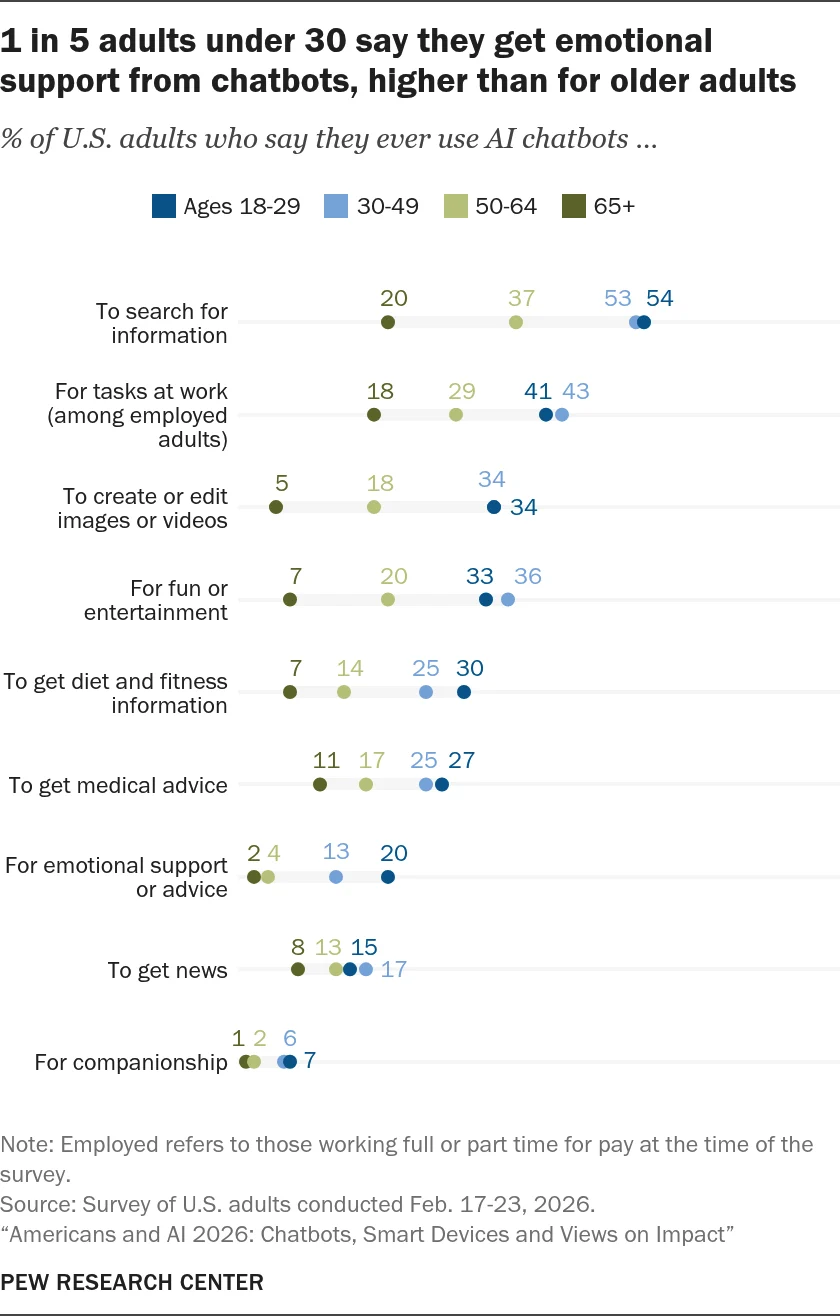
Artificial intelligence has rapidly transitioned from a niche technical curiosity to a ubiquitous force in the daily lives of millions. As the technology permeates everything from workplace productivity tools to the smart devices in our living rooms, the divide between how different generations adopt, understand, and perceive these advancements has become increasingly stark.
A comprehensive new study conducted by the Pew Research Center in February 2026, surveying over 5,000 U.S. adults, offers a definitive look at the current state of AI adoption in America. The findings suggest that while usage is rising across the board, the emotional and practical relationship Americans have with AI is heavily dictated by age.

Main Facts: A Rapidly Evolving Landscape
The data paints a picture of a nation in flux. AI chatbot adoption has surged since 2024, with nearly half of all U.S. adults (49%) now reporting that they have used tools like ChatGPT, Gemini, or Copilot. This represents a significant jump from 33% just two years prior.
However, this adoption is not uniform. Younger adults, particularly those under 30, are the most frequent users but also the most skeptical. While 66% of adults aged 18–29 have utilized AI chatbots, nearly half of this group (48%) believes that AI will have a negative impact on society over the next 20 years. In contrast, older Americans—those aged 65 and above—are far less likely to use these tools, with only 23% reporting they have ever tried a chatbot. Perhaps more notably, this older demographic is the most likely to express uncertainty regarding the long-term societal and personal consequences of AI, with 21% of seniors unsure about its impact on society and 29% unsure about its personal effect.

Chronology of Adoption: From Curiosity to Utility
To understand where we are, one must look at how quickly these tools have embedded themselves into the American fabric. In 2024, when the conversation around AI was primarily focused on the novelty of Large Language Models, usage was heavily concentrated in tech-savvy cohorts.
By 2026, the barrier to entry has lowered significantly. The 2026 data shows that adults in their 30s and 40s have caught up to their younger counterparts, with 61% of this middle-aged group reporting chatbot use—a dramatic increase from 41% in 2024. This suggests that AI has moved beyond the "early adopter" phase and into the mainstream, particularly for professionals who are leveraging these tools to assist with daily workplace tasks.

Despite this increased usage, there is a consistent theme across all age groups: a prevailing sense that the technology is advancing too quickly. Between 61% and 65% of Americans, regardless of their age, agree that AI development is moving at an unsustainable pace.
Supporting Data: How We Use the Tools
The utility of AI varies wildly depending on the user’s life stage. The Pew Research data highlights that younger adults are the primary drivers of "non-traditional" AI use. For example, one-in-five adults under 30 report using chatbots for emotional support or advice, a figure that drops to nearly zero for those over 50.

When it comes to search behavior, the shift is profound. A full 60% of Americans now read AI-generated summaries at the top of their search engine results. Here, again, age is a factor: 72% of adults under 30 utilize these summaries, compared to only 38% of those 65 and older.
The integration of AI into physical hardware also follows this demographic trend. While smart speakers are relatively common across all age groups, smart doorbells and thermostats—often requiring more active management and configuration—are most frequently found in the homes of adults in their 30s and 40s. These individuals are currently in their peak "nesting" years, suggesting that AI adoption in the home is closely tied to homeownership and the desire for home security and energy management.

The Confidence Gap
Beyond mere usage statistics, the research highlights a significant "confidence gap." While younger users are the most frequent adopters, they are not necessarily "confident" in their mastery of these tools. Only 31% of 18- to 29-year-olds describe themselves as "extremely" or "very" confident in their ability to use AI chatbots. This drops to a mere 6% among those 65 and older.
This lack of confidence correlates with how users perceive the impact of AI on their own capabilities. Interestingly, while the general public tends to think AI chatbots help with productivity, the jury is out on creativity. For young adults under 30, the sentiment is split: 25% believe AI helps their creativity, while 20% believe it actively hurts it. This indicates a nuanced, perhaps even conflicted, relationship with a tool that is becoming a cornerstone of their professional and creative workflows.

Implications for the Future
The implications of this research are substantial for policymakers, educators, and tech companies.
1. The Digital Divide 2.0
We are witnessing the emergence of a new type of digital divide. Historically, the digital divide was about access to hardware and high-speed internet. Today, it is about the "AI literacy divide." As AI becomes a mandatory skill for the modern workforce, older generations—and those less comfortable with the rapid evolution of chatbots—risk being sidelined.

2. The Mental Health Dimension
The fact that 20% of young adults are turning to AI for emotional support is a major red flag for mental health professionals. While chatbots can provide immediate, empathetic-sounding responses, they lack the lived experience, ethical framework, and human accountability of a licensed therapist. As these tools become more sophisticated, the line between "convenient advice" and "psychological reliance" will blur, necessitating new guidelines for how these companies design their emotional support features.
3. The Skepticism Paradox
It is striking that the most frequent users are also the most skeptical. This suggests that as people gain more "hands-on" experience with AI, they become more aware of its limitations, hallucinations, and potential for misuse. The high levels of skepticism among young people should be seen as an informed critique rather than a Luddite rejection. They are the "canaries in the coal mine," having tested these tools in their daily lives and found them lacking in reliability or safety.

4. Designing for Inclusion
For developers, the data is a call to action. The current interfaces of AI tools are clearly optimized for younger, digital-native users. If AI is to be a tool for the benefit of all, the design paradigms must shift to accommodate older users who may be more cautious, less confident, and less reliant on high-speed information processing.
Conclusion
The 2026 Pew Research study confirms that artificial intelligence has become an inescapable part of the American experience. However, it is not a monolithic experience. For the younger generation, it is an integrated, often complicated, and frequently frustrating tool that they are forced to master. For the older generation, it remains a distant, somewhat mysterious, and often unnecessary advancement.

As we look toward the next two decades, the challenge for society will not just be technological, but sociological. We must bridge the confidence gap, address the ethical concerns surrounding AI-driven emotional support, and ensure that the rapid advancement of these tools does not leave the most vulnerable—or the most hesitant—behind. The future of AI will not be decided solely by the algorithms themselves, but by how we, as a diverse society, choose to interact with them.
 Muslim
  Nana Muazin
  Siti Muinah