
 By Evan Lee Salim
Pollsters frequently caution that a survey is not a crystal ball. It is not designed to predict the future, nor is it a definitive verdict on the human condition. Instead, it serves as a snapshot—a precise, static image of public sentiment captured at a specific moment in time. However, the world is rarely static. When major geopolitical upheavals occur while researchers are still in the field, that snapshot becomes something far more dynamic: a high-speed capture of shifting perspectives.
A recent analysis by the Pew Research Center’s global team illustrates this phenomenon. During the spring of 2026, as pollsters conducted fieldwork across dozens of nations, the geopolitical landscape shifted abruptly with the outbreak of hostilities between the United States, Israel, and Iran. By leveraging advanced statistical modeling, researchers were able to move beyond the traditional "static snapshot" to track how public opinion regarding the U.S. and global economic stability fluctuated in the immediate aftermath of the February 28 airstrikes.
The Chronology of Conflict and Data Collection
The logistical reality of global polling is a process of weeks, often months. To achieve a nationally representative sample, teams must conduct thousands of interviews, either via telephone or in face-to-face settings. This extended timeframe created a unique opportunity to observe the "before and after" of a major international military event.
February 28, 2026: The Trigger
The catalyst for this shift was the joint U.S.-Israeli airstrike against targets in Iran. At this precise moment, the Pew Research team was already deep into the field in several countries, while preparations were underway in others. This created a natural experiment: would respondents interviewed in early March express significantly different views than those surveyed in late February?
March–April 2026: Tracking the Volatility
As the conflict progressed, the survey data began to mirror the volatility of the headlines. In countries heavily reliant on energy imports through the Strait of Hormuz, such as South Korea, the economic anxiety following the strikes was palpable. Fieldwork data began to show a clear correlation between the rising cost of energy and a precipitous decline in confidence regarding both the domestic economy and the U.S. as a geopolitical partner.
April 8, 2026: The Islamabad Exception
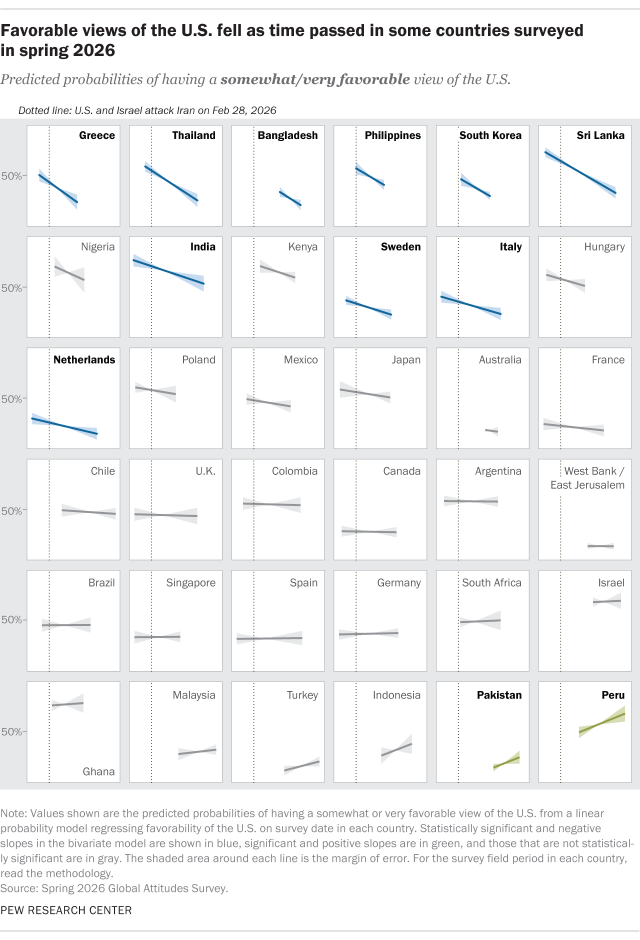
The timeline also reveals localized anomalies. For instance, in Pakistan, survey teams began their work on April 8. Contrary to the downward trend observed in many other nations, Pakistan showed a slight uptick in favorable views toward the U.S. Researchers attribute this not to a broader shift in policy, but to the timing of the U.S.-Iran peace talks hosted in Islamabad, which likely tempered the immediate anti-Western sentiment seen elsewhere.
Statistical Rigor: Moving Beyond the "Snapshot"
Determining whether public opinion is truly shifting in real time requires more than a simple comparison of averages. With a standard sample size of approximately 1,000 adults per country, dividing the data by week creates large margins of error, which could obscure genuine trends.

The Challenge of Demographic Variance
Researchers faced the inherent risk that respondents interviewed in the first week of a crisis might be demographically distinct from those interviewed in the final week. Factors such as geographical access, the willingness to participate in a follow-up call, or the availability of face-to-face interviewers can introduce "noise" into the data. To mitigate this, the Center utilized bivariate regression analysis.
The Power of Regression Modeling
By modeling the relationship between the date of the interview and the probability of a specific response, the team was able to analyze the entire sample simultaneously. This method allowed them to "control" for variables—such as age, gender, education, and political ideology—that might otherwise skew the results. Even after these statistical controls were applied, the trend remained stark: favorability toward the U.S. showed a statistically significant decline in countries including Greece, India, Italy, Kenya, South Korea, Sri Lanka, Sweden, and Thailand.
Supporting Data: Economic and Geopolitical Erosion
The data suggests a dual-pronged decline in public trust. Not only did perceptions of the U.S. as a "reliable partner" wane, but there was also a quantifiable decrease in the belief that the U.S. contributes to global peace and stability.
The Energy-Opinion Connection
The correlation between economic stability and views of the U.S. was most pronounced in regions where energy dependence is high. In nations like Canada, Chile, and the Netherlands, the "flip book" effect—the series of snapshots taken over the weeks—showed that as domestic economic outlooks worsened, so did perceptions of American leadership. This suggests that in the minds of many global citizens, the U.S. is viewed as the primary architect—and therefore the primary culprit—in the global economic climate.
Confidence in Leadership
The survey also tracked confidence in U.S. President Donald Trump’s ability to manage international affairs. The data indicates a slight but measurable decline across the survey period, particularly in the immediate aftermath of the February 28 strikes. This suggests that when international crises strike, the public is quick to project their anxieties onto the leadership of the world’s primary superpower.
Official Perspectives and Methodological Transparency
The Pew Research Center has been transparent about the limitations of this "real-time" approach. In their methodology report, researchers emphasized that in countries where fieldwork began several weeks after the initial conflict—such as many Muslim-majority nations—the data did not show a sharp decline. In these regions, views of the U.S. were already at a historical baseline of negativity, and the "shock" of the February 28 event was already baked into the pre-survey environment.
The Center’s commitment to providing both the topline survey results and the technical methodology serves as a benchmark for transparency in social science. By making the raw data available, they invite further scrutiny of how geopolitical events shape the psychological landscape of the global public.
The Broader Implications for Global Diplomacy
The implications of this research are profound for both policymakers and social scientists.
The "Flip Book" Reality
The primary takeaway is that the "snapshot" model of polling is increasingly insufficient for a world of rapid-fire global crises. When public opinion acts more like a "flip book"—where images change rapidly in succession—traditional polling methods risk capturing a distorted version of reality. For diplomats, this means that public sentiment is far more fragile and responsive to breaking news than previously assumed.
Policy Responsiveness
For governments, the data indicates that there is a very narrow window of time in which to frame the narrative of a military or economic event. If public opinion in key partner nations begins to sour within days of an airstrike, the window for diplomatic damage control is measured in hours, not weeks. The rapid shift in opinion in countries like South Korea and Greece highlights the volatility of alliances in the face of economic uncertainty.
Conclusion: A New Era of Polling
The 2026 survey cycle serves as a critical case study in how modern research can adapt to an volatile international environment. By moving beyond static data points and embracing statistical models that account for temporal shifts, pollsters are beginning to bridge the gap between "the snapshot" and "the reality."
As global events continue to accelerate, the ability to discern not just what people think, but how and when their views change, will be the most valuable tool in the political analyst’s kit. The "flip book" of 2026 proves that while the world may be unpredictable, our ability to measure that unpredictability is evolving—offering a clearer, albeit more unsettling, view of the global pulse.
 Muslim
  Nana Muazin
  Siti Muinah