
 By Lina Irawan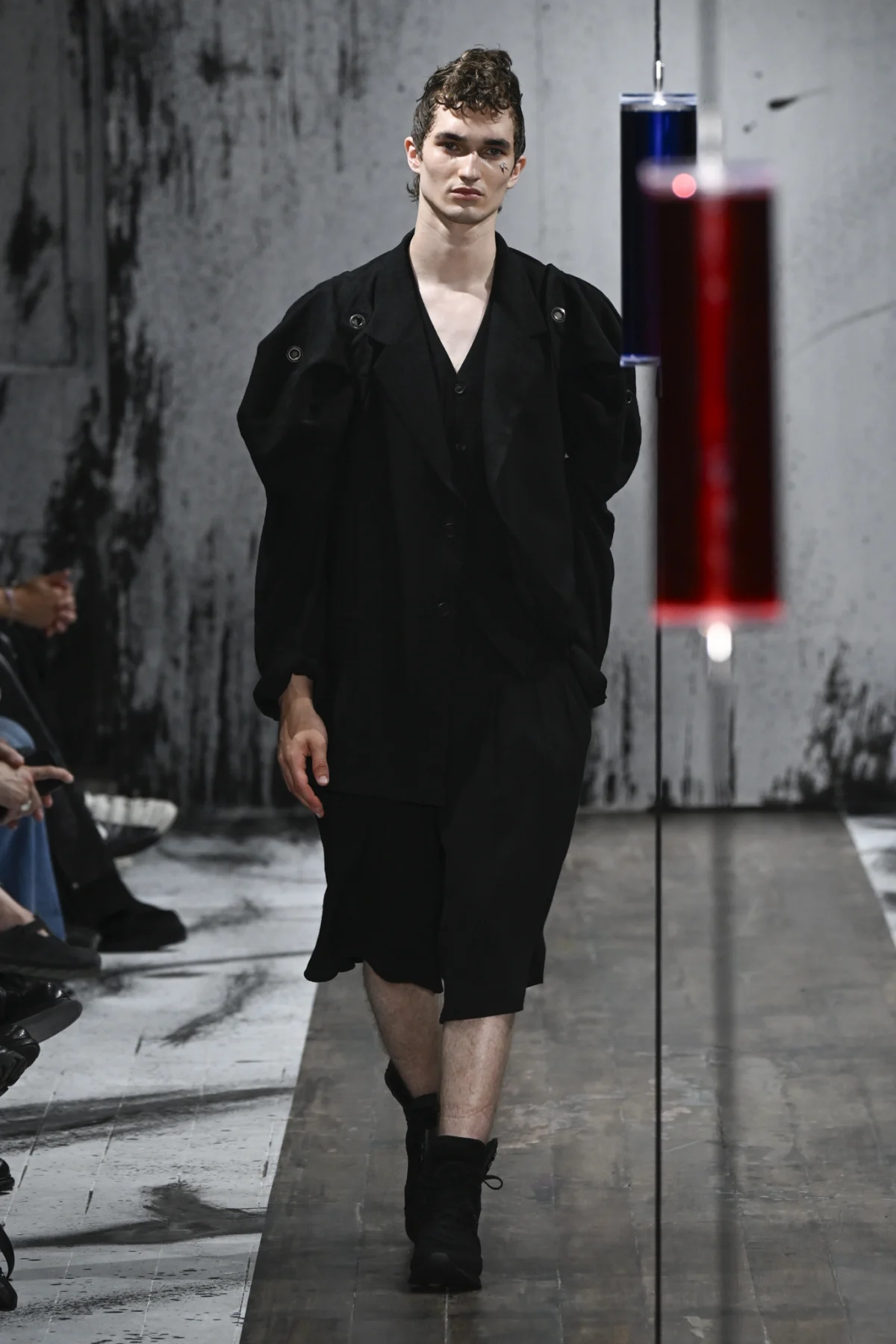
“Make haste slowly; do not be discouraged, but return to the work frequently.” These words, penned by the 17th-century French poet and critic Nicolas Boileau, served as the philosophical bedrock for Yohji Yamamoto’s latest spring men’s collection. In an industry often obsessed with the frantic, ephemeral nature of the trend cycle, Yamamoto offered something radical: a slow-burn study of the human frame, treated with the gravity and precision of a Renaissance master.
The Anatomy of the Shoulder: A Chronology of Construction
For Yamamoto, the protagonist of this season was the shoulder. If a painter approaches a grand canvas with dozens of preparatory sketches, Yamamoto approached the shoulder with a series of structural experiments that redefined the silhouette of the modern man.
The show opened with a trio of all-black looks that initially appeared uniform. Upon closer inspection, however, the audience was invited into a masterclass of deconstruction. These elongated jackets featured elaborately pleated sleeves, anchored by industrial-sized grommets, layered over loose-fitting shirts and voluminous shorts. This was not mere clothing; it was a rhythmic exploration of proportion.
As the collection progressed, the experimentation deepened. Yamamoto moved from standard tailoring into architectural abstraction. Some shoulders jutted upward into sharp, aggressive peaks, suggesting an almost militaristic posture. Others softened, turning into cocoon-like structures through the clever use of fabric inserts. There were even moments where the sleeve was entirely absent, forcing the viewer to re-evaluate the shoulder as a sculptural focal point rather than a utilitarian attachment.
Historical Synthesis: Chivalry and the Modern Heraldry
Yamamoto’s scholarly fluency in the history of dress is well-documented, but this season, that fluency felt particularly acute. The collection functioned as an extension of his enduring fascination with 19th-century fashion—a period that famously reinterpreted the chivalrous ideals and rigid silhouettes of medieval armor into the volume and motifs of the Victorian era.
Through this historical lens, the collection’s embellishments took on a new weight. Animal-inflected imagery and recurring cross motifs functioned as modern heraldic signifiers. The textile palette—ranging from somber black wool and raw, unbleached linen to intricate laces and devoré velvets that unveiled glimpses of printed mesh—echoed the opulence of ancient male regalia.
As the show reached its zenith, the references to armor became explicit. Knits painted in shimmering metallics or accented with sudden, sharp flashes of crimson evoked the texture of chain mail. It was a poignant commentary: in a world currently navigating unprecedented geopolitical and environmental volatility, who wouldn’t desire a bit of protective padding? When tailored with the unparalleled expertise of Yamamoto, this "armor" is not just defensive; it is a manifestation of resilience.
The Interior Battle: Poetic Inscriptions and Existentialism
Beyond the technical bravado, there remained the signature Yamamoto enigma. A handful of garments featured cryptic, poetic messages printed on the back. Phrases speaking of quests for "inner ghosts," "elsewhere," and "nostalgia" provided a psychological counterpoint to the physical rigidity of the clothing.
These inscriptions hinted that the real battleground was not external, but internal. By placing these messages on the back of the garments, Yamamoto suggested that the wearer is constantly moving away from their own psyche, or perhaps, searching for a version of themselves that has been left behind. It was a reminder that fashion, at its most profound, serves as a vessel for the human condition—a way to clothe our vulnerabilities while projecting a facade of strength.
Breaking the Binary: The Casting and the Narrative
Yamamoto has never been one to adhere to the rigid categorization of the body, and this season’s casting reinforced his disregard for gendered constraints. The runway featured a typical Yamamoto blend: a mix of striking, angular faces and "lived-in" bodies that defied the traditional, homogenized aesthetics of high-fashion models.
The choice to close the show with jewelry designer Rie Harui, the creative director of the Yohji Yamamoto by Riefe line, served as a definitive statement. In the backstage chaos that followed—a scene defined by the traditional, good-natured jousting between the designer and the press—Yamamoto noted that Harui’s inclusion was "important." Her presence as both a female model and a collaborating designer bridged the gap between the garments and the creative force behind the accessories, reinforcing the idea that the collection was a collaborative, fluid space that refused to be bound by traditional gender norms or professional hierarchies.
Environmental Anxiety: A Designer’s Response to the Times
The atmosphere at the show was thick with a palpable, unspoken tension. Fashion week, held during a period of record-breaking heat, left the "baking" crowd acutely aware of the climate catastrophe. When asked to contextualize his work within the present moment, Yamamoto was characteristically candid and complex.
"It is very comfortable, but at the same time… uncomfortable," he mused, articulating the duality of existing in a modern, luxury-laden industry while the world faces existential threats. His response, however, was not one of defeat. Despite acknowledging that "the going gets hard," his philosophy remained stoic: "You have to keep on living."
Implications: The Legacy of Slow Fashion
The implications of this collection extend far beyond the immediate trends of the upcoming season. In a digital age that demands instant gratification and constant novelty, Yamamoto’s insistence on "making haste slowly" serves as a necessary rebuke to the industry.
By returning to the work—by obsessing over the architecture of a shoulder, the drape of a linen weave, or the placement of a grommet—Yamamoto is preserving the sanctity of craftsmanship. His work suggests that the antidote to modern anxiety is not to run faster, but to engage more deeply with the material world.
Furthermore, by integrating historical motifs with contemporary existential dread, Yamamoto positions his brand as a sanctuary. The collection is a testament to the fact that clothing can be both a shield against a harsh reality and a medium for poetic exploration.
Conclusion
Yohji Yamamoto’s latest offering was more than a seasonal presentation; it was a meditation on the permanence of the human spirit. Through his meticulous study of construction, his deep historical references, and his refusal to be categorized, he has once again proven why he remains the architect of modern dissent.
As we look toward an uncertain future, the "armor" that Yamamoto provides—both literal and metaphorical—offers a sense of grounding. He reminds us that even when the world feels as though it is fracturing, the act of creation, the pursuit of beauty, and the courage to "keep on living" are the most profound forms of resistance. In the silence between the pieces, and in the deliberate, studied walk of his models, one finds the enduring legacy of a designer who understands that fashion is not just about what we wear, but about how we survive.
 Nana Muazin
  Nana
Nana  Ali Ikhwan