
 By rifanmuazin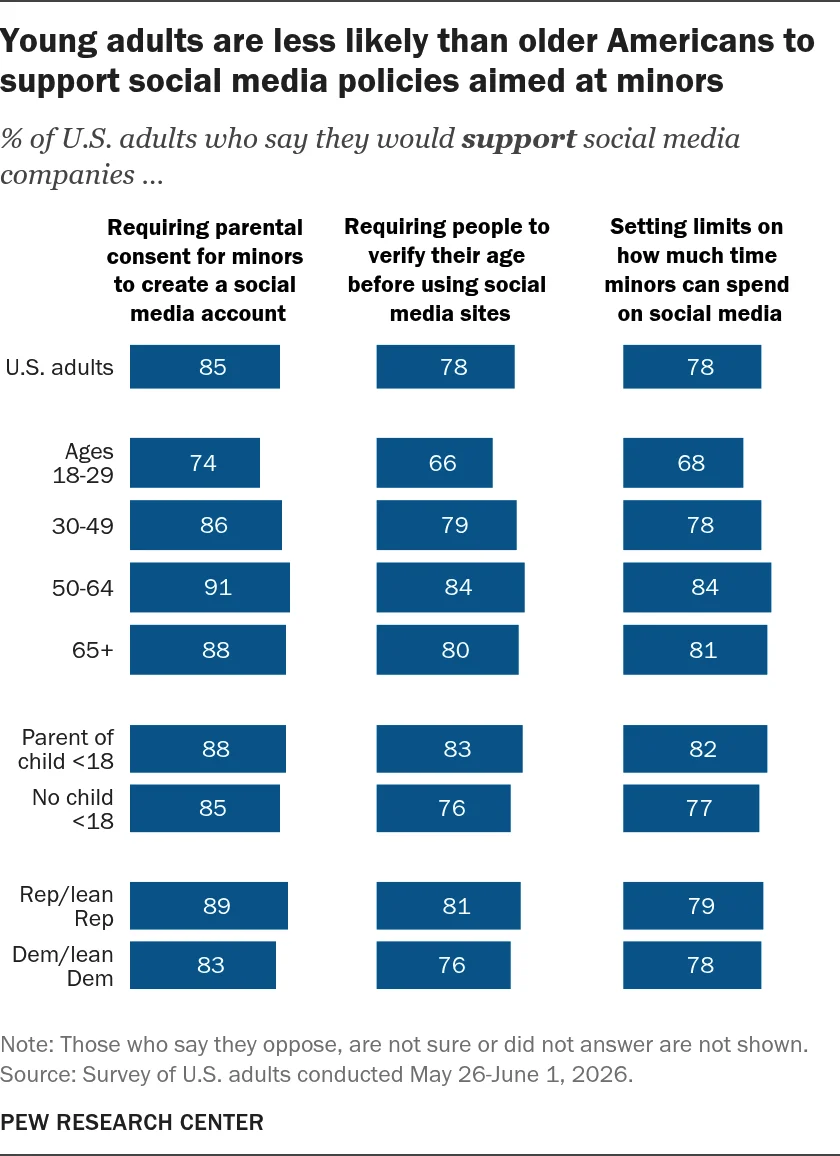
In an era where digital connectivity is ubiquitous, the intersection of childhood development and social media influence has become a focal point of intense public and political debate. A comprehensive new survey from the Pew Research Center, conducted between May 26 and June 1, 2026, reveals that nearly six-in-ten U.S. adults now support a blanket ban on social media access for anyone under the age of 16. This finding underscores a significant shift in public sentiment, reflecting growing anxieties regarding the long-term impact of digital platforms on the mental health and safety of the nation’s youth.
As global governments—ranging from Australia and Canada to the United Kingdom—actively evaluate or implement stringent age-gating policies, the United States finds itself at a crossroads. Legislative bodies, including those in California, are currently debating measures that would mandate age verification and restrict access for minors, signaling a potential departure from the relatively self-regulated landscape of the past two decades.
The State of Public Opinion: A Broad Consensus
The Pew Research Center survey, which sampled 9,750 U.S. adults, provides a granular look at how the American public perceives the role of social media in the lives of children. The data indicates that 56% of adults support a ban on social media for those under 16, while only 21% oppose such a measure. A notable 23% remain unsure, reflecting the complexity of implementing enforcement mechanisms that protect children without infringing upon digital privacy or free speech.

Support for these measures is not limited to specific demographics; rather, it appears to be a broad, cross-partisan issue. While age and parental status do create some variance in the intensity of support, the overall trend is one of widespread agreement that current industry standards are insufficient.
A Chronology of the Digital Safety Debate
To understand the current push for regulation, one must look at the timeline of digital oversight in the United States.
- Early 2000s: The rise of social media platforms was largely met with optimism, focusing on connectivity. The "13-plus" age requirement, largely dictated by the Children’s Online Privacy Protection Act (COPPA), became the industry standard, intended primarily to protect data privacy rather than to limit social interaction.
- 2020–2023: As research into the correlation between social media use and teen mental health challenges—such as anxiety, depression, and body dysmorphia—grew, public concern shifted from data privacy to the psychological well-being of users.
- 2023: Pew Research Center’s previous reporting indicated a strong foundation for parental consent requirements. At that time, 81% of adults favored mandatory parental consent for minors to join platforms.
- 2025–2026: The discourse reached a fever pitch. In late 2025, reports on "Teens, Social Media and AI Chatbots" highlighted the new risks posed by generative AI, further fueling the demand for legislative intervention.
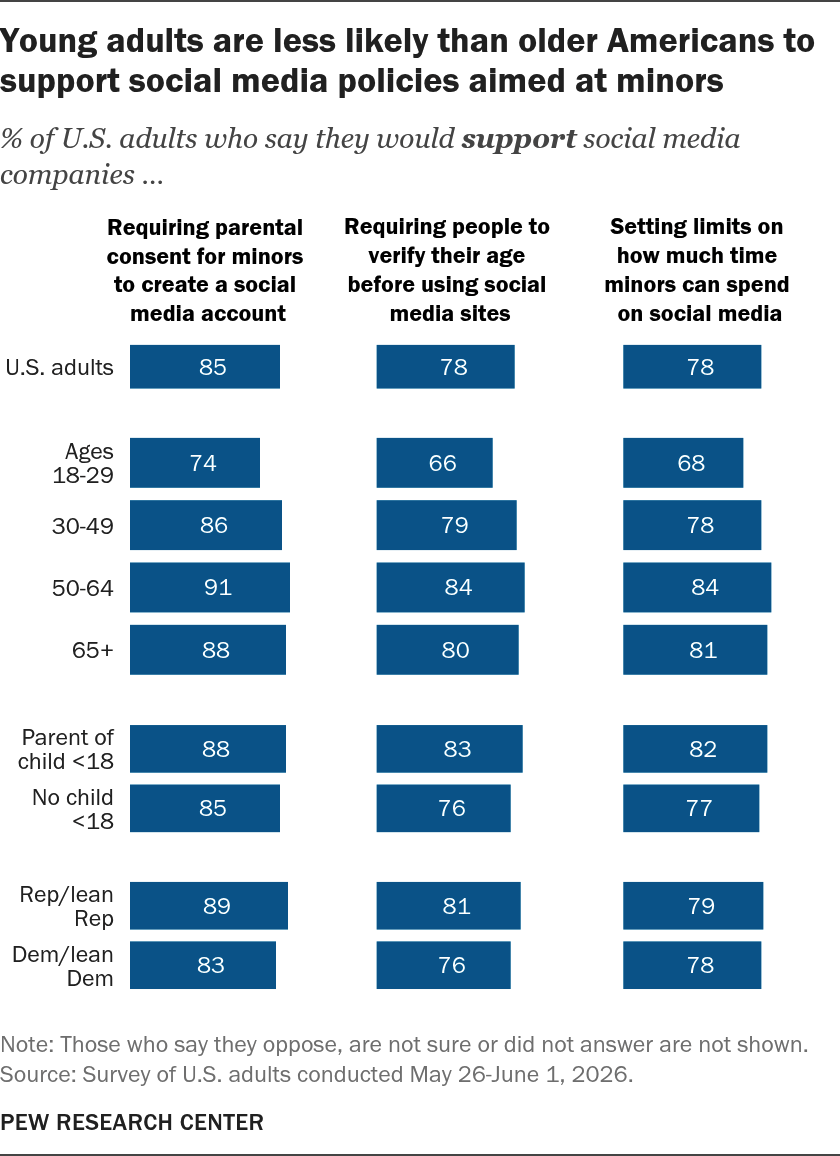
- June 2026: The current survey marks a definitive point in the conversation, showing that support for restrictive measures has grown even since 2023, with support for parental consent rising to 85% and approval for time limits climbing to 78%.
Supporting Data: Why Parents and Voters Want Change
The data provides a clear picture of what Americans want from technology companies. Beyond the proposed under-16 ban, the public is demanding structural changes to how platforms interact with minors.

Escalating Support for Protective Policies
Support for three key protective measures has increased across the board since 2023:
- Parental Consent: Now backed by 85% of adults (up from 81% in 2023), this remains the most popular policy tool.
- Age Verification: Currently supported by 78% of adults, up from 71% in 2023. This reflects a growing public expectation that platforms should proactively ensure users meet minimum age requirements.
- Time Limits: Also at 78%, this represents a significant jump from 69% in 2023, showing that the public is increasingly comfortable with algorithmic interventions designed to curb excessive screen time.
Demographic Nuances
While the consensus is strong, demographic differences persist. Parents of children under 18 are, perhaps unsurprisingly, the most fervent advocates for these restrictions. For instance, 65% of parents support the under-16 ban, compared to 52% of those without children under 18.
Interestingly, age also plays a role in the intensity of support. Adults ages 30 to 49—many of whom are the parents of Generation Alpha and younger members of Gen Z—are the most likely to support the under-16 ban at 63%. Younger adults (18–29) are slightly more skeptical than their older counterparts, likely due to their personal integration with these platforms, yet they still maintain a majority-support stance at 52%.

Official Responses and Political Implications
The political landscape is increasingly responsive to these polling figures. In Washington, lawmakers have held multiple hearings focusing on the "duty of care" that tech platforms owe to their users.
Legislative proposals in California and elsewhere are essentially attempting to codify what the public has been asking for: strict age verification, limitations on addictive algorithms, and enhanced transparency regarding data collection. Critics of such legislation argue that age verification requirements could lead to a massive collection of sensitive identification data, potentially creating more privacy risks than they solve. However, the sheer volume of support across partisan lines suggests that politicians are unlikely to ignore the call for action.
Industry leaders have generally responded with promises of "better tools" and "safety features." Many platforms have rolled out "Teen Accounts" or "Family Centers," which allow parents to set time limits and monitor activity. However, the survey data implies that the American public is no longer satisfied with optional, opt-in safety features; there is a clear preference for mandatory, industry-wide regulations.

Broader Implications: The Future of Digital Childhood
The implications of these findings extend far beyond simple policy debates. They suggest a fundamental shift in the social contract between technology companies and the public.
The End of the "Wild West"
For years, social media companies operated under the assumption that they were neutral platforms, not responsible for the content or the effects of their services on minors. That era is effectively coming to an end. The public’s overwhelming support for age verification and time limits indicates that the "neutral platform" defense is no longer politically or socially viable.
The Role of Technology in Mental Health
The ongoing debate over social media’s impact on the well-being of young people has moved from the clinical realm to the dinner table. As the American public continues to voice its support for restrictions, the onus will increasingly fall on tech companies to innovate in ways that prioritize user health over engagement metrics.
Global Synchronization
The movement in the U.S. is not occurring in a vacuum. As countries like Australia and the U.K. pioneer legislation to restrict social media access for minors, they are setting a global standard. If the U.S. follows suit, it would create a massive, coordinated effort to redefine the digital experience for the next generation.
Conclusion
The data from the Pew Research Center is a clear signal that the status quo is no longer acceptable to a majority of Americans. The rise in support for parental consent, age verification, and time limits, coupled with the widespread desire for an under-16 ban, suggests that the digital environment for children is destined for a radical transformation.
Whether through state-level mandates or federal legislation, the path forward appears to be one of increased oversight. As lawmakers and tech executives navigate this changing landscape, they must balance the public’s urgent desire for safety with the practicalities of a global, interconnected digital economy. One thing remains certain: the days of unrestricted access to social media for young people are under intense scrutiny, and the public is ready for change.

Research for this report was conducted by Jeffrey Gottfried and Monica Anderson, focusing on the intersection of internet technology and public policy. The methodology utilized the American Trends Panel, ensuring the results are representative of the full U.S. adult population.
 Muslim
  Nana Muazin
  Siti Muinah