
 By Evan Lee Salim
Market behavior is undergoing its most radical transformation in decades. For years, brands have obsessed over the "customer journey"—a linear path from awareness to consideration to conversion. However, the rise of artificial intelligence has shattered this linearity. AI is no longer just a tool for content creation or customer service chatbots; it has become an invisible, pervasive middleman in the consumer’s decision-making process.
The fundamental shift is this: AI is not merely reshaping how people discover products; it is fundamentally altering how they decide to purchase them. As of mid-2026, over 60% of consumers are actively using AI to conduct product research, effectively delegating the heavy lifting of comparison, review aggregation, and feature analysis to algorithms. For brands, this means your product is being interpreted, summarized, and surfaced by systems you do not control.
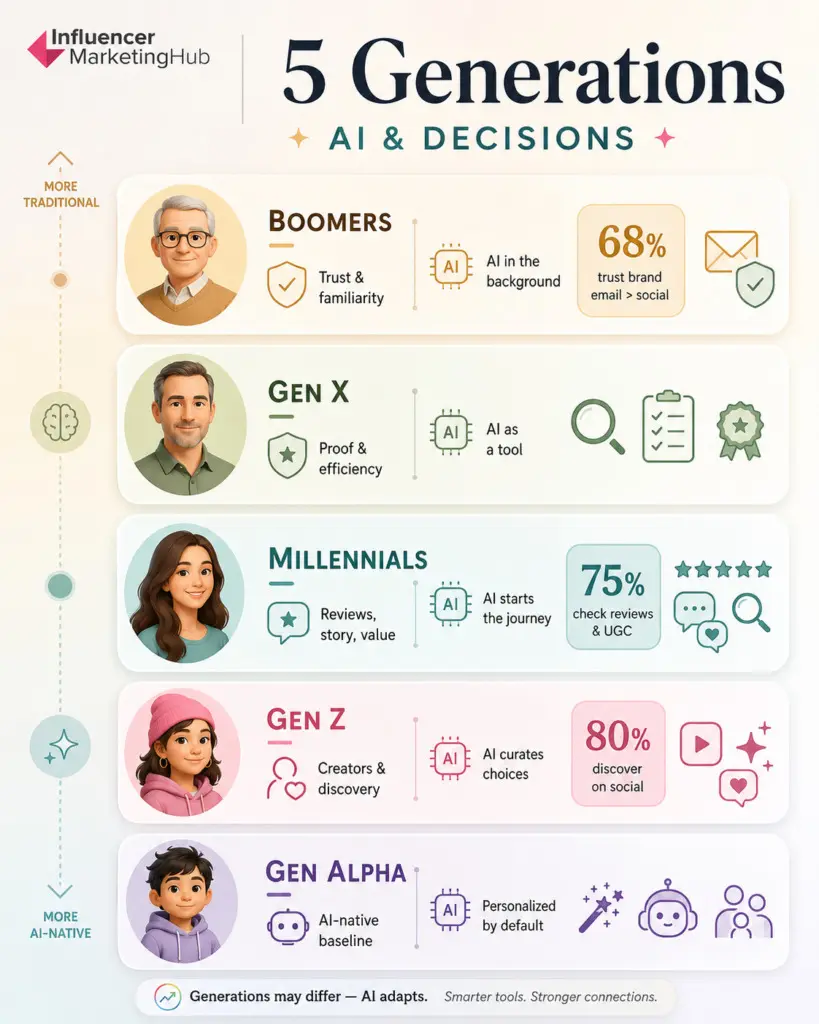
The Five Generations: A Divergent Relationship with AI
While the technology is universal, the relationship with it is deeply generational. Understanding how these cohorts delegate their decision-making to AI is the new baseline for marketing success.
1. Gen Z: The AI-Native Searchers
For Gen Z, the concept of a "search engine" has moved beyond Google. They are increasingly bypassing traditional search entirely, opting for AI-powered discovery within TikTok, Instagram, and Reddit. Data shows that 40% of Gen Z now favor social-search platforms for product discovery. Their reliance on AI is rooted in speed and social validation; they trust an AI-summarized recommendation that factors in real-time user sentiment over a static, SEO-heavy landing page.
2. Millennials: The Efficiency Seekers
Millennials, the "bridge" generation, view AI as a productivity tool. They use AI-powered comparison tools to maximize their time. Whether they are planning a vacation or researching a high-ticket household item, they expect AI to cut through the noise. They are the most likely to use LLMs (Large Language Models) to create side-by-side comparisons of technical specifications, making them highly sensitive to the quality of data provided in AI summaries.
3. Gen X: The Skeptical Validators
Gen X approaches AI with a healthy dose of professional skepticism. They are more likely to use AI for professional research and high-intent purchases where risk mitigation is key. They use AI as a gatekeeper to ensure they aren’t being misled by marketing fluff. For brands, this means Gen X requires "AI-proof" content—detailed, accurate, and transparent documentation that stands up to an AI’s analysis.
4. Baby Boomers: The Assisted Explorers
Boomers are the fastest-growing demographic for AI adoption. They use AI as a digital assistant to simplify complex interfaces. Their reliance on AI is often voice-activated or integrated into smart home devices. For this group, the "AI layer" must be intuitive, accessible, and high-trust.
5. Gen Alpha: The Conversationalists
Though still young, Gen Alpha is interacting with AI in a purely conversational capacity. They do not "search"; they "ask." This generation will likely view AI not as a tool, but as a standard interface for all commerce.
The Mechanics of the New Funnel
The traditional marketing funnel—Top of Funnel (Awareness), Middle (Consideration), and Bottom (Conversion)—has been replaced by a fragmented, multi-screen ecosystem.
The Rise of the "Second Screen" and Beyond
Research indicates that 87% of consumers are using a secondary device while consuming traditional media like television. This creates a "dual-track" decision process. A consumer might see an ad on a Connected TV (CTV) and immediately use a smartphone to ask an AI, "Is this brand actually good?"
If your brand’s digital footprint is not optimized for AI retrieval, you are losing the battle before the customer even lands on your website. This is the "Zero-Click" challenge: if the AI provides the answer in its summary, the user may never visit your site, but they will form a definitive opinion based on the data the AI ingested.
The Search-Social-AI Convergence
The search landscape is no longer siloed. It is a mesh of social proof (TikTok/Reddit), algorithmic discovery (Google/AI), and direct brand engagement. Brands that win in this era are those that realize SEO is no longer just about keywords—it is about Answer Engine Optimization (AEO). You must ensure that the information describing your brand is accurate, compelling, and structured in a way that AI systems can easily ingest and prioritize.
Supporting Data: Why Precision Matters
- The Trust Gap: 75% of consumers express a higher propensity to purchase when offered personalized interactions. AI is now the primary engine for that personalization, yet consumers are wary of "creepy" data usage. Brands must strike a balance between hyper-personalization and data privacy.
- The Power of Experience: Despite the digital shift, 70% of consumers report that in-person or "tangible" experiences significantly increase their purchase intent. The goal is to use AI to bridge the gap between digital discovery and real-world experience.
- The Speed Factor: AI has compressed the decision-making cycle. Consumers can now move from "I wonder if I should buy this" to a final decision in minutes, thanks to AI-generated summaries that consolidate hours of traditional research.
Implications for Modern Brands
The transition to an AI-influenced market has profound implications for how CMOs must allocate budgets and strategy.
1. Move from "Message" to "Context"
Stop asking, "What is our message?" and start asking, "Who are we reaching, how do they decide, and what AI layer is guiding their decision before they even interact with us?" Your content strategy must be designed to inform the AI models that your customers are querying.
2. Prioritize "AI-Readiness"
Your website architecture, product descriptions, and customer reviews must be structured for machine readability. If your brand information is trapped in PDFs or non-indexed formats, you are invisible to the AI assistants that your customers rely on.
3. Invest in First-Party Data
As AI platforms begin to gate access to their own data, your ability to collect and leverage first-party data is your only competitive advantage. Use this data to train your own brand-specific AI agents, providing customers with an "official" version of your brand that is more accurate than third-party AI interpretations.
4. The Human-AI Hybrid Strategy
While AI handles the data and the initial filtering, the "human" element—creativity, empathy, and community building—remains the differentiator. Brands should use AI to handle the "science" of the decision-making process while focusing their human efforts on the "art" of brand loyalty.
Conclusion: The Era of Precision
The fundamental reality of 2026 is that conversion now stems from precision. Understanding your audience is no longer enough; you must understand the AI intermediaries they employ to navigate their world. The brands that will dominate in the coming years are those that treat AI not as a threat to their funnel, but as a critical partner in the decision-making ecosystem.
By showing up accurately, compellingly, and consistently across every AI-assisted touchpoint, brands can transform the "AI layer" from a gatekeeper into an advocate. In this new landscape, the winner is not necessarily the brand with the loudest voice, but the brand with the most relevant, machine-accessible, and trust-worthy presence.
 Iffa Jayyana
  Siti Muinah
  Asro
Asro 