
 By Reynand Wu
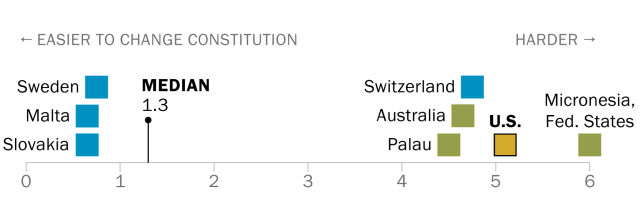
WASHINGTON — Ahead of Constitution Day on September 17, a comprehensive comparative analysis of global governance frameworks has revealed a striking structural reality: despite overwhelming public support for numerous political reforms among Americans—ranging from campaign finance limitations to age and term limits for government officials—the U.S. Constitution stands as the second-hardest foundational charter in the democratic world to amend.
The finding, drawn from an extensive Pew Research Center evaluation of democratic governance models worldwide, highlights a profound tension at the heart of the American political experiment. While citizens increasingly demand systemic updates to address modern political realities, the institutional architecture designed by the Framers 237 years ago intentionally places formidable roadblocks in the path of change.
Main Facts: The Anatomy of Constitutional Rigidity
At its core, the difficulty of altering a nation’s foundational law dictates how easily a democracy can adapt to shifting cultural, technological, and economic landscapes. In the United States, the legal hurdles required to modify the document are notoriously high.
Under Article V of the U.S. Constitution, amendments must clear a two-tiered hurdle:
- Legislative Approval: Proposed amendments must win a two-thirds supermajority vote in both the U.S. House of Representatives and the Senate.
- State Ratification: They must then be ratified by three-fourths of the state legislatures—amounting to 38 out of 50 states—or through specially convened state ratifying conventions.
This high bar explains why, over more than two centuries, the document has been successfully amended just 27 times, with the last successful change—the 27th Amendment regarding congressional pay raises—taking effect in 1992, though it was originally proposed in 1789.
To measure how the U.S. stacks up globally, researchers utilized a classic classification scheme developed by the late political scientist Donald S. Lutz in his seminal 1994 American Political Science Review study, "Toward a Theory of Constitutional Amendment." Lutz’s scoring system evaluates the procedural steps, legislative thresholds, voter referendums, and sub-national approvals required by a nation’s charter.
Out of 106 countries classified as democracies in the Pew dataset, 101 possess codified constitutions with explicit amendment rules (while five rely on uncodified systems spread across statutes, legal precedents, and unwritten norms). When analyzing the "least difficult" legal pathway specified in each codified charter, the United States scores a rigid 5.10 on the amendment difficulty index.

Only one democracy in the world maintains a higher barrier to constitutional change: the Federated States of Micronesia (FSM), which posted a staggering difficulty score of 6.00.
Chronology: From the Philadelphia Convention to Modern Global Benchmarks
Understanding the current rigidity of the U.S. charter requires looking back at its drafting and the historical evolution of constitutional design across the globe.
- May–September 1787: Delegates gather at the Constitutional Convention in Philadelphia, crafting a charter explicitly designed to avoid the whims of transient majorities. Recognizing the dangers of both stagnation and instability, they forge Article V to make changes possible yet deliberately deliberative.
- December 1791: The Bill of Rights—the first 10 amendments—is ratified simultaneously, establishing fundamental liberties that set a high watermark for American civic identity.
- 1865–1870 (The Reconstruction Era): Following the Civil War, the 13th, 14th, and 15th Amendments are rushed through under extraordinary historical duress, fundamentally rewriting citizenship, voting rights, and federal authority. This remains the most concentrated burst of structural alteration in U.S. history outside of the Bill of Rights.
- June 1994: Political scientist Donald S. Lutz publishes his influential framework in the American Political Science Review, providing scholars with a mathematical model to quantify and compare constitutional amendment thresholds across sovereign states.
- July–September 2026: Pew Research Center releases a sweeping multi-part analysis examining how American-style democracy stands out globally. The specific constitutional amendment findings are published ahead of Constitution Day, providing empirical context to ongoing domestic debates over political reform.
Supporting Data: Where the World Ranks
The global ranking of constitutional amendment difficulty shatters the assumption that major democracies operate under similar rules of legal evolution. Federal systems that require dual-level consent—securing majorities at both the national legislature and regional state or cantonal levels—dominate the upper tiers of amendment difficulty.
The Hardest National Constitutions to Amend (Top Tiers)
- Federated States of Micronesia: 6.00 (Requires dual two-thirds legislative votes, presidential approval, and three-quarters voter approval across at least three of four states)
- United States: 5.10 (Two-thirds congressional supermajority + three-fourths state legislature ratification)
- Switzerland: 4.75 (National legislative approval combined with mandatory nationwide referendums requiring a double majority of citizens and cantons)
- Australia: 4.65 (Parliamentary approval + nationwide referendum requiring a majority of voters overall and a majority of voters in a majority of states)
- Palau: 4.50
Other nations featuring rigorous amendment pathways include Fiji (3.80), Costa Rica (3.65), Liberia (3.60), and Romania (3.35).
The Easiest National Constitutions to Amend
At the opposite end of the spectrum lie countries—often featuring unicameral (single-chamber) parliaments—where constitutional alterations can be passed much like ordinary legislation, provided they meet a designated legislative majority threshold.
- Slovakia & Malta: 0.65 (Among the most flexible codified democratic frameworks)
- Sweden: 0.75
- Norway, Austria, Portugal, and Hungary: 0.80
- France: 0.90
Notably, large regional democracies display vastly different internal approaches. While the U.S. sits near the absolute apex of rigidity, Brazil maintains a much more flexible framework with an amendment difficulty score of just 0.90, allowing its post-1988 democratic constitution to be updated with relative frequency to address governance challenges.
Official Responses and Expert Perspectives
Legal scholars, political scientists, and institutional reformers have long debated the merits and drawbacks of constitutional entrenchment.
Proponents of a rigid constitution argue that high barriers protect minority rights from the tyranny of shifting electoral majorities. By forcing broad consensus across geographic, demographic, and partisan lines, the U.S. framework ensures that foundational changes reflect deep, enduring national agreement rather than momentary partisan victories.
However, critics and reform advocates point out that structural rigidity creates a dangerous institutional bottleneck. When public opinion shifts decisively on structural issues—such as campaign finance reform, judicial ethics, or congressional term limits—the near-impossibility of amending the Constitution can breed profound public cynicism toward democratic institutions.
"When a political system experiences severe partisan polarization alongside an amendment mechanism that requires near-consensus, institutional paralysis is almost guaranteed," notes governance literature examining the Pew findings. "Citizens are left demanding reforms that the founding document makes functionally unattainable through standard legal channels."
Furthermore, comparative law experts emphasize that federal systems inherently struggle with amendment inertia. Requiring sub-national units (such as U.S. states or Swiss cantons) to weigh in gives small geographical minorities outsized veto power over national modernization efforts.
Implications: Navigating Stagnation in a Polarized Era
The implications of the U.S. Constitution’s high amendment barrier extend far beyond academic theory, directly shaping the daily reality of American governance and political discourse.
- Shift to Judicial Interpretation: Because formal constitutional amendments are so rare, the burden of modernizing the nation’s laws falls disproportionately on the federal judiciary. Changes in societal norms, technology, and civil rights are frequently negotiated through Supreme Court interpretations rather than explicit constitutional text, heightening the political stakes of judicial appointments.
- Reliance on Sub-Constitutional Workarounds: Frustrated by federal gridlock, policymakers increasingly turn to state-level ballot initiatives, executive orders, and sub-statutory regulations to enact systemic changes. This patchwork approach often deepens interstate legal fragmentation.
- Deepening Civic Frustration: Pew Research Center surveys consistently demonstrate that large majorities of Americans favor structural updates to their political system. The stark reality that their Constitution is the second-hardest in the democratic world to change helps explain why systemic reform feels perpetually out of reach, fueling populist discontent and institutional alienation.
As the nation marks Constitution Day, the data serves as both a celebration of an enduring framework and a sobering reminder of its inflexibility. In an era defined by rapid global transformation, the U.S. experiment faces a historic test: whether a 237-year-old framework engineered for an 18th-century agrarian republic can successfully manage the complexities of a modern, interconnected world without the safety valve of constitutional adaptability.
 Pevita Pearce
  Basiran