
 By Asro
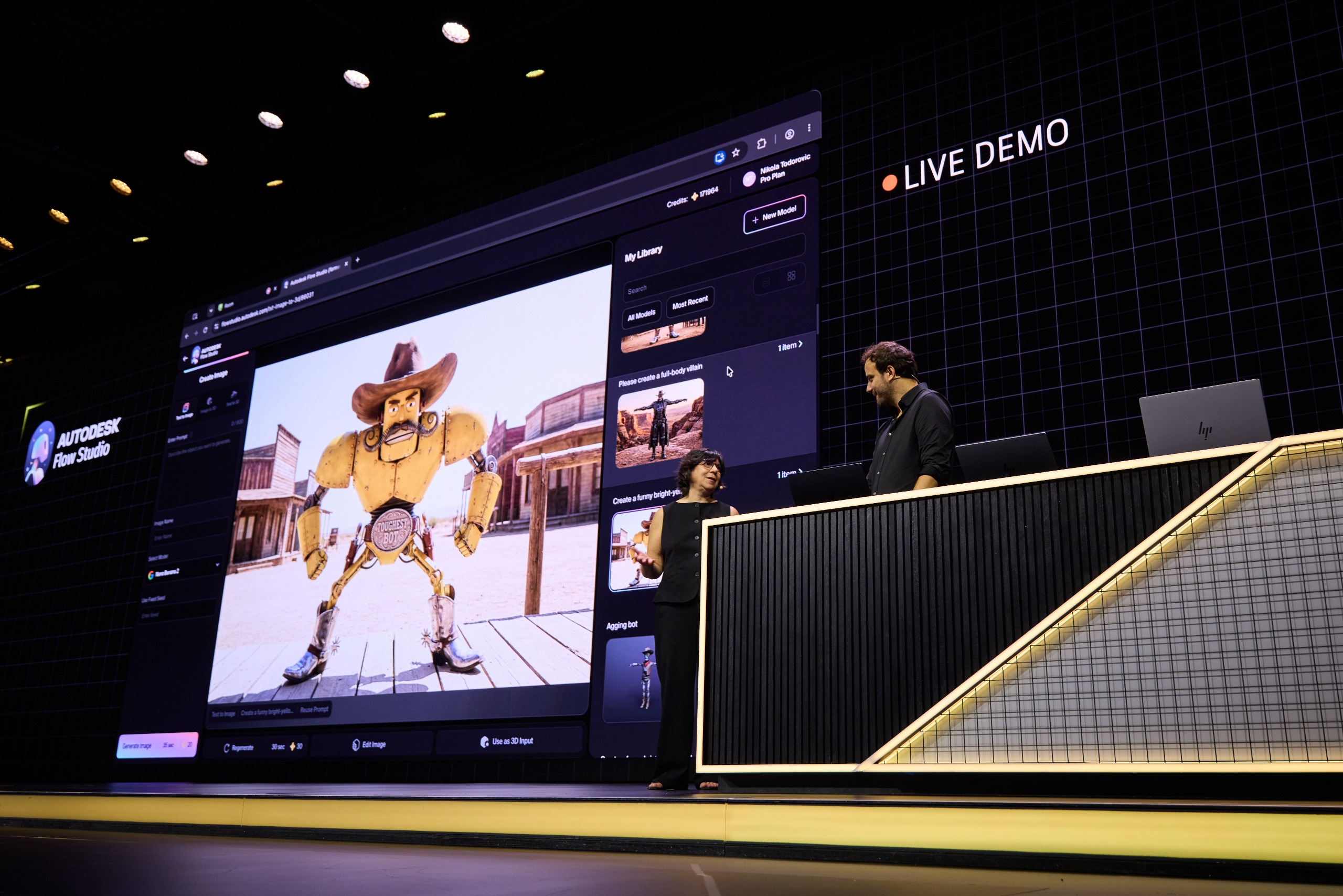
At Autodesk University 2026 (AU26) in Las Vegas, the tech giant unveiled a short film that captured the industry’s imagination—and its frustrations. Titled Robots of the Wild West, the demo was intended to showcase the potential of generative AI in professional animation workflows. However, in a refreshing display of transparency, Maurice Patel, Autodesk’s VP of Media & Entertainment (M&E) Industry Strategy, pointed out a glaring continuity error during the screening: a character sits down next to another at a table, only to be seen sitting across the corner from her just one shot later.
For many, this might be a reason to hide the demo. For Autodesk, it was a centerpiece for a deeper conversation about the current state of AI. As the industry grapples with the transition from traditional CGI to AI-assisted workflows, Robots of the Wild West stands as a testament to the fact that while AI is an incredible engine for creativity, it remains, in its current form, a tool that requires a human hand on the steering wheel.
The Reality of "Shots" vs. "Worlds"
To understand why the character moved seats, one must understand how Autodesk classifies AI progress. Patel breaks the technology down into three categories: tasks, shots, and worlds.
"AI is great at serendipitous content and is terrible at directed content," Patel explains. In this taxonomy, a "task" is something like MotionMaker, an AI tool integrated into Maya that handles specific locomotion for humans, dogs, or horses. It is highly specialized, trained to do one thing well. A "shot"—where Robots of the Wild West resides—is the domain of generative video. It is currently the most volatile frontier.
The "holy grail" remains the "world"—a persistent environment that understands physics and maintains continuity. "The idea of prompting a whole movie is a myth," says Patel. Current generative models lack the object permanence required for long-form narrative consistency. If you run the same prompt twice, you get different results. If you try to fix a character’s position, you might inadvertently alter their costume or the lighting. When a model gets "stuck" in a creative loop, the only way forward is often to restart from scratch.

Orchestration Over Automation
Autodesk’s philosophy at AU26 has been clear: AI should empower the artist, not replace the studio. This is why the company is pushing Flow Studio and its 3D Editor + Canvas feature. Instead of asking a single AI model to "generate a Western film," Autodesk’s approach is to provide a platform for orchestration.
By blocking cameras, characters, and performances in 3D before the AI is invoked, creators can exert control over the final output. This hybrid approach—mixing traditional CG, real footage, and generative AI—is where Patel sees the future. "We fundamentally believe that the future of AI is orchestration," he notes, offering a subtle critique of competitors who promise a "one model to rule them all" solution.
Chronology of a Creative Shift
The evolution of digital art has always been marked by periods of disruption. Patel, who began his career training artists on digital compositing tools like Avid, draws a direct line between the rise of digital tools in the 90s and the AI revolution of today.
- The Early Days (1990s): Digital compositing replaced traditional optical workflows. At the time, it was seen as a threat to "real" film craft. Instead, it turned a niche cottage industry into a massive global sector.
- The VFX Boom (2000s–2020s): Visual effects became the backbone of modern cinema. However, the cost of production skyrocketed, with some blockbusters now costing upward of $200 million.
- The AI Integration (2026 and beyond): Autodesk is positioning its tools to lower the barrier to entry, hoping to combat the "sequel and reboot" culture driven by high production costs.
Patel argues that the current high costs of AAA games and films force studios to take fewer risks. By utilizing AI for efficiency, he hopes studios can pivot back to mid-budget, high-concept storytelling—the kind seen in A24 or Blumhouse hits like Backrooms or Obsession.
The "AI Slop" Problem and the Cost of Innovation
While the promise of AI is high, the cost is equally tangible. Patel is skeptical of the "miracle" low-budget AI films, such as the widely discussed Dreams of Violets. While the project was touted as being made for $2,000, Patel suspects this figure ignores the massive, hidden costs of compute and the fact that the director, Ash Koosha, is an AI engineer who likely utilized his own resources.

"If you don’t care about the content, you get AI slop, essentially," Patel warns. The industry is currently witnessing a trend where companies produce AI-generated ads—such as the controversial Coca-Cola holiday spot—that are riddled with errors. While these errors might generate social media "buzz," they represent a failure in professional standards. In the past, a VFX vendor would have rejected such work; today, the novelty of the AI medium is often used to mask its shortcomings.
The Human Element: Why Bugs Bunny Cannot Be Prompted
Perhaps the most poignant moment of the discussion at AU26 was Patel’s reflection on the role of the animator. "The art of an animator isn’t knowing how to use animation curves," he said. "The art of an animator is understanding how to make the performance shine."
This is the core of the Autodesk defense. A model can be trained on a million rabbits, but it will never generate the nuance of Bugs Bunny. That requires human imagination, timing, and intent. The "Robots of the Wild West" demo, with its continuity errors, was not a failure of the tech, but a demonstration of the current limit of machine intelligence.
Implications for the Future of Filmmaking
The implications of this shift are profound:
- Democratization vs. Quality: Lower costs will allow more creators to enter the field. However, the industry will need to establish new standards for what constitutes "finished" work.
- The Rise of the Orchestrator: The role of the "Animator" or "VFX Artist" is evolving into that of an "Orchestrator," someone who manages multiple AI agents and traditional tools to create a cohesive whole.
- Experimentalism: If AI can handle the "heavy lifting" of rendering and basic locomotion, artists can reclaim time for experimentation. This could lead to a new golden age of independent cinema where visual complexity is no longer tied strictly to budget.
A "Newbie" in a New Era
When asked how he feels about the rapid pace of change, Patel is refreshingly honest. "It’s a love-hate thing," he admits. "I was the CG expert once. Now, I’m a newbie."
This humility is perhaps the most important takeaway from Autodesk’s position. By acknowledging that they are "so early in the AI journey," Autodesk is positioning itself as a partner in the struggle rather than a vendor of a magic button. The industry is moving toward a future where the "happy accident"—like the robot who moved seats at a table—is no longer a sign of failure, but a starting point for a deeper, more human-driven creative process.
The goal for the next decade, according to Patel, is not to create a machine that can dream, but to create a machine that can help humans realize their own dreams more efficiently. The "Robots of the Wild West" might have a few bugs, but it proves one thing definitively: the artist is still the most essential component in the rendering pipeline.
 rifanmuazin
  Reynand Wu
  Muslim