
 By Sagoh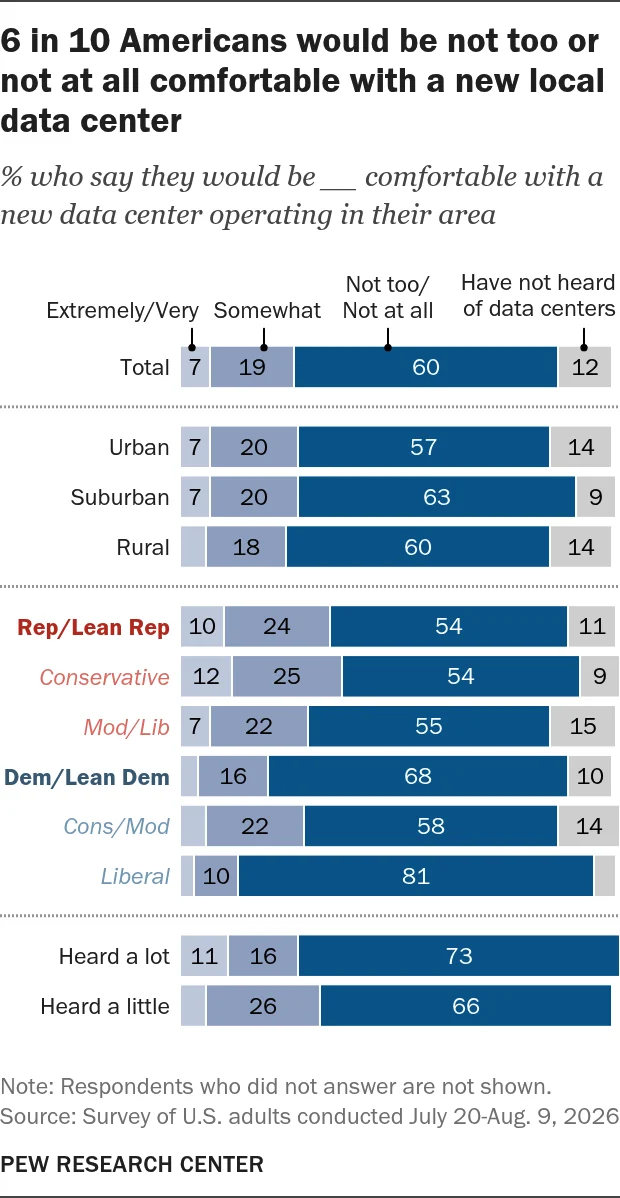
WASHINGTON — Public sentiment toward the sprawling infrastructure underpinning the artificial intelligence revolution has soured significantly over the past several months. According to a comprehensive new survey released by the Pew Research Center, Americans are expressing mounting alarm over the environmental and economic toll of data centers, with a decisive majority indicating they would feel uncomfortable if such a facility were built in their backyards.
The findings, derived from a nationally representative survey of 10,548 U.S. adults conducted between July 20 and August 9, arrive amid a wave of grassroots protests, localized zoning battles, and sudden legislative pushback. As tech giants race to secure the immense computing power required to train and run complex AI models, the communities designated to host these facilities are increasingly pushing back, forcing a high-stakes reckoning between digital innovation and local quality of life.
Main Facts: A Shift Toward Broad Skepticism
The data reveals a dramatic hardening of public opinion across nearly every measured category since the beginning of the year.
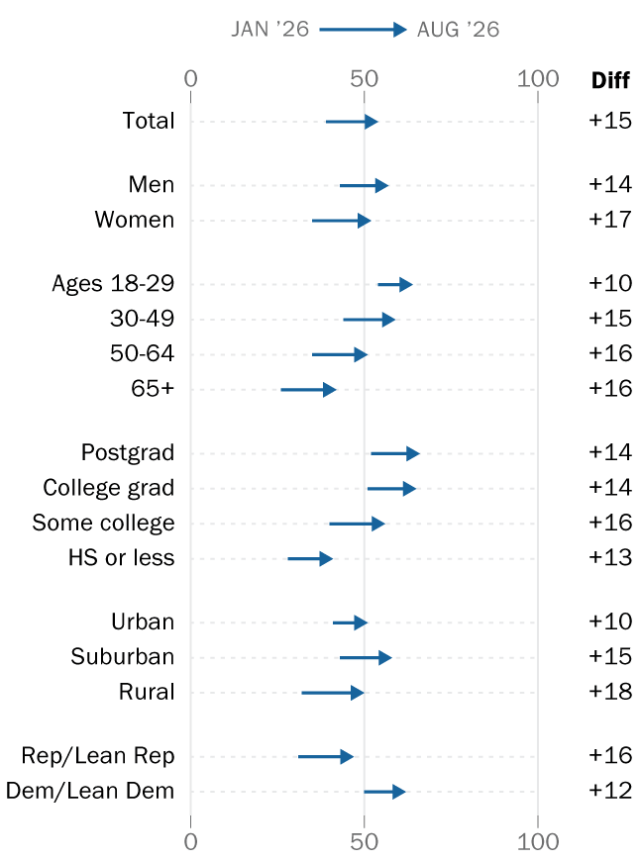
- Environmental Concerns Lead the Charge: More than half of all U.S. adults (54%) now view data centers as "mostly bad" for the environment, a steep climb from 39% in January.
- Fears Over Utility Bills: Half of Americans (50%) believe data centers are mostly bad for home energy costs, up from 38% earlier in the year. Given that these massive server farms consume vast quantities of electricity—often straining local power grids—concerns over rising residential utility bills have struck a chord with consumers.
- Quality of Life: Nearly half of the population (49%) says these facilities have a mostly negative impact on the quality of life for nearby residents, a significant jump from 30% in January.
- Local Discomfort: Overall, 60% of Americans report they would be "not too" or "not at all" comfortable with a new data center operating in their local area. By contrast, only 7% would be extremely or very comfortable, while 19% express moderate comfort.
Despite the heavy emphasis on potential drawbacks, views regarding local economic benefits remain somewhat divided. Roughly equal shares of the public—between 21% and 24%—view data centers as either mostly good or mostly bad for local jobs and tax revenues. However, negative sentiment in these areas has also crept upward, with those viewing the facilities as detrimental to local employment rising from 15% to 24%, and tax revenue concerns ticking up from 12% to 21%.

Chronology of a Techlash: How Public Perception Shifted in 2026
The rapid souring of public opinion does not occur in a vacuum; it is the product of an escalating collision between rapid technological deployment and local reality over the course of the year.
- January 2026: Pew Research establishes baseline data indicating early apprehension. At this stage, while awareness is moderate (with 25% having heard "a lot" about data centers), anxiety regarding environmental impacts is already visible, though confined largely to specific demographic and regional cohorts.
- Spring 2026: Local opposition gains momentum. Reports emerge detailing how rural electric co-ops and municipal utility boards are struggling to balance the sudden, massive power demands of incoming server farms with the needs of residential ratepayers.
- Summer 2026 (July 20 – August 9): Pew conducts its follow-up survey, capturing a widespread hardening of negative attitudes. During this window, grassroots pushback intensifies nationwide, turning data center proposals into fierce battlegrounds in municipal council meetings.
- Late August 2026: State-level interventions materialize. Following months of local unrest, political leaders begin altering their stances. Texas Governor Greg Abbott issues a statewide moratorium on new data center connections in August, while political leaders in other states move to reevaluate or suspend lucrative tax incentive packages.
Supporting Data: Demographic and Partisan Deep-Dive
The Pew survey highlights that negative views are not isolated to a single political party or geographic type, though distinct patterns emerge across demographics.
The Rural-Urban Divide
While data centers are increasingly slated for rural communities—where vast tracts of cheap land and access to transmission lines make them attractive to developers—rural residents are increasingly wary. The share of rural Americans who view data centers as harmful to the environment jumped from 32% in January to 50% in August. Similar spikes occurred regarding home energy costs (up to 46%) and local quality of life (up to 45%).
Urban and suburban residents harbor similar or even higher levels of apprehension, with 58% of suburbanites and 51% of urban dwellers citing environmental concerns.

Partisan Dynamics
While a partisan gap persists, skepticism has grown across the political spectrum.
- Democrats and Leaners: Consistently more critical, 62% of Democrats view data centers as environmentally harmful (up from 50% in January), and 68% would feel uncomfortable with a facility in their area. Liberal Democrats are particularly opposed, with 81% expressing local discomfort.
- Republicans and Leaners: While traditionally more favorable toward commercial and industrial development, GOP sentiment has shifted noticeably. The percentage of Republicans who view data centers as detrimental to local quality of life nearly doubled, jumping from 24% in January to 42% in August. Overall, 54% of Republicans say they would be uncomfortable hosting a local facility.
Familiarity Breeds Contempt
Awareness of data centers has surged alongside the negative sentiment. Roughly nine-in-ten Americans (88%) have now heard at least a little about data centers, up from 75% in January. Those who report hearing "a lot" about the facilities jumped from 25% to 35%. Notably, familiarity appears to correlate with skepticism: among Americans who have heard "a lot" about data centers, 73% view them as bad for the environment, and an identical 73% would be uncomfortable having one in their area.
Official Responses and Political Friction
The growing public backlash has placed elected officials in a delicate balancing act, pitting the national imperative for AI dominance against the immediate grievances of local constituents.
On the federal level, the executive branch has remained staunchly pro-infrastructure. President Donald Trump has consistently championed data center expansion as vital for maintaining American technological supremacy and fueling economic growth during his second term. Administration officials argue that slowing down digital infrastructure development would hand a strategic advantage to foreign competitors in the global race for artificial intelligence supremacy.
Conversely, state and local leaders—facing direct pressure from constituents—are increasingly charting an independent course.
- Texas: Governor Greg Abbott shocked the tech industry in August by issuing a statewide moratorium on new data center approvals, citing grid reliability and water usage concerns.
- Pennsylvania and Illinois: Governors Josh Shapiro (D-PA) and JB Pritzker (D-IL) have both recently shifted toward tighter regulatory oversight. Pritzker notably moved to suspend certain tax breaks for data center developments, demanding a deeper public dialogue regarding resource allocation before further expansion.
- Local Municipalities: Across the country, local zoning boards are seeing an unprecedented influx of contested hearings, with residents citing noise pollution from industrial cooling fans, massive water consumption, and the aesthetic degradation of rural and suburban landscapes.
Implications: The Crossroads of the AI Era
The Pew Research Center findings underscore a profound structural challenge for the technology sector: the physical footprint of the digital economy is finally hitting home. For years, cloud computing and AI were viewed by the general public as abstract, frictionless entities existing primarily "in the cloud." The physical reality—massive windowless warehouses humming with thousands of servers, drawing the electrical equivalent of small cities, and requiring millions of gallons of water for cooling—is shattering that illusion.
If the current trajectory of public sentiment holds, tech companies and policymakers will face formidable hurdles. The friction between national technological ambition and grassroots environmentalism threatens to slow development pipelines, drive up operational costs, and entrench regulatory hurdles at the state and local levels.
For industry leaders, the mandate moving forward is clear: technological innovation can no longer outpace community relations. Without proactive investments in grid modernization, renewable energy integration, and transparent local engagement, the backlash documented by Pew suggests that the future of the AI revolution may face an increasingly hostile domestic landscape.
 Dwi Wanna
  Basiran
  Suro Senen