
 By Sagoh
Main Facts
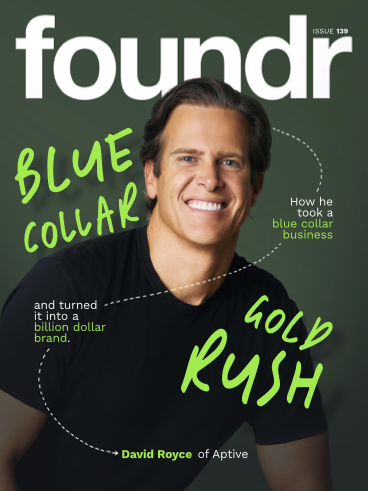
In the modern landscape of high-stakes entrepreneurship, conventional wisdom dictates that the path to a billion-dollar valuation runs through Silicon Valley software, disruptive fintech platforms, or biotech innovations. David Royce shattered that blueprint entirely. As the founder and chairman of Aptive Environmental—currently the third-largest residential pest control service in North America—Royce built his fortune in an unglamorous, blue-collar industry that most finance graduates wouldn’t touch with a ten-foot pole.
Royce’s business philosophy cuts against the grain of modern startup culture. He posits that sustainable success is not dictated by the prestige of an industry, the pedigree of a university degree, or whether an opportunity looks impressive on paper. Instead, it relies on a singular, grueling principle: a willingness to execute tasks that others actively avoid, maintaining that momentum long enough to achieve absolute mastery.
Over a career spanning more than two decades, Royce has engineered four multi-million and billion-dollar enterprises. His track record includes three lucrative exits of varying scales to the same strategic buyer, culminating in Aptive, a titan that scaled to over $500 million in annual revenue. In a candid interview with Foundr CEO Nathan Chan, Royce detailed the winding, often counterintuitive journey from an academically insecure child to one of America’s most stealthy and successful wealth builders.
Chronology: From Struggling Student to Pest Control Mogul
Early Struggles and the Catalyst for Focus
Long before commanding a half-billion-dollar enterprise, David Royce struggled profoundly with traditional academics. Unable to focus unless emotionally invested in a subject, he grew up believing he lacked intelligence—a common symptom of undiagnosed adult ADHD.
The turning point arrived in the sixth grade. A teacher named Mrs. Luft looked past his academic hurdles and believed in him before he could believe in himself. Propelled by this newfound validation, Royce drove himself to achieve top marks. Looking back, he recognizes his ADHD as a powerful double-edged sword: debilitating in monotonous environments, yet serving as an absolute superpower when applied to high-stakes, engaging pursuits like sales and entrepreneurship.

The Door-to-Door Crucible
Royce entered the pest control industry purely by accident during his college years. Hearing that a friend had cleared $25,000 selling pest control services door-to-door over a single summer, Royce drove to Sacramento to try his hand at the trade.
The reality was punishing. Operating on a commission-only structure, Royce failed to make a single sale during his entire first week. While his teammates effortlessly closed deals, Royce walked away empty-handed day after day. Rather than packing his bags, Royce leveraged his stubbornness. He spent the weekend at a bookstore, bought half a dozen sales guides, and dedicated 90 minutes every day to studying the craft. By the end of the summer, he emerged as the top sales rookie among 200 representatives, grossing an extraordinary $225,000—equivalent to roughly half a million dollars today.
Transitioning from Employee to Founder
Armed with a finance degree and substantial savings earmarked for an MBA, Royce initially planned a career in investment banking. However, a pivotal conversation with his boss—who had just sold his own pest control startup to Terminix for $10 million—altered his trajectory. His mentor urged him to bypass 80-hour workweeks as an investment banking analyst and launch his own venture instead.
Overcoming initial vanity—the juvenile notion that success required a skyline view and a formal corporate suit—Royce swallowed his ego. He took $300,000 saved from his college summers, gathered operational pain points from his former boss, and founded his first venture.
Near Bankruptcy and Scaling Pains
Year one in Los Angeles brought a near-fatal business lesson. While the company achieved hyper-growth—securing 7,500 new customers in a single year, far surpassing the projected 4,000 to 5,000—it nearly drove the enterprise into bankruptcy.

The underlying business model required Royce to pay upfront sales commissions long before recurring subscription revenues trickled in. Facing a critical cash crunch, Royce had to personally appeal to his top sales leaders, offering an extra 10% interest in exchange for delaying their bonus checks by a couple of months. The crisis cemented a lifelong mantra: Revenues are vanity, profits are sanity, but cash flow is reality.
Serial Exits and the Asset Deal Masterclass
Rather than locking himself into traditional corporate scaling, Royce mastered the art of the asset deal. Across his first three companies, he sold exclusively the customer base and the service technicians to a single strategic buyer. Crucially, he retained his core leadership team, operational managers, and high-performing sales force.
With this intact "golden goose" and fresh capital, Royce systematically launched subsequent companies in new markets, entirely bypassing outside investors and equity dilution.
Supporting Data and Strategic Pillars
Royce’s meteoric rise was fueled by deliberate operational mechanics that set his companies apart from the estimated 20,000 other pest control competitors in North America.
- The Sales Training Engine: Royce codified his field experience into three fundamental pillars:
- Option Closes: Moving away from yes-or-no questions to presumptive alternatives (e.g., "Will Tuesday at three or five work better?").
- RAC (Resolve, Ace, Close): Overcoming customer hesitation by isolating doubts, introducing an unexpected value proposition, and closing from a new angle.
- Body Language Mastery: Teaching reps that physical posture and confidence dictate conversion rates far more than scripts.
- Early Tech Adoption: Seventeen years ago, long before it was standard practice for blue-collar services, Royce integrated proprietary software and mobile applications to gamify sales. Nation-wide sales tournaments consistently boosted representative productivity by up to 30%.
- Unsexy Margins: Pointing to The Wall Street Journal, Royce notes that roughly 43% of the top 0.1% of U.S. income earners ($2.3M+ annually) built their fortunes in boring, blue-collar industries. These essential service models feature high recurring revenues that remain largely insulated from economic downturns.
Official Responses and Cultural Philosophy
Beyond sales mechanics, Royce pioneered a radical corporate culture rooted in employee ownership and high-impact experiential rewards.

Inspired by Tony Hsieh’s Delivering Happiness, Royce recognized that culture must be intentionally designed rather than treated as an afterthought. Aptive’s headquarters featured an NCAA basketball court, golf simulators, and game rooms, while company retreats took employees skydiving, swimming with sharks, and racing Ferraris.
However, Royce maintains that perks are merely "sugar, not protein." The true anchor of retention was twofold: elite training and broad-based equity sharing.
"We had over $500 million in annual revenue, and companies in my industry sell between one and three times revenue. So we gave away a nine-digit number to our team members at the exit… Many received six- or seven-digit figures. Lots of our team members paid off their mortgages and student loans. Another bought his parents a brand-new car. Turns out ownership is a far better retention tool than ping-pong tables."
The Cost of Stepping Back
In later years, Royce faced the ultimate test of leadership: stepping down as CEO and learning to let go. He handed the reins to a trusted protégé whom he had spent a decade mentoring. However, a subsequent executive hire—a Chief Financial Officer sourced from a billion-dollar tech company—brought a painful lesson. Unaccustomed to the granular expense structure of a home-services enterprise, the CFO’s oversight contributed to missed financial forecasts precisely as Aptive initiated a major sale process valued between $1 billion and $1.6 billion. The forecasting errors caused potential buyers to walk away.
Reflecting on the misstep, Royce noted: "Resumes don’t run companies. People do. Never miss your forecast while running a sale process. Buyers hate it, and it hands them leverage in the negotiation."
Implications
David Royce’s trajectory offers a profound blueprint for contemporary entrepreneurs navigating an economy increasingly saturated by digital noise and artificial intelligence.
As AI automation rapidly takes over white-collar administrative tasks, legal analysis, and software coding, Royce emphasizes the enduring value of physical, essential labor. "AI can write code, but it’s not unclogging your toilet anytime soon. It can’t climb on your roof. And it definitely can’t treat the termites in your walls."
Ultimately, Royce argues that the true reward of entrepreneurship transcends financial exits or multi-million dollar valuations. Echoing Mahatma Gandhi’s philosophy on leadership, his lasting legacy is measured not by personal accolades, but by the leaders forged along the way. For founders willing to swallow their pride, embrace unglamorous markets, and master the art of execution, the most lucrative opportunities are often those hidden in plain sight.
 Evan Lee Salim
  Basiran
  Suro Senen