
 By Lina Hope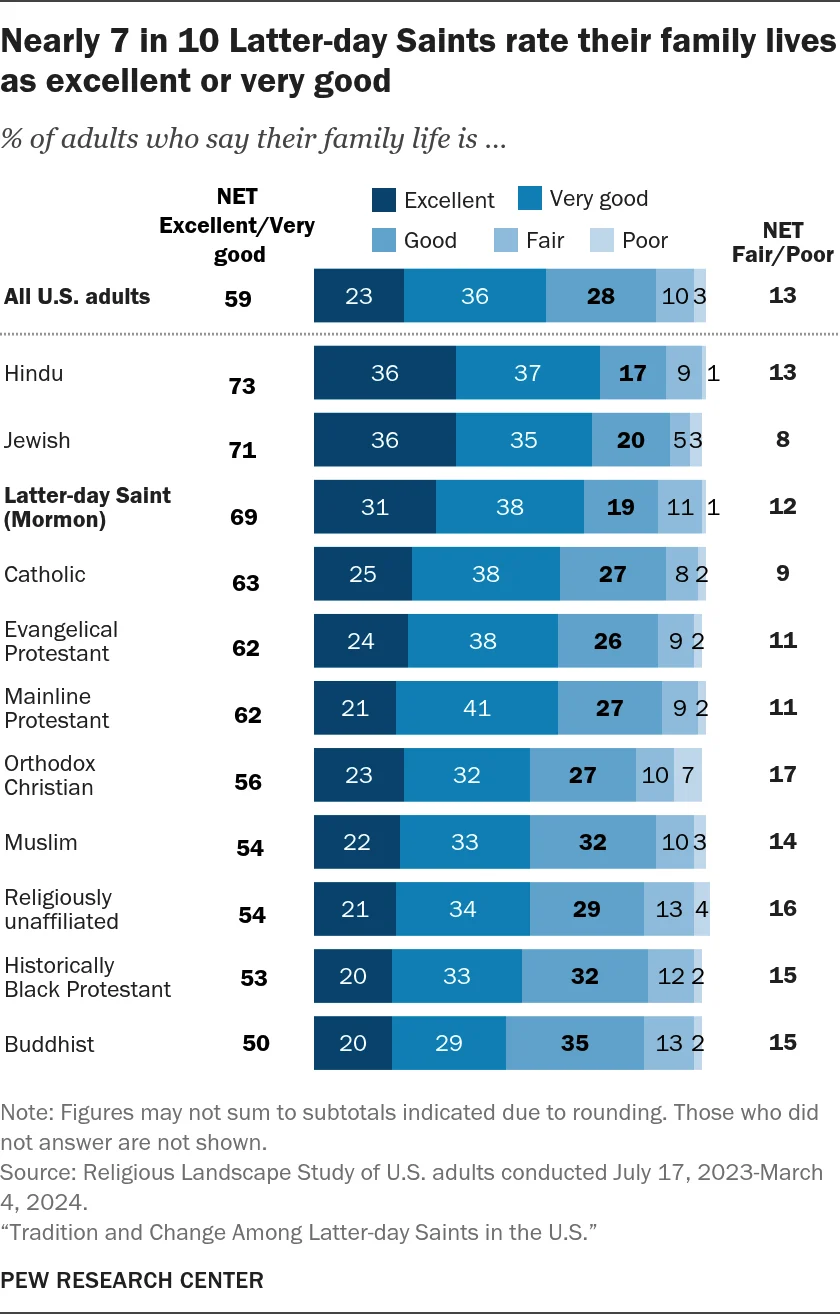
WASHINGTON — A comprehensive new study released by the Pew Research Center offers a detailed snapshot of the religious beliefs, family structures, and social viewpoints of members of the Church of Jesus Christ of Latter-day Saints—widely known as Mormons—living in the United States.
Drawing from data gathered during the Center’s extensive 2023–2024 Religious Landscape Study (RLS), the report captures a portrait of a faith community deeply anchored in traditional values, intensely focused on family cohesion, yet navigating subtle shifts in demographic composition and evolving social perspectives.
While nearly 70% of Latter-day Saints rate their family lives as excellent or very good—placing them near the top of all U.S. religious traditions in terms of domestic satisfaction—the community is also confronting broader national trends, such as declining rates of households with minor children. Furthermore, while maintaining notably traditional perspectives on gender roles and workforce participation, the community exhibits measurable internal evolutions, including a significant upward trend in support for women in the paid labor market over the past decade.
Main Facts and Demographic Overview
The Pew Research Center project explores the intersection of religious commitment, marriage, and sociopolitical outlooks among American Latter-day Saints. Based primarily on the 2023–24 RLS—which surveyed 36,908 randomly sampled U.S. adults, including 565 self-identified Latter-day Saints and 316 former members—the findings highlight several core realities:
- High Domestic Satisfaction: Nearly seven in ten Latter-day Saints (69%) describe their family life as excellent or very good, comparable to Hindus (73%) and Jews (71%), and significantly higher than the general U.S. adult average (59%).
- Religious Homogamy: Among married Latter-day Saints, 87% share their faith with their spouse, marking one of the highest rates of religious intermarriage alignment among major American religious traditions.
- Traditional Gender and Parenting Views: Approximately 79% of Latter-day Saints believe that children are better off when at least one parent stays home rather than both working outside the home. Moreover, 41% specifically advocate for mothers to be the stay-at-home parent, a figure higher than the national average.
- Shifting Workforce Attitudes: While maintaining traditional views, the proportion of Latter-day Saints who view the increasing presence of women in the workforce as "a change for the better" has climbed to 61%, up significantly from 49% in 2014.
Chronology of Study and Institutional Evolution
To understand the trajectory of the modern Latter-day Saint community in the United States, researchers rely on a multi-decade tracking framework that captures both demographic adjustments and institutional terminology updates.
2007–2011: Early Baseline Studies
The Pew Research Center established its initial comprehensive baseline of the American religious landscape in 2007, followed by a dedicated, large-scale survey of Latter-day Saints in 2011 ("Mormons in America"). During this period, 71% of Latter-day Saints reported being married, and 49% reported having minor children (under 18) living in their homes. These metrics reflected a younger, family-dense demographic profile compared to the broader U.S. public.

2014–2018: Societal Shifts and Terminological Changes
Subsequent landscape tracking in 2014 recorded early signs of shifting social attitudes, noting that roughly 49% of church members viewed the rise of women in the workforce positively. Simultaneously, the broader religious and cultural ecosystem surrounding the church began to transform. Most notably, in 2018, leadership under church President Russell M. Nelson initiated a concerted effort to emphasize the full, formal name of the faith—the Church of Jesus Christ of Latter-day Saints—while actively discouraging the colloquial use of the term "Mormon" for the institution and its members.
2023–2024: The Recent Religious Landscape Study
Conducted between July 17, 2023, and March 4, 2024, the latest RLS data captures the community in a post-pandemic America. This comprehensive dataset allowed researchers to evaluate how decades of cultural change, shifting economic pressures, and evolving generational viewpoints have impacted America’s roughly 2% to 3% Latter-day Saint minority.
Supporting Data: Family Dynamics and Religious Intermarriage
The structural backbone of Latter-day Saint theology heavily emphasizes the eternal nature of family units. Temple marriages are believed to bind spouses and children together past mortal death, and church doctrine consistently promotes weekly devotional practices, such as "Family Home Evening."
Marriage and Household Composition
While the overall marriage rate among Latter-day Saints has remained relatively stable over the past two decades—hovering around two-thirds (roughly 66%) of adults—the presence of minor children in the home has experienced a notable decline.
- In 2007, 49% of Latter-day Saint households included children under 18.
- By the 2023–24 RLS, that figure had dropped to 37%.
- This contraction mirrors a broader national trend: across all U.S. adults, the share of households with minor children fell from 35% to 28% over the same timeframe, driven by declining fertility rates and delayed family formation nationwide.
Spousal Alignment and Religious Discourse
Married Latter-day Saints display extraordinary levels of religious integration within their marital partnerships compared to the broader American populace:
- Shared Beliefs: 77% of married Latter-day Saints report that their religious beliefs are very similar to those of their spouse (compared to a national average of 51% for married adults).
- Spousal Piety: 73% state that religion is very important in their spouse’s life.
- Daily Conversation: 37% report talking about religion with their spouse on a daily basis, far exceeding Protestant (26%), Catholic (12%), and Jewish (14%) married cohorts.
Official Responses and Institutional Context
Scholars and institutional representatives have noted that the findings underscore the resilience of core religious values in an increasingly secularized America.

Jonathan Evans and Rebecca Leppert, the lead researchers behind the Pew report, emphasize that while Latter-day Saints maintain distinct theological and social boundaries, they are not entirely insulated from broader economic and demographic currents. The decline in households with children, for instance, points to the shared impact of housing affordability, changing career timelines, and economic pressures faced by young families across all religious traditions in the United States.
Furthermore, the church’s ongoing transition away from the "Mormon" moniker—reflected carefully in the methodology of the Pew report, which prioritizes the formal title "Latter-day Saint" while acknowledging historical usage—demonstrates a self-conscious institutional effort to foreground the Christ-centric nature of their theology over cultural stereotypes.
Implications for Sociopolitical and Cultural Landscapes
The findings of the 2023–24 Religious Landscape Study carry significant implications for understanding the future of American civil society, gender politics, and religious conservatism.
1. The Paradox of Traditionalism and Adaptation
Latter-day Saints remain one of the most socially and religiously conservative cohorts in the United States, frequently aligning with evangelical Protestants on questions of family structure, scriptural authority, and parenting philosophies. However, the data reveals a population capable of internal evolution. The dramatic increase in support for women in the workforce—jumping from 49% in 2014 to 61% in the latest study—indicates that even within highly traditional religious frameworks, younger generations and shifting economic realities are fostering a more pragmatic approach to modern professional life.
2. Political and Social Cohesion
Because 87% of married Latter-day Saints share the same faith, and because religious discussions occur daily in a high percentage of homes, the home functions as a potent reinforcement engine for religious and political identity. Prior segments of the RLS project highlight that while Latter-day Saints lean heavily Republican, they frequently stand apart from partisan peers on specific issues of community diversity and institutional trust, guided largely by their distinct communal ethos and global missionary experiences.
3. Future Demographic Resilience
As secularization and religious "disaffiliation" (the rise of the "nones") continue to reshape the American religious landscape, stable retention and strong family-centric institutions remain vital for the Church of Jesus Christ of Latter-day Saints. The data suggests that while the community is grappling with lower birth rates and fewer children at home—mirroring national patterns—its deep-seated internal cohesion, high rates of religious homogamy, and high domestic satisfaction provide a formidable foundation for community continuity in the decades ahead.
 Dwi Wanna
  Basiran