
 By Asep Darmawan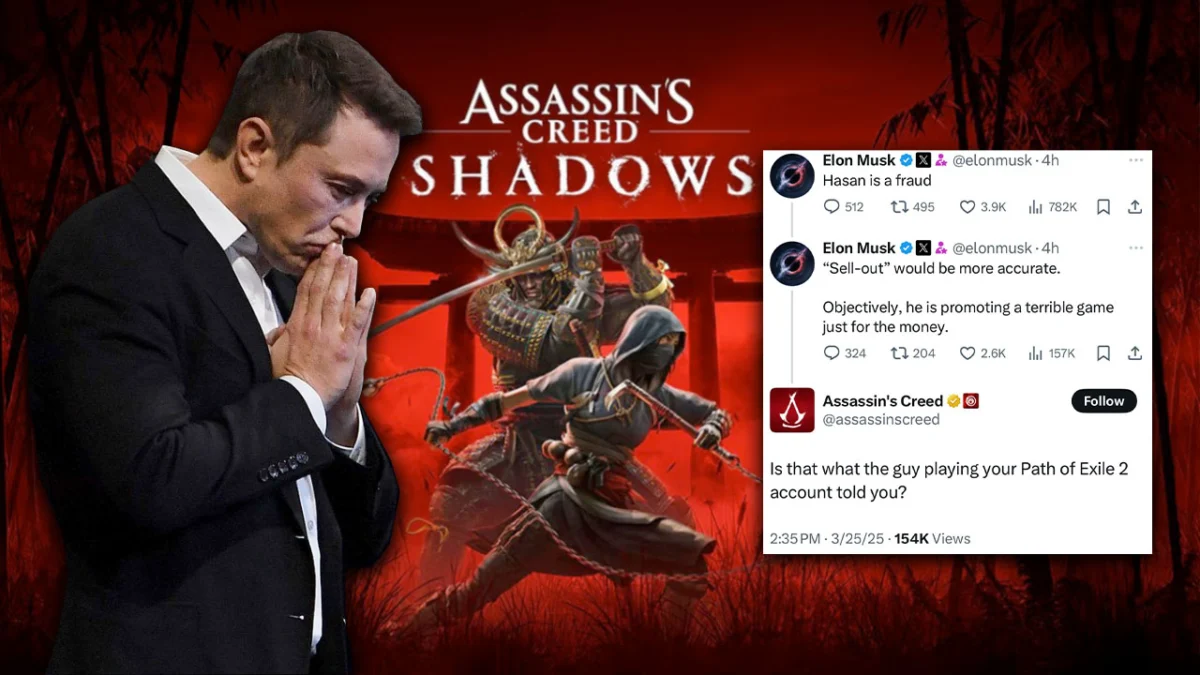
Main Facts: Elon Musk Ignites Gaming Feud, Gets Ratioed by Assassin’s Creed
In a recent digital skirmish that has captivated the internet, entrepreneur and X owner Elon Musk once again found himself at the center of a widespread mockery within the gaming community. This time, the official Assassin’s Creed account, operated by Ubisoft, delivered a scathing public rebuke on Musk’s own social media platform, X (formerly Twitter). The incident unfolded following Musk’s sharp criticism of prominent Twitch streamer Hasan Piker and the upcoming Assassin’s Creed: Shadows, which he dismissed as a "terrible game." The Assassin’s Creed account responded by pointedly referencing Musk’s prior "fraud gamer" controversy involving Path of Exile 2, igniting a firestorm of viral engagement and widespread public amusement.
The confrontation began when a well-known video game critic, Grummz, publicly denounced Ubisoft for sponsoring Hasan Piker, a streamer often associated with leftist political views, to promote Assassin’s Creed: Shadows. Musk swiftly weighed in, echoing Grummz’s sentiments and escalating the rhetoric by labeling Piker a "fraud" and a "sell out" for endorsing what Musk deemed an inferior product purely for financial gain. The official @AssassinsCreed account, seizing a critical opportunity, retorted with a meticulously crafted jab that instantly went viral. Their tweet directly challenged Musk’s gaming authenticity, asking, "Is that what the guy playing your Path of Exile 2 account told you?" This single tweet garnered over 400,000 likes overnight and unleashed an avalanche of memes, jokes, and widespread schadenfreude at Musk’s expense. The incident not only reignited discussions about Musk’s gaming credibility but also showcased a bold, uncharacteristic move from a major corporate brand in directly confronting a high-profile figure on a platform he controls. The ensuing public reaction highlighted the delicate balance between celebrity influence, corporate branding, and the often-unforgiving scrutiny of the online gaming community.
The Spark: A Controversial Collaboration and a Fiery Exchange
The latest chapter in Elon Musk’s recurring entanglements with the gaming world was precipitated by a contentious promotional strategy for an eagerly anticipated title and the subsequent intervention of influential online personalities. This sequence of events, culminating in a viral corporate takedown, underscores the volatile intersection of gaming culture, political discourse, and celebrity commentary on social media.
Grummz’s Initial Provocation
The catalyst for the entire saga was the outspoken video game critic known as Grummz. With a reputation for strong opinions and a significant following, Grummz took to X to voice his displeasure with Ubisoft’s marketing strategy for Assassin’s Creed: Shadows. His criticism centered on the decision to engage Hasan Piker, a Twitch streamer renowned for his political commentary and often identified with leftist ideologies, to stream and promote the new game. Grummz’s critique, while framed around the perceived quality and direction of the game, carried an undeniable undercurrent of ideological disapproval, suggesting that Ubisoft was aligning itself with a figure whose political stance might alienate a segment of the gaming audience. This initial provocation set the stage for a broader debate, drawing attention not just to the game itself, but to the cultural and political implications of its marketing. Grummz’s post, designed to spark conversation and controversy, succeeded in attracting the attention of one of the internet’s most prominent and provocative figures: Elon Musk.
Elon Musk Enters the Fray
Never one to shy away from a public debate, particularly on a platform he owns, Elon Musk swiftly entered the fray. Aligning himself with Grummz’s critique, Musk escalated the attack with his characteristic bluntness. He launched a direct assault on Hasan Piker, unequivocally labeling him a "fraud" and a "sell out." Musk’s accusation stemmed from his belief that Piker was promoting Assassin’s Creed: Shadows solely for financial gain, irrespective of the game’s actual quality, which Musk himself disparagingly referred to as "terrible." This intervention was consistent with Musk’s broader public persona, where he frequently weighs in on cultural and political discussions, often adopting a contrarian or provocative stance. His pronouncements, regardless of their subject, tend to draw immense attention and often polarize opinion. In this instance, his comments were interpreted by many as an attempt to undermine both Piker’s professional integrity and the legitimacy of Ubisoft’s marketing efforts, further intensifying the already simmering debate. Musk’s status as the owner of X added another layer of irony and scrutiny to his public statements, as he was effectively using his own platform to engage in a highly personal and critical exchange.
Hasan Piker’s Defense and Challenge
Unsurprisingly, Hasan Piker did not take Musk’s accusations lying down. A seasoned streamer accustomed to online confrontations, Piker quickly engaged in a series of spirited exchanges with Musk. These "barbs," often mediated or further inflamed by Grummz’s continued commentary, saw Piker defending his professionalism and challenging Musk’s credibility. The peak of this direct confrontation came when Piker issued a highly public and specific challenge: a "duel" in the notoriously difficult action RPG Elden Ring. This challenge was a direct gauntlet thrown, inviting Musk to prove his gaming prowess in a widely respected, skill-intensive title, thereby implicitly questioning Musk’s own authority to judge other gamers or games. Musk, in response, dismissed Piker’s challenge, resorting to personal attacks by calling him "chickens—" for having previously blocked him on X. This exchange, playing out in real-time across the social media platform, underscored the personal nature of the dispute and the high stakes involved in challenging public figures within the online gaming sphere. Grummz, meanwhile, continued to egg on the argument, effectively acting as an instigator, amplifying the drama and ensuring maximum public visibility for the unfolding digital spectacle.
Chronology of the "Fraud Gamer" Allegations
The recent exchange on X between Elon Musk and the Assassin’s Creed account was not an isolated incident but rather a direct callback to a previous, widely publicized controversy that severely dented Musk’s reputation within the gaming community. This earlier episode, often dubbed the "fraud gamer controversy," involved Musk’s alleged deceptive practices in the online role-playing game Path of Exile 2. Understanding this prior event is crucial to grasping the potency and effectiveness of the Assassin’s Creed account’s viral retort.
The Path of Exile 2 Scandal Unfolds
Earlier this year, Elon Musk found himself embroiled in an embarrassing public controversy that began with his purported high-level gameplay in Path of Exile 2. The game, a highly complex and demanding action RPG known for its intricate mechanics and steep learning curve, typically requires hundreds, if not thousands, of hours for players to reach its upper echelons. Musk had been livestreaming his gameplay, presenting himself as a proficient player operating a character with significant in-game achievements and high rankings.
However, eagle-eyed and experienced Path of Exile 2 veterans quickly spotted glaring inconsistencies. Despite controlling a character that, by all appearances, should have demonstrated advanced tactical understanding, efficient movement, and mastery of complex skill rotations, Musk’s actual gameplay was perceived as remarkably amateurish. Players observed him "blundering across the map," a term that in PoE2 parlance implies inefficient pathing, failing to optimize resource usage, making basic errors in combat engagements, and generally displaying a lack of the nuanced game knowledge expected of a high-rank player. For veteran players, these observations were akin to watching someone with a black belt in martial arts perform basic moves with the clumsiness of a beginner – an immediate red flag that something was amiss. The disconnect between the character’s apparent progression and the player’s demonstrated skill became a hot topic of discussion across gaming forums and social media.
Data Analysis and the "Account Boosting" Theory
The suspicions intensified as players delved deeper, examining publicly available game data associated with Musk’s account. This data revealed that the account was "playing from Asia or using a VPN to play from Asia." For the uninitiated, this detail might seem innocuous, but for seasoned online gamers, it immediately raised a significant red flag. Playing from a drastically different geographical region, particularly one known for its highly competitive and often professional gaming scene, is a common characteristic associated with "account boosting" services.
Account boosting refers to the practice where a player hires a more skilled individual (often from regions with lower labor costs or a stronger competitive gaming culture, such as parts of Asia) to play on their account. The booster then "grinds" the game, accumulating experience, items, and rankings, thereby elevating the account’s status without the actual owner having to put in the effort or possess the requisite skill. This practice is widely considered cheating within the gaming community, as it misrepresents a player’s true abilities and undermines the integrity of competitive rankings. The combination of Musk’s visibly subpar gameplay with the suspicious geographical data led to an almost unanimous conclusion among the Path of Exile 2 community: Musk was not genuinely playing his own high-rank character but was rather employing a booster.
Musk’s Admission and Justification
As the evidence mounted and the accusations grew louder, Elon Musk eventually conceded to the allegations. In a move that was met with a mix of surprise and derision, he publicly admitted to "account boosting." However, his admission came with a caveat, framed as a justification rather than a confession of outright cheating. Musk claimed, "It’s impossible to beat the players in Asia if you don’t, as they do!" This statement attempted to normalize the practice, suggesting that account boosting was a necessary evil to compete at the highest levels, particularly against highly skilled Asian players.
This justification, however, largely fell flat with the gaming community. While competitive gaming can be intense, and some players might resort to such tactics, Musk’s position as a public figure and a billionaire owner of a major social media platform meant his actions were scrutinized through a different lens. His attempt to legitimize account boosting as a competitive strategy was widely seen as an evasion of responsibility and a further blow to his already shaky gaming credibility. The admission, rather than quelling the controversy, merely confirmed the community’s suspicions and solidified the "fraud gamer" narrative around him.
Public Backlash and Memetic Fallout
The immediate aftermath of Musk’s Path of Exile 2 admission was a torrent of public backlash. The gaming community, known for its fierce loyalty to authenticity and fair play, responded with an "embarrassing barrage of memes and jokes" at Musk’s expense. Social media platforms, particularly X, were flooded with content ridiculing his gaming skills, his justification for boosting, and the overall hypocrisy of his claims of being a serious gamer. The incident became a prime example of how quickly and effectively the "chronically online" demographic can mobilize to scrutinize and critique public figures. The image of Musk, the visionary tech mogul, being exposed as a gaming fraud provided ample fodder for internet humor, permanently attaching the "fraud gamer" label to his public image. This prior scandal was precisely the ammunition the Assassin’s Creed account deployed in their recent viral takedown, demonstrating the long memory of the internet and the enduring power of past controversies.
Supporting Data: The Viral Backlash and Community Response
The Assassin’s Creed account’s bold response to Elon Musk was more than just a witty retort; it was a strategically executed move that leveraged Musk’s own past controversies, resulting in an overwhelming wave of public support and viral engagement. The immediate aftermath on X showcased the immense power of social media to amplify a brand’s voice and galvanize a community.
The Assassin’s Creed Ratio’s Explosive Impact
The core of the viral success lay in the phenomenon of "ratioing" – a term on X/Twitter indicating that a tweet has received significantly more replies and retweets than likes, often signifying widespread disagreement, criticism, or in this case, a resounding endorsement of the tweet’s sentiment against the original poster. The @AssassinsCreed tweet, referencing Musk’s Path of Exile 2 controversy, achieved an explosive impact, garnering over 400,000 likes overnight. This staggering number, alongside countless retweets and replies, cemented its status as a massively successful corporate "ratio." It was a clear and unequivocal signal from the internet community that they overwhelmingly sided with the Assassin’s Creed account’s stance and found Musk’s earlier criticism hypocritical and deserving of rebuke. The sheer volume of positive engagement indicated a collective satisfaction among users who felt that Musk had been deservedly "called out."

Memes, Jokes, and Corporate Trolling
The internet’s response was not limited to mere likes and retweets; it exploded into a vibrant tapestry of memes, jokes, and expressions of corporate trolling. Users, reveling in the moment, quickly circulated various humorous takes on the situation:
- "I was unfamiliar with your game" Meme: This popular internet meme, typically used to concede that a previously dismissed entity or person has unexpectedly proven their worth, was widely deployed. Users, perhaps previously indifferent or even critical of Assassin’s Creed, declared their newfound respect for the brand based solely on its audacious takedown of Musk. It encapsulated the sentiment of many who were impressed by the account’s bravery and wit.
- User @soundaholism’s Pledge: A particularly notable example of community reaction came from X user @soundaholism, who quoted the @AssassinsCreed tweet with a powerful declaration. They vowed to purchase Assassin’s Creed: Shadows at full price, without waiting for a sale, explicitly stating that their decision was "solely motivated" by the brand’s successful ratio of Elon Musk. This specific instance highlighted how a well-executed social media interaction could directly translate into consumer intent, demonstrating the tangible impact of effective brand engagement.
- The "$44 Billion to Get Cooked" Joke: Perhaps the most prevalent and ironic joke circulating was the observation that Elon Musk had paid a staggering $44 billion to acquire X, only to be "cooked" – a slang term for being thoroughly humiliated or roasted – on his own platform. This joke perfectly encapsulated the absurdity of the situation, highlighting the profound irony of the platform’s owner becoming the target of widespread mockery facilitated by the very system he controls. It resonated deeply with users who often view Musk’s ownership of X with a mix of fascination and skepticism.
- Other General Internet Reactions: Beyond specific memes, there was a general outpouring of admiration for the Assassin’s Creed account’s "chef’s kiss" moment, with users celebrating its boldness and precision. Many viewed it as a satisfying moment of comeuppance for a figure who frequently dishes out criticism without always considering his own vulnerabilities. The incident became a prime example of internet culture’s ability to swiftly and collectively respond to public figures, especially when perceived hypocrisy is involved.
The collective response demonstrated that the Assassin’s Creed account had successfully tapped into a broader sentiment regarding Elon Musk’s online persona and past controversies. The sheer volume and nature of the supporting data underscore the viral success of the ratio and its significant impact on public perception.
Official Responses: Ubisoft’s Bold Stance
The official response from the Assassin’s Creed account was not merely an impulsive retort but a calculated and highly effective strategic move by Ubisoft. In an era where corporate brands often shy away from direct confrontation with powerful public figures, this incident stands out as a bold departure, signaling a potential shift in how companies navigate the complex landscape of social media and public relations.
The Strategic Strike from @AssassinsCreed
The tweet from @AssassinsCreed was a masterclass in targeted corporate trolling. Its precision lay in its direct recall of Elon Musk’s "fraud gamer controversy" involving Path of Exile 2. By asking, "Is that what the guy playing your Path of Exile 2 account told you?", the account didn’t just counter-argue; it disarmed Musk by attacking his credibility at its core. This wasn’t a generic insult; it was a specific, well-researched jab that leveraged a known vulnerability.
The intelligence of this move cannot be overstated. The social media team behind the Assassin’s Creed account clearly understood the historical context and the enduring resentment within the gaming community regarding Musk’s alleged account boosting. By bringing this up, they effectively turned Musk’s own accusations of "fraud" and "sell out" back on him, creating a powerful moment of hypocrisy exposure. The brevity and sharpness of the tweet allowed it to cut through the noise, making an immediate and undeniable impact. It was a digital equivalent of a mic drop, delivered with surgical precision.
A Brand’s Calculated Risk
For a major corporate entity like Ubisoft, operating the official Assassin’s Creed account, engaging in such direct public mockery of a prominent figure like Elon Musk carried inherent risks. Corporate social media strategies typically lean towards neutrality, brand promotion, and careful crisis management, avoiding controversial political or personal spats. Directly challenging the owner of the platform itself could theoretically invite negative repercussions, from algorithmic suppression to direct personal attacks from Musk.
However, in this instance, the risk appears to have paid off handsomely. The decision to confront Musk head-on resonated deeply with their target audience – gamers who value authenticity and often express disdain for perceived hypocrisy, particularly from billionaires. The move was widely interpreted as courageous and relatable, humanizing the brand by demonstrating a willingness to stand up against perceived injustice or arrogance. It signaled that the brand understood and empathized with the frustrations of its community. The overwhelming positive reception, evidenced by the viral likes and supportive comments, suggests that Ubisoft accurately gauged the sentiment of their audience and the broader internet, turning a potential PR misstep into a massive public relations victory. It showcased a brand confident enough to take a stand, earning them significant goodwill and an undeniable boost in visibility for Assassin’s Creed: Shadows.
Broader Industry Implications
The bold move by the Assassin’s Creed account could very well set a precedent for other game companies and indeed, other brands across various industries. In an increasingly polarized and social media-driven world, where public figures frequently engage in provocative online behavior, brands are faced with a choice: remain silent and risk being seen as complicit or out of touch, or engage directly and risk controversy.
This incident suggests that a carefully calculated, witty, and culturally aware response can be incredibly effective. It signals a potential shift in how brands interact with controversial public figures, especially on platforms they own. Rather than always deferring to corporate caution, some brands may now feel empowered to adopt bolder, more personalized voices that align with the values and humor of their target demographics. This could lead to a more dynamic and less sanitized corporate presence on social media, where authenticity and quick wit are rewarded, even if it means engaging in direct confrontation. The Assassin’s Creed incident demonstrates that, when executed correctly, a brand can emerge from such a confrontation not only unscathed but significantly enhanced in public perception and relevance.
Implications: Beyond the Digital Duel
The viral exchange between Elon Musk and the Assassin’s Creed account extends far beyond a simple online spat, touching upon deeper implications regarding the evolving landscape of gaming, celebrity culture, and social media. It highlights critical aspects of authenticity, brand voice, and the blurred lines between entertainment and politics in the digital age.
The Intersection of Gaming, Politics, and Celebrity Culture
This incident serves as a stark illustration of the increasingly interwoven nature of gaming, politics, and celebrity culture. What began as a gaming-related marketing campaign quickly spiraled into a political debate (Grummz’s criticism of Piker’s "leftist" views), then involved a global celebrity (Elon Musk), and ultimately triggered a response from a major entertainment franchise. This convergence is no longer an anomaly but a recurring feature of online discourse. Public figures like Musk, with their vast platforms and outspoken opinions, frequently inject themselves into cultural debates, whether they are experts or not. Similarly, streamers like Hasan Piker wield significant influence, often blending gaming content with political commentary, blurring the traditional boundaries of entertainment. The Assassin’s Creed brand, in turn, found itself navigating this complex nexus, demonstrating that even ostensibly apolitical entertainment entities must be prepared to engage with broader cultural currents to maintain relevance and connect with their audience. The episode underscores how social media platforms have become the primary battlegrounds where these diverse spheres collide, shaping public opinion and influencing brand perception.
Authenticity in the Gaming Community
At the heart of the "fraud gamer" controversy and the Assassin’s Creed ratio is the fundamental value of authenticity within the gaming community. Gamers, particularly those deeply invested in competitive or skill-based titles, place a high premium on genuine achievement, fair play, and demonstrable skill. Musk’s Path of Exile 2 scandal directly challenged these values. His alleged account boosting was perceived as an act of dishonesty, undermining the integrity of the game’s ranking system and disrespecting the effort of legitimate players. When he then criticized Hasan Piker as a "fraud" and "sell out" for promoting a game, the irony was not lost on the community.
The Assassin’s Creed account’s response powerfully tapped into this sentiment, using Musk’s own perceived lack of authenticity as a weapon against his judgment of others. For many gamers, a genuine passion for games involves playing them, learning them, and earning one’s place, not buying it. Musk’s actions and subsequent justification for account boosting fundamentally clashed with this ethos. His perceived hypocrisy alienated a significant portion of the gaming audience, making the Assassin’s Creed retort resonate deeply as a defense of genuine gaming culture against perceived pretension.
The Power of Social Media and Brand Voice
The incident is a potent case study in the evolving power of social media, particularly X, as a platform for both personal brand building and corporate communication. It showcased how a well-crafted, timely, and bold statement from a brand can cut through noise, garner massive attention, and significantly enhance its public image. The Assassin’s Creed account’s success demonstrates that brands are increasingly recognizing the need for a distinct, authentic, and sometimes provocative voice to connect with digitally native audiences. Gone are the days when bland, overly cautious corporate messaging was sufficient.
In an environment where engagement is king, a brand’s willingness to be witty, to take a stand, or even to "troll" a public figure can be a powerful differentiator. The incident also highlights the unique position of X, where the platform’s owner is also a frequent and controversial participant in public discourse. This creates a dynamic where brands and individuals can directly challenge the proprietor on his own turf, leading to highly publicized and often ironic outcomes. The Assassin’s Creed ratio will likely be studied as an example of successful, high-stakes brand engagement on social media.
A Continuing Saga for Elon Musk
For Elon Musk, this incident is yet another chapter in a long and increasingly public saga of controversies. From his Tesla endeavors to his management of X and his forays into space exploration, Musk consistently generates headlines, often by virtue of his outspoken and confrontational style. His interactions, whether with politicians, journalists, or now, gaming communities, invariably produce significant engagement – both fervent support and scathing criticism. The "fraud gamer" episode, now revived by Assassin’s Creed, reinforces a recurring theme in Musk’s public life: his tendency to attract scrutiny and spark debate, often with self-inflicted wounds. It underscores that while his influence is undeniable, so too is the internet’s capacity to hold him accountable, often with humor and a long memory.
The Future of "Assassin’s Creed: Shadows" and Hasan Piker
Beyond Musk’s personal narrative, the incident has tangible implications for the involved parties. For Assassin’s Creed: Shadows, the controversy provided an immense, unplanned marketing boost. The viral nature of the ratio, the widespread discussion, and the pledges from users like @soundaholism to buy the game suggest that Ubisoft’s bold move likely generated significant positive publicity and potentially increased pre-orders and initial sales. It transformed a negative narrative around its promotional choice into a moment of triumph.
Hasan Piker, too, emerged from the confrontation with heightened visibility and reinforced credibility among his audience. His willingness to challenge Musk, particularly with the Elden Ring duel, solidified his image as a confident and principled streamer. While the initial criticism from Grummz and Musk aimed to discredit him, the eventual outcome saw him largely vindicated in the eyes of many, further cementing his status as a prominent voice in the intersection of gaming and online culture. The digital duel, therefore, left a lasting mark on all involved, resonating far beyond the initial flurry of tweets.
 Nila Kartika Wati
  Azzam Bilal Chamdy