
 By Ali Ikhwan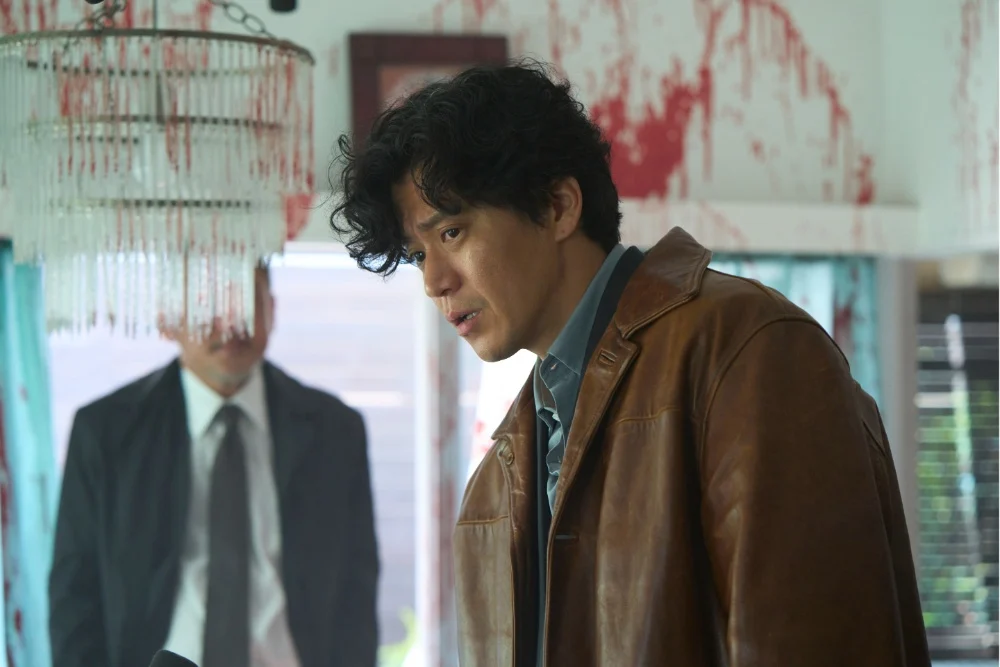
The legacy of Abel Ferrara’s 1992 cult classic, Bad Lieutenant, is one of visceral, soul-shredding intensity. With Harvey Keitel’s tour-de-force performance as a man collapsing under the weight of his own moral rot, the film set a high bar for the neo-noir genre. Even Werner Herzog’s 2009 "re-imagining," Bad Lieutenant: Port of Call New Orleans, managed to inject a delirious, hallucinatory energy into the archetype of the corrupted lawman. However, the latest attempt to revitalize the franchise—Takashi Miike’s Bad Lieutenant: Tokyo—serves as a stark reminder that simply transplanting a title to a new geographic location does not guarantee a cinematic soul.
Despite the pedigree of a director known for his relentless, boundary-pushing filmography, Bad Lieutenant: Tokyo emerges as a baffling, overstuffed, and ultimately hollow exercise. While it borrows the broad strokes of its predecessors, the film fails to find a rhythm, resulting in a narrative that is as disjointed as its protagonist’s drug-addled mind.
The Chronology of a Stalled Investigation
The film, penned by Daisuke Tengan, opens with an aesthetic blunder that sets the tone for the 108-minute slog: a block of on-screen text meant to establish context that vanishes before the human eye can even begin to register its significance. From there, we are introduced to Detective Yabuki (Shun Oguri), a man whose life is a tapestry of divorce, gambling addiction, and chemical dependency.
The film’s sole moment of dark, jarring levity occurs early on, as Yabuki drops his children off at school, only to snort cocaine in full view of their peers. It is a bold, albeit fleeting, window into the depravity of the character. Following this, Yabuki is summoned to a crime scene that feels ripped from a more compelling movie: a Yakuza member, bound and contorted in a sexual rendezvous that turned lethal, his neck twisted into an impossible geometry.
Rather than pursuing the investigation with the fervor of a classic noir detective, Yabuki is characterized by profound apathy. He views the grizzly scene not as a call to justice, but as a potential currency; he sells the information to a bookie to cover his mounting baccarat debts. This establishes the film’s core problem: Yabuki is not a tragic figure struggling with redemption, but a passive vessel through which a series of disconnected, tedious events occur.
As the film progresses, the plot attempts to broaden its scope by introducing a secondary string of killings. A recently released gang member is systematically murdering his former associates, turning their remains into meatballs—a grim visual that stands as the only moment in the film to elicit a truly visceral, if somewhat stomach-churning, reaction. Yabuki follows a thin trail to the killer’s former orphanage, a sequence that promises a deep dive into the detective’s own past, only for the film to abruptly abandon this thread in favor of new, equally underdeveloped detours.
The Global Disconnect: Introducing the FBI
The film attempts to inject a sense of international intrigue with the arrival of Gwen Birgssen, an FBI agent played by Lily James. Birgssen is perpetually hungover, sporting an accent that wanders through the American South with little consistency, and burdened by dialogue that feels like a parody of hardboiled genre tropes.
Birgssen arrives in Tokyo to track down Megan (WWE star Liv Morgan), the rebellious daughter of an American politician currently studying the culinary arts in Japan. Her presence in the film is meant to act as a catalyst for Yabuki’s latent professional drive, but their interactions are as clunky as the plot itself. They meet, they discuss the case in circles, and they fail to ignite any real chemistry or narrative momentum. The film teases that this intersection of characters will serve as the "kick-off" for the action, but instead, it merely marks another point where the story stalls.
Supporting Data: An Anatomy of a Failure
To understand why Bad Lieutenant: Tokyo fails, one must look at the structural choices made by the production. The film is essentially a 108-minute first act. The "setup" phase of the narrative never truly ends; the film is a landscape of exposition, character introductions, and subplots that are left to wither on the vine.
- Atmospheric Deficiency: Despite the neon-soaked, sprawling potential of Tokyo’s nightlife, the film feels claustrophobic and limited. Miike, typically a master of creating unique, lurid atmospheres, fails to capture the city’s heartbeat. The visual language is flat, lacking the grit necessary to ground the story in a sense of reality.
- The Problem of Passivity: Yabuki remains a bystander in his own life. The major developments in both the Yakuza murder case and the disappearance of the American student are not solved by the detective. Instead, information is simply handed to him by peripheral characters via telephone. He is a protagonist who is consistently acted upon rather than acting.
- A Lack of Internal Conflict: Both Ferrara and Herzog used the "Bad Lieutenant" concept to explore deep, existential, and spiritual agony. In those films, the corruption was the point. Here, Yabuki’s moral failing is treated as a character trait rather than a narrative engine. He is cornered by the camera a few times, but he never undergoes a transformation or a moment of true reckoning.
Official Responses and Industry Context
While there has been no official statement from Takashi Miike regarding the reception of the film, industry analysts suggest that the project faced significant pressure to modernize a classic property for an international market. The inclusion of stars like Lily James and Liv Morgan indicates a desire to appeal to Western audiences, but the result is a tonal tug-of-war that satisfies neither the fans of Japanese noir nor the global action market.
The "overstuffed" nature of the script points to a production that may have been trying to juggle too many disparate influences. By attempting to marry the Yakuza crime subgenre with a fish-out-of-water international thriller, the film loses its focus. The result is a work that feels like a series of loosely connected music videos, lacking the connective tissue of a coherent screenplay.
Implications for the "Bad Lieutenant" Franchise
The failure of Bad Lieutenant: Tokyo raises serious questions about the viability of the franchise moving forward. When a property is so intrinsically linked to the unique, tortured psyche of its protagonist, attempts to "re-imagine" it without a singular, burning vision often lead to dilution.
The film does not truly find its footing until roughly fifteen minutes before the final credits, when a legitimate, intriguing twist is finally introduced. However, at that stage, it is a case of too little, too late. The audience has already spent ninety minutes watching a passive lead drift through a city that feels like a collection of sets rather than a living, breathing urban environment.
The implication for future filmmakers is clear: a "bad lieutenant" requires more than just a badge, a drug habit, and a bad attitude. They require a world that pushes back, a moral gravity that is felt by the viewer, and a narrative urgency that dictates every scene. Without these, the title is nothing more than a hollow brand name.
In its current state, Bad Lieutenant: Tokyo stands as a cautionary tale in the landscape of remakes. It is a film that wanders aimlessly, lost in the very neon maze it seeks to exploit, ultimately leaving viewers with little to remember beyond a few disjointed images and the frustration of watching a master filmmaker misfire so spectacularly. For those seeking the raw, uncompromising spirit of the original, this Tokyo-based excursion is best left as a side street not worth traveling down.
 Siti Muinah
  Jia Lissa
  Nana
Nana 