
 By Iffa Jayyana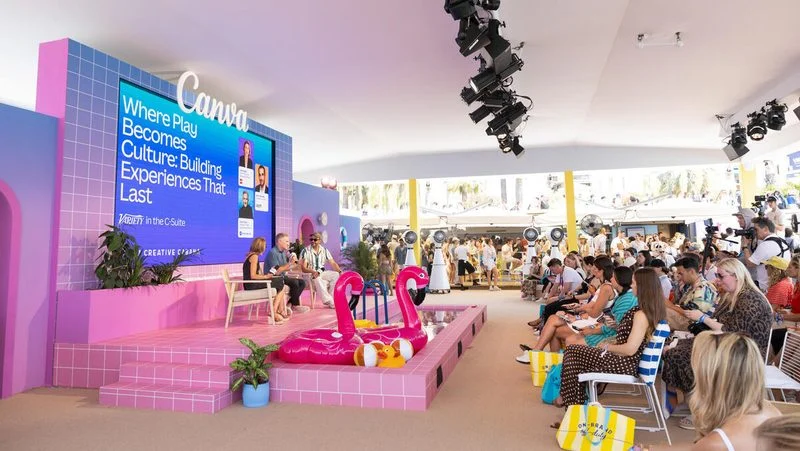
The intersection of artificial intelligence, consumer engagement, and the evolving digital economy took center stage at the 2026 Cannes Lions International Festival of Creativity. In a series of high-level conversations recorded at the Canva Creative Cabana, Variety business editor Todd Spangler sat down with industry titans from NBCUniversal, IBM, State Farm, Autodesk, and Coinbase. The result was a comprehensive look at how global leaders are navigating the “AI era” while maintaining the human-centric storytelling that defines their brands.
The AI Paradox: Skills, Jobs, and the Human Element
One of the most pressing themes of this year’s festival was the palpable tension between AI’s rapid technological adoption and the human workforce’s ability to keep pace.
Dara Treseder, CMO of Autodesk, highlighted a critical discrepancy in the labor market. Citing research that reveals 82% of people are comfortable using AI in their personal lives, Treseder pointed out that only a third feel confident utilizing these tools in a professional capacity.
"Maybe a little too comfortable—I don’t think we need AI to be our therapist," Treseder joked, before turning to the serious economic implications. "There is a massive mismatch between job seekers and the jobs available. We are seeing the number of roles requiring AI skills more than double, yet the workforce is not yet equipped to fill them."
To bridge this gap, Autodesk has committed $350 million toward upskilling the next generation. This initiative focuses on the “Make” industries—architecture, engineering, construction, product design, and media—ensuring that the human element of design remains at the forefront of the AI transition.
The Agentic Future: Coinbase and Operational Efficiency
For Coinbase, AI is not a novel experiment; it is foundational. Cat Ferdon, CMO of the leading cryptocurrency exchange, emphasized that the company’s "agentic-forward" approach is woven into the fabric of their operational DNA. Under the leadership of founder Brian Armstrong, Coinbase has spent over a year integrating AI into every facet of its workflow.
"We believe pretty strongly that AI can help you reach creative outcomes faster," Ferdon explained. "However, it is not a replacement for human creativity. It is an optimizer, a tool to clear the path for the real visionaries."
By automating mundane processes, Coinbase aims to keep its creative talent focused on high-value, high-impact branding. In an industry defined by volatility and rapid change, this internal efficiency allows Coinbase to remain nimble, ensuring their marketing efforts resonate with a new generation of finance-savvy consumers.
IBM: Transforming Creative Output Through Automation
Jonathan Adashek, Senior VP of marketing and communications for IBM, provided an inside look at how "Big Blue" has leveraged AI to fundamentally change the nature of creative work. For IBM, the primary goal was to rescue their creative teams from the burden of derivative, repetitive tasks.
"Our creatives were spending 80% of their time on grunt work," Adashek noted. "They weren’t being creatives; they were being operators. We’ve been able to take that number down to 40% and it’s still dropping."
A standout example of this efficiency was IBM’s collaboration with the Sphere in Las Vegas. By utilizing AI to assist in design and concepting, a project that was estimated to take over two weeks was completed in just two days. The result was not just speed, but a higher quality of creative output, as the AI provided designers with new, unexpected avenues for exploration.
Beyond the creative benefits, the financial impact has been profound. Through AI, automation, and process optimization, IBM has successfully reduced its annual spend by $4.5 billion over the last three years, with plans to cut an additional $1 billion this year.
Cultural Connections: State Farm and the BravoCon Phenomenon
While the tech giants focused on efficiency, the conversation shifted to the importance of "shared interest" marketing. Kristyn Cooke, chief agency sales marketing officer for State Farm, and Mark Marshall, chairman of advertising partnership for NBCUniversal, discussed the evolution of brand presence at cultural events.
State Farm’s partnership with NBCUniversal’s BravoCon serves as a case study in modern experiential marketing. According to Cooke, the key to reaching younger demographics is moving away from static branding and toward active participation.
"It’s about connecting around shared interests and passion points," Cooke said. "Early on, we focused on branded spaces. Now, we evolve those into memorable experiences. We created a way for fans to interact and feel something. The audience is the story, and they are incredibly engaged."
This shift underscores a broader trend: brands are no longer just sponsors of events; they are facilitators of fan experiences. By embedding themselves into the fabric of communities—like the fervent Bravo fandom—brands can achieve an authenticity that traditional advertising simply cannot replicate.
The Future of Storytelling: NBCUniversal and the 2028 Olympics
Looking ahead to the 2028 Summer Games in Los Angeles, Mark Marshall outlined NBCUniversal’s strategy for a monumental shift in sports broadcasting. Having just come off the momentum of Paris 2024, NBCU is aiming to transform the Olympic viewing experience into a personalized journey.
"The last U.S. Summer Olympics were in Atlanta in 1996, where we aired 186 hours of programming," Marshall recalled. "In 2028, we will be close to 8,000 hours."
The strategy is clear: the fans are the curators. Through platforms like Peacock, viewers can now choose their own experience, whether that means watching specific sports live or opting for the narrative-driven nightly recaps hosted by Mike Tirico.
"Fans love the sports, but what they really love is the storytelling of how the athletes got there," Marshall added. "That is the strategy we are infusing across the NBA, MLB, and NFL. We are moving from simply broadcasting a game to telling the human story of the athlete."
Implications: The Synthesis of Tech and Humanity
The conversations held at the Variety podcast stage at Cannes offer a blueprint for the next half-decade of business. The consensus is clear: AI is the engine, but the human remains the driver.
1. Productivity as a Prerequisite
Companies like IBM and Coinbase have proven that AI is not just for software developers; it is a vital tool for creative departments. By offloading 40–50% of derivative tasks to AI, these firms are allowing their staff to reclaim their time for genuine innovation. The $4.5 billion in savings reported by IBM serves as a compelling financial argument for aggressive AI integration.
2. The Skills Mismatch
Autodesk’s $350 million commitment highlights the danger of the "AI divide." While the technology is accessible, the expertise to wield it effectively is in short supply. Corporations that do not invest in training their workforce will likely find themselves at a competitive disadvantage within the next three years.
3. The Return to Authentic Experiences
As AI makes digital content cheaper and more abundant, the value of physical, high-emotion experiences—like those facilitated by State Farm at BravoCon—is skyrocketing. Brands are realizing that in a world of algorithmic content, the "human moment" is the ultimate commodity.
4. Personalization at Scale
NBCUniversal’s vision for the 2028 Olympics highlights the death of the "one-size-fits-all" broadcast. By leveraging digital platforms to offer 8,000 hours of content, NBCU is mirroring the consumer’s desire for control. The takeaway for all marketers is that the consumer wants to be the curator of their own entertainment.
Conclusion
The 2026 Cannes Lions Festival served as a reminder that the rapid evolution of technology does not signal the end of creativity—it signals a pivot. From IBM’s efficiency-driven creative studios to NBCUniversal’s hyper-personalized sports coverage, the leaders of industry are finding that AI is most effective when it serves to amplify, rather than replace, human intent. As the industry looks toward the 2028 Olympics and beyond, the focus remains locked on the same goal: using the most sophisticated tools available to tell the most human stories possible.
 Siti Muinah
  Ammar Sabilarrohman
  Layla Zulfa