
 By Asep Darmawan
WASHINGTON — Artificial intelligence has rapidly woven itself into the fabric of modern commerce, education, and daily labor. Tools like OpenAI’s ChatGPT, Google’s Gemini, and Microsoft’s Copilot are routinely cited as transformative forces reshaping the global economy. Yet, despite an undeniable upward trend in national usage statistics, a stubborn and substantial digital divide persists across the United States.
According to a comprehensive national study conducted by the Pew Research Center, roughly half of all U.S. adults (51%) report that they never use AI chatbots. Even more telling for the trajectory of the technology, these non-users are largely indifferent to what they are missing. Far from experiencing a fear of missing out (FOMO), the vast majority of Americans outside the chatbot ecosystem harbor no immediate plans to adopt these tools, driven by a potent mix of apathy, deep-seated data privacy worries, and skepticism regarding factual accuracy.
The findings offer a sobering counter-narrative to Silicon Valley’s breathless accelerationism, revealing that millions of Americans remain fundamentally unpersuaded of AI’s utility in their personal lives.
Main Facts: The State of AI Non-Adoption in 2026
The data, drawn from a broad Pew Research Center survey of 5,119 U.S. adults surveyed between February 17 and 23, 2026, paints a nuanced portrait of a nation split down the middle.
While 49% of the adult population reports ever having used an AI chatbot, the remaining 51% stands firm in total non-adoption. This divide is not distributed evenly; it breaks cleanly across demographic lines defined by age and race:
- The Age Chasm: The generational split regarding AI engagement is stark. Among adults aged 65 and older, a striking 77% say they never use chatbots. This skepticism softens only slightly among those aged 50 to 64, where 58% report total non-use. Conversely, younger cohorts embrace the technology at much higher rates: only 34% of adults aged 18 to 29 and 39% of those aged 30 to 49 abstain from chatbot use.
- Racial and Ethnic Variations: Non-adoption rates also fluctuate across racial and demographic groups. White (54%), Black (51%), and Hispanic (50%) adults report higher rates of non-use compared to Asian adults, among whom 70% report having used a chatbot, leaving an abstention rate of just 29% (estimates for Asian adults represent English speakers only).
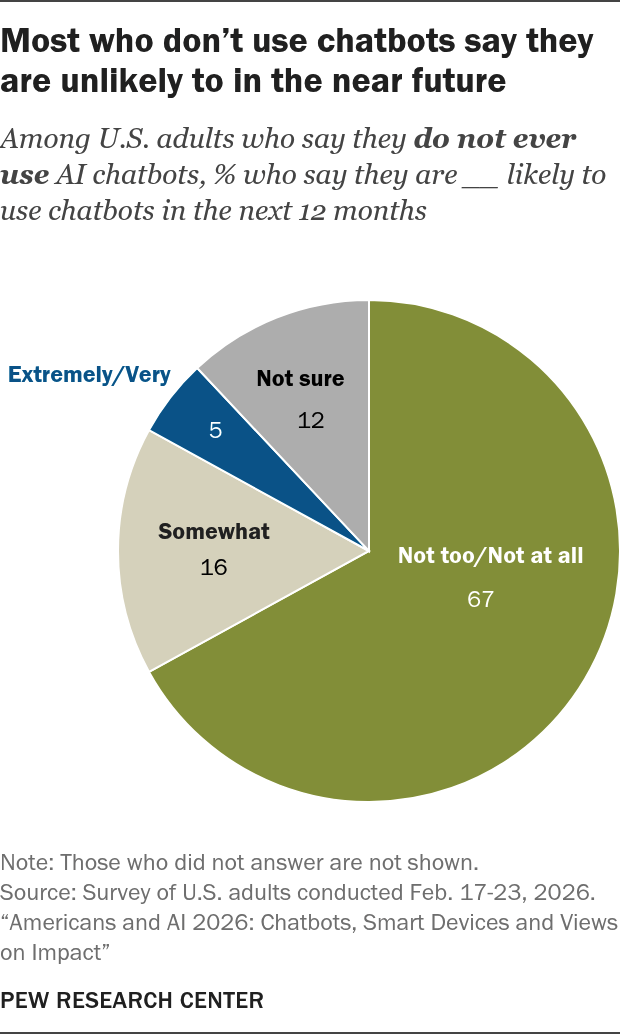
- Indifference to the Future: Perhaps most discouraging for AI developers looking to capture the remaining uninitiated market is the sheer lack of future intent. Among current non-users, roughly two-thirds (67%) state they are unlikely to use chatbots in the next 12 months—with 40% asserting they are not at all likely. Only 5% believe it is extremely or very likely they will adopt the technology over the coming year.
Chronology: The Evolution of Public Skepticism Toward Generative AI
To understand how the American public arrived at this current standoff, it is helpful to trace the rapid arc of generative AI’s public debut and consumer reaction:
- Late 2022: The public release of OpenAI’s ChatGPT thrust generative AI into the mainstream cultural consciousness. Initial reactions oscillated between novelty, panic, and widespread experimentation as users tested the limits of automated text generation.
- 2023–2024: Tech giants rushed to integrate conversational AI into search engines, productivity suites, and consumer devices. Industry analysts touted chatbot adoption curves that outpaced the early days of smartphone adoption. However, early friction points—such as "hallucinations" (fabricated facts), copyright controversies, and corporate data-scraping scandals—began to seed public distrust.
- 2025: As AI features became ubiquitous defaults baked into operating systems and software updates, pushback emerged from privacy advocates and digital minimalists. Sociological studies began tracking a distinct "AI fatigue" among mainstream consumers who felt overwhelmed by forced technological upgrades.
- February 2026: Pew Research Center fields its comprehensive Americans and AI 2026 survey via the American Trends Panel. The resulting dataset captures a mature market where the low-hanging fruit of early adopters has been harvested, leaving behind a hard core of hesitant or entirely disinterested consumers.
- October 2026: Pew releases granular deep-dives into the psychology of non-users, revealing that lack of interest—rather than a lack of digital literacy—is the primary barrier holding back the majority of the uninitiated.
Supporting Data: Why Americans Say "No Thanks" to Chatbots
When researchers pressed non-users on why they refuse to interact with AI chatbots, the responses dismantled the assumption that digital exclusion is purely a matter of technological illiteracy. Instead, conscious personal choice, security concerns, and quality doubts dominate the landscape.
Among U.S. adults who never use chatbots, the survey identified several primary deterrents:

1. Apathy and Disinterest
The single most prevalent reason cited for avoiding chatbots is simple indifference. 83% of non-users cite a lack of interest as a factor, with a massive 60% pointing to it as a major reason they stay away. For these individuals, standard search engines, traditional software, and human interaction fulfill all their daily digital needs without the intervention of an artificial conversationalist.
2. Privacy and Data Security Anxiety
In an era dominated by corporate data breaches and targeted surveillance, personal data protection remains a paramount concern. 79% of non-users cite privacy fears, with 54% categorizing this as a major reason. Consumers worry about what happens to the personal information, prompts, and context they feed into commercial AI models, fearing exploitation or unauthorized corporate profiling.
3. Distrust in Accuracy
Generative AI’s well-documented tendency to present falsehoods with absolute confidence has not gone unnoticed by the public. 76% of non-users point to a lack of trust in accuracy, with 45% calling it a major barrier. Many potential users view chatbots as unreliable sources prone to error, preferring verified human expertise or established reference materials.
4. The Digital Competency Gap
While secondary to privacy and interest, practical skill gaps do play a role for a subset of the population. 55% of non-users mention not knowing how to use chatbots, though only 29% classify this as a major reason. Notably, social anxiety plays virtually no role in abstention: only 14% worry that others will judge them for using AI, with a mere 3% calling it a major factor.

Official Responses and Expert Perspectives
Sociologists and technology analysts monitoring the Pew study emphasize that the tech industry must adjust its expectations regarding universal adoption.
Dr. Michelle Faverio, research associate focusing on internet and technology research at the Pew Research Center, notes that the division highlights a fundamental misalignment between tech developers and the average consumer.
"When new technologies roll out, there is often an implicit assumption that every demographic will naturally cycle through the adoption curve over time," industry analysts point out. "However, the data surrounding AI chatbots suggests something different. A substantial portion of the population is not merely waiting for a more user-friendly interface; they are making a conscious choice that these tools offer no tangible improvement to their quality of life."
Industry insiders, meanwhile, view the high rate of non-adoption not as a failure, but as an untapped market opportunity. Software executives argue that as AI agents become invisible infrastructure—embedded quietly into banking apps, healthcare portals, and customer service lines—users may soon interact with AI daily without ever realizing they are engaging with a "chatbot."
Implications: What This Means for the Future of AI Integration
The revelation that half of the American public remains entirely detached from AI chatbots carries profound implications for policy, economy, and culture:
- The Deepening Digital Divide: As society pushes toward AI-driven efficiency in government services, healthcare triage, and job recruitment, the exclusion of non-users—particularly older adults—risks creating a two-tiered system. Populations lacking trust in or access to AI systems may find themselves marginalized as digital interactions become increasingly automated.
- The Necessity of Trust-Building: For AI developers and policymakers hoping to bridge this gap, technical performance enhancements alone will not suffice. The data demonstrates that winning over the skeptical public requires robust, legally binding privacy guarantees and radical transparency regarding data usage. Until consumers feel confident that their personal data is protected and that output accuracy is reliable, apathy and suspicion will remain dominant.
- A Counter-Cultural Movement of Minimalism: The normalization of AI refusal signals a broader cultural pushback against relentless technological expansion. Just as the "right to disconnect" movement challenged the expectation of 24/7 digital availability, choosing to bypass AI represents an intentional boundary drawn by consumers weary of a shifting digital landscape.
Ultimately, the Pew Research Center study serves as a necessary check on tech-industry hyperbole. While generative AI will undoubtedly continue to anchor the strategies of corporations and governments, its path to becoming a truly universal consumer tool remains blocked by an American public that looks at the chatbot revolution and decides, quite simply, that it can live without it.
 Sagoh
Sagoh  Nana
Nana 