
 By Siti Muinah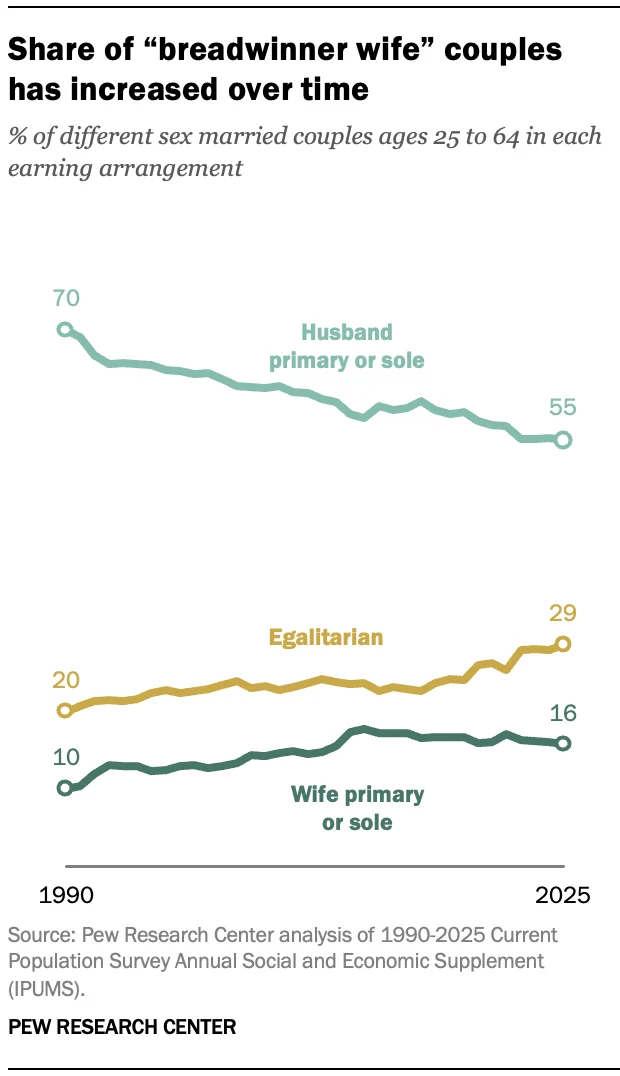
In the cultural zeitgeist of the 2020s, few unions have captivated the American public quite like the marriage of Taylor Swift and Travis Kelce. Beyond the headlines, the flashbulbs, and the global tour stops, their partnership serves as a high-profile mirror reflecting the structural shifts occurring within the institution of marriage itself.
While the couple may represent a unique tier of celebrity, new data from the Pew Research Center suggests that they are not outliers; rather, they are emblematic of broader demographic trends that have transformed American domestic life over the last thirty-five years. As the definition of the "typical" American marriage evolves, sociologists are looking at the Swift-Kelce dynamic to understand how modern couples navigate professional success, timing, and personal history in an era of unprecedented social change.
The Modern Matrimony: Key Statistical Shifts
Jake Hays, a researcher at the Pew Research Center specializing in families and relationships, notes that the American journey toward the altar has undergone a radical transformation. Through a rigorous analysis of U.S. Census Bureau data and the Current Population Survey (CPS), researchers have identified three defining pillars of this new marital landscape.
1. The Delay of the "I Do"
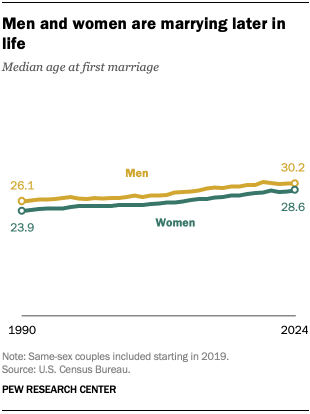
The most immediate trend is the increase in the median age at first marriage. In 1990, the social blueprint for marriage was set early: men typically married at 26, and women at 24. By 2024, those numbers had climbed to 30 for men and 29 for women.
Swift and Kelce, both 36, fall slightly above these median figures, yet their timing resonates with a population that is increasingly skeptical of rigid timelines. According to Pew’s latest findings, roughly half of all Americans now believe there is "no best age" to marry, marking a departure from the mid-century expectation of marriage as a rite of passage for one’s early twenties.
2. The Rise of the Breadwinner Wife
Perhaps the most significant economic shift is the narrowing gap in spousal earnings. In 1990, only 10% of opposite-sex married couples featured a wife who earned significantly more than her husband. By 2025, that figure climbed to 16%.
While Swift and Kelce are extreme outliers—both earning well over $1 million annually—their dynamic highlights a cultural shift toward egalitarianism in financial power. The "breadwinner wife" is no longer a statistical anomaly, but an established trend in the contemporary labor market, reflecting the narrowing gender pay gap and the rising professional attainment of women.
3. The "First-Time" Commitment
Contrary to the belief that modern marriage is increasingly transient, there is a notable rise in couples entering their first union. In 1990, 55% of new marriages were first-time unions for both partners. By 2024, that number rose to 68%. Swift and Kelce, both having never been married previously, fit perfectly into this trend, suggesting that despite later marriage ages, the commitment to "the first time" remains a dominant social preference.
A Chronology of Change: From 1990 to 2025
To understand how we arrived at this moment, one must look at the longitudinal data provided by the U.S. Census Bureau and the American Community Survey (ACS).
- The 1990 Baseline: The American family unit was defined by early adulthood entry. Education paths were often shorter, and the societal pressure to marry before age 25 was at its peak. Economic models relied heavily on the male-as-sole-provider structure.
- The 2008 Pivot: The Great Recession acted as a catalyst for changing marriage patterns. With the implementation of the American Community Survey, researchers began to gain granular, self-reported data on marital history, revealing a growing trend of individuals choosing cohabitation or singleness over early marriage.
- The 2020–2025 Acceleration: Post-pandemic, the cultural conversation around "work-life balance" and "relationship equity" moved to the forefront. The shift in breadwinner status became a focal point of economic reports, as the labor market saw a surge in dual-income households and female-led income structures.
Supporting Data: The Methodology Behind the Trends
The research provided by Pew Research Center is not mere speculation; it is the result of years of data harmonization. Utilizing microdata files provided by the University of Minnesota’s IPUMS project, researchers have been able to standardize variable names and coding across decades, allowing for a seamless comparison between the 1990s and the present day.
The "Breadwinner Wife" data, for instance, focuses exclusively on different-sex married couples between the ages of 25 and 64 where at least one spouse reported earnings. By filtering out non-working couples, the data provides a clear view of how professional status influences domestic hierarchy. Similarly, the first-marriage data draws on a combination of National Center for Health Statistics (NCHS) records and the American Community Survey, providing a dual-layered verification of marriage trends across all 50 states.
Official Responses and Expert Commentary
"The marriage of Taylor Swift and Travis Kelce is a lens through which we can view much broader societal movements," says Jake Hays. "While their wealth is exceptional, their life choices—marrying in their mid-30s, navigating the complexities of high-earning careers, and committing to their first marriage—are reflective of the American public’s new priorities."
Sociologists emphasize that these shifts are not necessarily signs of a "decline" in marriage, but rather an evolution of the institution’s purpose. Where marriage was once a mandatory economic contract for survival, it has become an aspirational partnership based on mutual support and individual fulfillment. The public response to the data suggests that Americans are increasingly validating these choices, with fewer people judging those who wait until their 30s to find their life partners.
Implications: The Future of the American Family
What does this mean for the future of the family in the United States? The implications are threefold:
1. Economic Restructuring
As more wives take on the role of primary breadwinner, the domestic division of labor is being renegotiated. The "second shift"—the expectation that women handle housework despite their professional earnings—is under fire. Future generations are likely to see more fluid roles in child-rearing and domestic management, regardless of which partner brings home the larger paycheck.
2. A Redefinition of "Success"
The delay in marriage age implies that education and career establishment have become the new prerequisites for adulthood. For many, marriage is no longer the start of an adult life, but rather a milestone achieved once that life is already well-underway. This creates more stable, albeit older, couples who are potentially more prepared for the challenges of long-term partnership.
3. The Durability of First Marriages
The rise in first-time marriages for both spouses suggests that despite high divorce rates in previous decades, the aspiration for a long-term, singular marriage remains strong. This is a critical insight for policymakers and family counselors: the "marriage gap" is not disappearing; it is simply being delayed and professionalized.
Final Thoughts
As Taylor Swift and Travis Kelce navigate their life together, they are essentially modeling a new American reality. They are not merely celebrities; they are the face of a demographic transition. Whether it is through the lens of late-onset marriage, the rise of the breadwinner wife, or the commitment to first-time unions, their life path resonates with millions of Americans who are choosing to build their families on their own terms.
As the Pew Research Center continues to track these trends, one thing remains clear: the American family is not fading away. Instead, it is becoming more diverse, more equitable, and more reflective of the individual ambitions that define modern society. The "new normal" of marriage is here, and it looks remarkably like the world we are currently building—one partnership at a time.
 Pevita Pearce
  Neng Nana