
 By Nana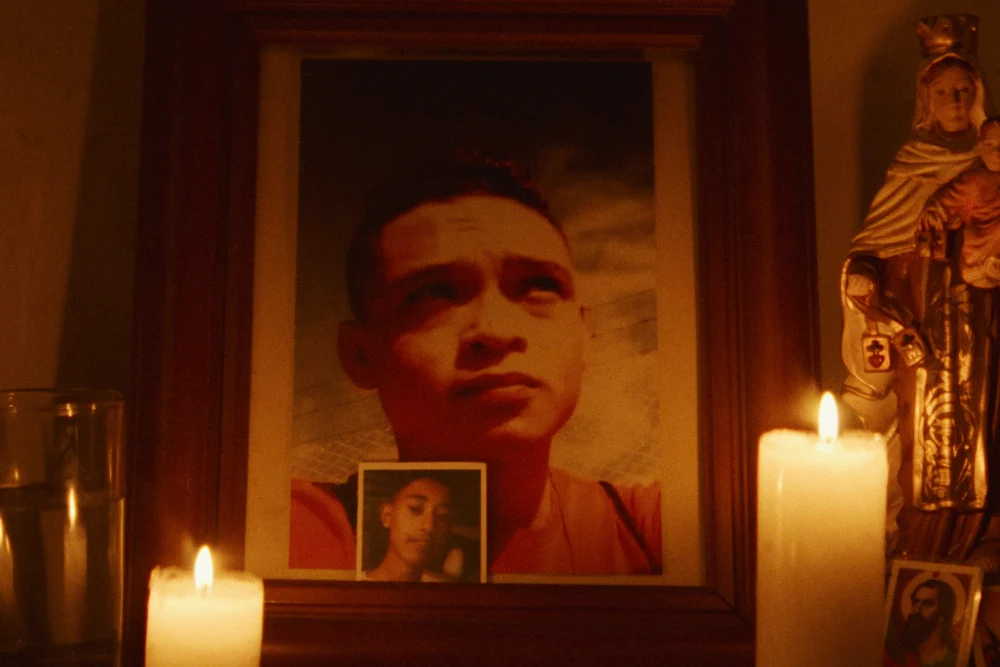
Since the mid-1960s, the landscape of Colombia has been irrevocably scarred by a complex, multi-layered conflict between the state, right-wing paramilitary groups, and leftist guerrilla insurgents. While the political intricacies of these decades-long hostilities have been parsed by historians and peace negotiators, a more visceral, human-scale tragedy has persisted in the background: the systematic "forced disappearance" of thousands of civilians.
While the term "forced disappearance" has become a standardized euphemism in international humanitarian law, its clinical nature fails to capture the lived reality of those left behind. For the families of the missing, time does not function linearly. It is not a healer; it is a stagnant, suffocating medium. This profound, existential paralysis is the subject of the haunting new feature film Five Years, Four Months, directed by Juan Miguel Gelacio and Esteban Hoyos García. Premiering in the Crystal Globe competition at the Karlovy Vary International Film Festival, the film serves as both a cinematic achievement and a somber document of the unresolved grief that continues to haunt the Colombian social fabric.
The Human Cost: A Chronology of Grief
The narrative of Five Years, Four Months centers on Martha Baquero, a character whose experiences are synthesized from the real-life testimonies of women who collaborated with the filmmakers. Martha’s journey is not one of catharsis, but of an agonizing, recursive search for her son, Fabian.
The film eschews the typical tropes of investigative thrillers, opting instead for a deliberate, meditative pace that mirrors the soul-crushing bureaucracy of exhumation projects. We witness Martha’s life through the lens of her "in-between" existence: long, wearying bus rides across the Colombian countryside, the rhythmic filing of endless government paperwork, and the physical toll of digging into earth that may or may not hold the answers she craves.
The chronology of Martha’s search is marked not by calendar dates, but by the accumulation of small, devastating tasks. The filmmakers utilize these "narratively uneventful" sequences to build a portrait of total alienation. Martha exists in a state of suspended animation, forever waiting—for a phone call, for a lab result, for a sign that her son’s journey has ended. Her isolation is heightened by a meticulous sound design that forces the audience to experience the world as she does: hyper-aware of the wind, the traffic, and the surrounding flora, yet entirely detached from the humanity of those around her.
Supporting Data: The Magnitude of the Disappeared
The tragedy depicted in the film is rooted in a harrowing statistical reality. According to the Colombian Truth Commission and various human rights organizations, over 120,000 people have been subjected to forced disappearance in Colombia since the 1960s. This figure represents one of the highest rates of disappearance in the Western Hemisphere.
Unlike traditional homicide victims, the "disappeared" exist in a liminal space of legal and emotional uncertainty. Their families are denied the closure of a funeral or a grave, leaving them in a state of "ambiguous loss." This phenomenon, as explored in the film, creates a specific psychological trauma: the survivor feels that to move on with life is to betray the missing.
The film highlights the role of communal support—specifically the dance therapy groups for grieving mothers—where women share their burdens. However, as the character of Martha suggests, this community serves only as a temporary salve. The internal, singular drive to find the truth remains a lonely, solitary quest, often leading the bereaved toward desperate measures in the absence of institutional success.
Official Responses and Institutional Failure
The Colombian government, under the 2016 Peace Agreement with the FARC, established the Unit for the Search for Persons Deemed as Missing (UBPD). This state-led entity was tasked with the monumental, and often impossible, job of locating the remains of thousands of victims scattered across clandestine graves, mass burial sites, and remote jungles.
Despite these efforts, the gap between the state’s logistical processes and the families’ emotional needs remains vast. The film captures this friction perfectly. Martha’s interactions with the state are marked by a profound sense of futility. She is a woman reduced to a file number, waiting for a system that is fundamentally ill-equipped to handle the volume of the tragedy.
When official channels prove insufficient, the film introduces the character of Sandra, played with poignant intensity by Carmía Martínez. Sandra represents the desperate alternatives that arise in the vacuum left by the state. She proposes a "spiritual" search—speaking to the dead—a narrative turn that could be viewed as a descent into desperation or a leap of faith. It raises a critical question regarding institutional failure: when the state fails to provide answers, are the victims’ families justified in turning to the supernatural, the occult, or the criminal underworld to find closure?
The Implications: Cinema as a Witness
The brilliance of Gelacio and García’s work lies in its refusal to offer easy answers. The film’s aesthetic is one of "anxious anticipation." The surreal, dreamlike sequences of anonymous, naked bodies in a dark forest serve as a visual manifestation of Martha’s internal state—a nightmare from which she cannot wake, even in the light of day.
The performance of Jenny Nava as Martha is a masterclass in restraint. Her face is a blank canvas upon which the audience projects their own understanding of grief. She does not perform "hysteria" in the traditional sense; she performs the "opacity" of a woman who has been hollowed out by loss.
The implications of this film are profound for the broader discussion of post-conflict societies. It challenges the viewer to look beyond the political headlines and into the domestic spaces where the war never truly ended. In the film’s climactic scene, where Martha speaks of her son for the first time, the natural world around her—the lush, vibrant Colombian landscape—becomes a vessel for her love. It suggests that while the state can bury a body, it cannot extinguish the memory of a person.
Conclusion: Finding Meaning in the Void
Five Years, Four Months is a testament to the fact that for the families of the disappeared, the passage of time is not a linear progression toward healing. It is a spiral. The film functions as an act of solidarity, urging the viewer to sit with the discomfort of unresolved grief.
By focusing on the sensory and the intimate, Gelacio and García have created a work that transcends the specific geography of Colombia. It is a universal meditation on the nature of absence. As Martha moves toward an uncertain conclusion, the audience is left to grapple with the same realization that haunts the film’s characters: that sometimes, the only way to endure the silence of the disappeared is to continue speaking into it, regardless of whether an answer ever comes.
The film serves as a sobering reminder that for the thousands of families still waiting, the conflict is not a chapter in a history book—it is the air they breathe. Through its hypnotic pace and unflinching gaze, Five Years, Four Months confirms that cinema has the power to transform the invisibility of the victims into a presence that can no longer be ignored.
 Nila Kartika Wati
  Siti Muinah
  Ammar Sabilarrohman