
 By Nana Muazin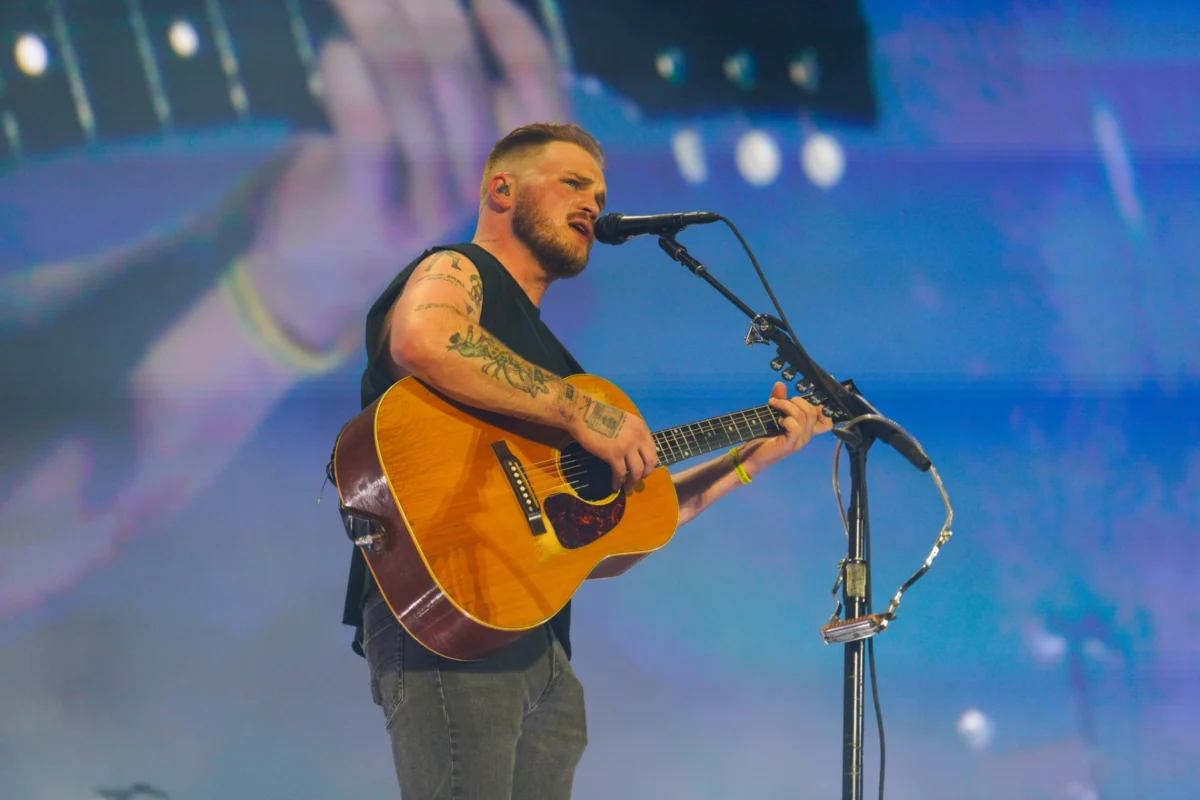
A Historic Night in Foxborough
In a monumental display of his burgeoning status as one of country music’s most influential figures, Zach Bryan has officially etched his name into the history books of Gillette Stadium. On Saturday, October 3, the 30-year-old singer-songwriter delivered a powerhouse performance during the second of his back-to-back shows for the With Heaven on Tour circuit, drawing an unprecedented crowd that eclipsed all previous records at the Foxborough, Massachusetts venue.
According to official figures released by the stadium, Bryan performed for a staggering 73,538 fans. This figure is particularly remarkable given that Gillette Stadium’s standard seating capacity is listed at 64,628. The surge in attendance highlights the artist’s immense drawing power, as concert configurations allow for expanded floor space and standing-room-only sections that frequently push legendary venues well beyond their traditional football-game limitations.
The stadium’s official Instagram account commemorated the milestone by sharing a series of high-energy photographs from the night, captioning the post, "Tonight, Zach Bryan broke the Gillette Stadium attendance record with 73,538 fans!" The atmosphere inside the stadium, a hub for the New England Patriots, was described by attendees as electric, serving as a testament to the emotional connection Bryan has forged with his fanbase through his raw, unfiltered songwriting.
A Chronology of the Weekend
The record-breaking Saturday night followed an equally eventful opening performance on Friday, October 2. While the Saturday show focused on the sheer scale of the audience, the Friday night set became the subject of intense national discourse due to a sartorial choice made by the artist.
The weekend’s proceedings were set against the backdrop of a highly scrutinized touring climate. Originally, fans in the region had anticipated the arrival of Ed Sheeran’s Loop Tour for two dates at Gillette Stadium on September 25 and 26. However, those performances were abruptly canceled due to severe weather conditions, leaving a vacuum in the local live music scene that Bryan’s massive, record-setting takeover ultimately filled.
The Controversy: Attire and Public Discourse
The most significant point of friction during the weekend occurred on the opening night of Bryan’s residency. As he took the stage, the "I Remember Everything" singer was observed wearing a black T-shirt emblazoned with the phrase "Free Palestine." Reports from various outlets, including TMZ, confirmed that members of his band joined him in wearing matching apparel.
Bryan, known for his stoic stage presence, did not explicitly address the political messaging during his set, choosing instead to let the visual statement stand on its own. However, the choice of attire immediately reverberated through the media landscape, particularly because of the venue’s ownership. Gillette Stadium is owned by the Kraft Group, helmed by Robert Kraft, who has been a vocal participant in the broader public conversation regarding the ongoing conflict in the Middle East.
Contextualizing the Tension: The Macklemore Precedent
Zach Bryan’s decision to wear the shirt comes during a period of heightened sensitivity within the touring industry regarding political expression. Just weeks prior, hip-hop artist Macklemore was removed from the remaining North American dates of Ed Sheeran’s Loop Tour.
The catalyst for Macklemore’s removal was a series of pro-Palestinian remarks made during his performances at New Jersey’s MetLife Stadium on September 4 and 5. The backlash was swift, fueled in part by a petition from the Israeli-American Council, which pressured promoters to act. Messina Touring Group, the firm responsible for the tour, eventually issued a statement noting that several venues had indicated they would not permit Macklemore to perform on their premises following his comments.

Robert Kraft, the owner of the New England Patriots and the Gillette venue, has been a significant figure in this specific controversy. In a public statement addressing the tension surrounding musical performances, Kraft articulated his belief that while the suffering of the Palestinian people is a reality that warrants empathy, there is a distinct "line" concerning rhetoric that he views as antisemitic. He argued that venue owners have a responsibility to foster environments that do not devolve into hate speech, a stance that has put him at the center of a complex debate regarding the role of artists as political conduits.
Bryan’s History of Political Expression
This is not the first time Zach Bryan has used his platform to engage with volatile political subject matter. The artist has frequently challenged the traditional boundaries of the country music genre, which historically favors a more conservative alignment.
In October 2025, Bryan released a teaser for his track "Bad News," which featured lyrics referencing Immigration and Customs Enforcement (ICE) raids. The song prompted a sharp rebuke from the Department of Homeland Security and officials within the White House, who characterized the messaging as inflammatory and factually misaligned with their operations.
At the time, Bryan refused to retreat, taking to social media to defend the song. He asserted that the lyrics were intended to highlight the human toll of political policy and urged his listeners to reject the polarization of social media. "The song speaks to both sides," Bryan wrote, encouraging fans to seek nuance in an era of binary political conflict. The song was later featured on his studio album, With Heaven on Top, which ascended to the No. 1 spot on the Billboard 200 in January, signaling that his fan base remained loyal despite the political friction.
Implications for the Touring Industry
The record-breaking attendance at Gillette Stadium serves as a dual-sided narrative for the modern music industry. On one hand, it illustrates the sheer economic might of artists like Zach Bryan, who can move tens of thousands of tickets regardless of the current socio-political climate. The 73,538 attendees represent a triumph of live music, proving that the demand for in-person experiences remains at an all-time high.
However, the events of the weekend also highlight the increasingly precarious relationship between artists, venue owners, and the political stances they take on stage. The contrast between Bryan’s decision to wear a controversial shirt and the recent, more punitive actions taken against artists like Macklemore creates a complex precedent. It raises questions about venue autonomy, the contractual obligations of performers, and whether the "venue-as-platform" model will see stricter oversight in the future.
For now, the focus remains on the music. Bryan’s ability to pack a stadium beyond its intended capacity suggests that his audience is deeply invested in his personal brand—a brand that is increasingly defined by its willingness to lean into controversy rather than shy away from it.
Conclusion: The Path Forward
As With Heaven on Tour continues, the industry will be watching closely to see if Bryan’s actions lead to any formal professional repercussions or if his status as a top-tier stadium filler provides a layer of insulation against the type of backlash that sidelined his peers.
The attendance record at Gillette Stadium will go down as a career-defining moment for Bryan, but the weekend will likely be remembered just as much for the silence that followed his sartorial statement. In an era where music and politics are increasingly intertwined, Bryan has demonstrated that he intends to keep his voice heard—even when he isn’t singing. Whether this path leads to further friction with the touring establishment or cements his reputation as a fearless provocateur remains to be seen. What is certain, however, is that for 73,538 people in Foxborough, the music was the only thing that mattered.
 Layla Zulfa
  Raul Delapena Setiawan
  Asro
Asro 