
 By Lina Hope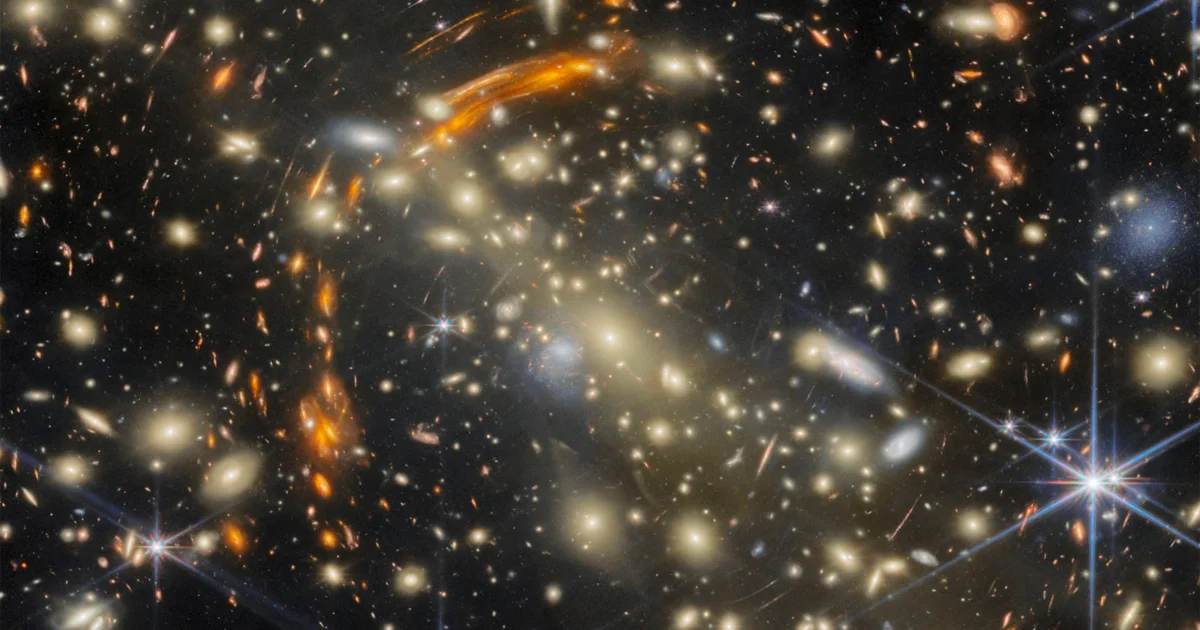
The collaboration of the National Aeronautics and Space Administration (NASA), the European Space Agency (ESA), and the Canadian Space Agency (CSA) has once again redefined our understanding of the cosmos. Released as the newest NASA/ESA/CSA James Webb Space Telescope (JWST) Picture of the Month, a breathtaking new image of the galaxy cluster MACS J0454.1-0300 stands as one of the most powerful and visually arresting examples of gravitational lensing ever recorded in astronomical history.
Described by ESA Webb scientists as a "cosmic house of mirrors," the image presents a galactic carnival where background galaxies are warped, stretched into luminous arcs, and multiplied across the expanse of space. Located five billion light-years away from Earth, the foreground cluster MACS J0454.1-0300 acts as a massive magnifying glass, allowing modern astronomy to peer deep into the primordial universe. Because the light captured in this observation traveled across space for billions of years, astronomers are effectively viewing these celestial bodies as they existed when the universe was merely eight billion years old—a true cosmic time machine operating on a grand scale.
Main Facts: Unlocking the Mechanics of Spacetime
At the heart of this discovery is the fundamental physics governing our universe. Gravitational lensing is not merely a visual trick; it is a profound manifestation of Albert Einstein’s general theory of relativity, first published in 1915. According to this cornerstone of modern physics, space and time are inextricably linked into a four-dimensional fabric known as spacetime.
When celestial objects of immense mass—such as massive galaxy clusters—occupy this fabric, they cause spacetime to curve. What humans perceive as gravity is, fundamentally, the physical curvature of this spacetime fabric. As light from distant background sources travels across the universe, its trajectory is bent and altered by the massive gravitational fields it encounters along the way.
"Extremely massive celestial bodies such as galaxy clusters cause spacetime to be significantly curved," explains the ESA Webb documentation team. "In other words, they act as gravitational lenses."
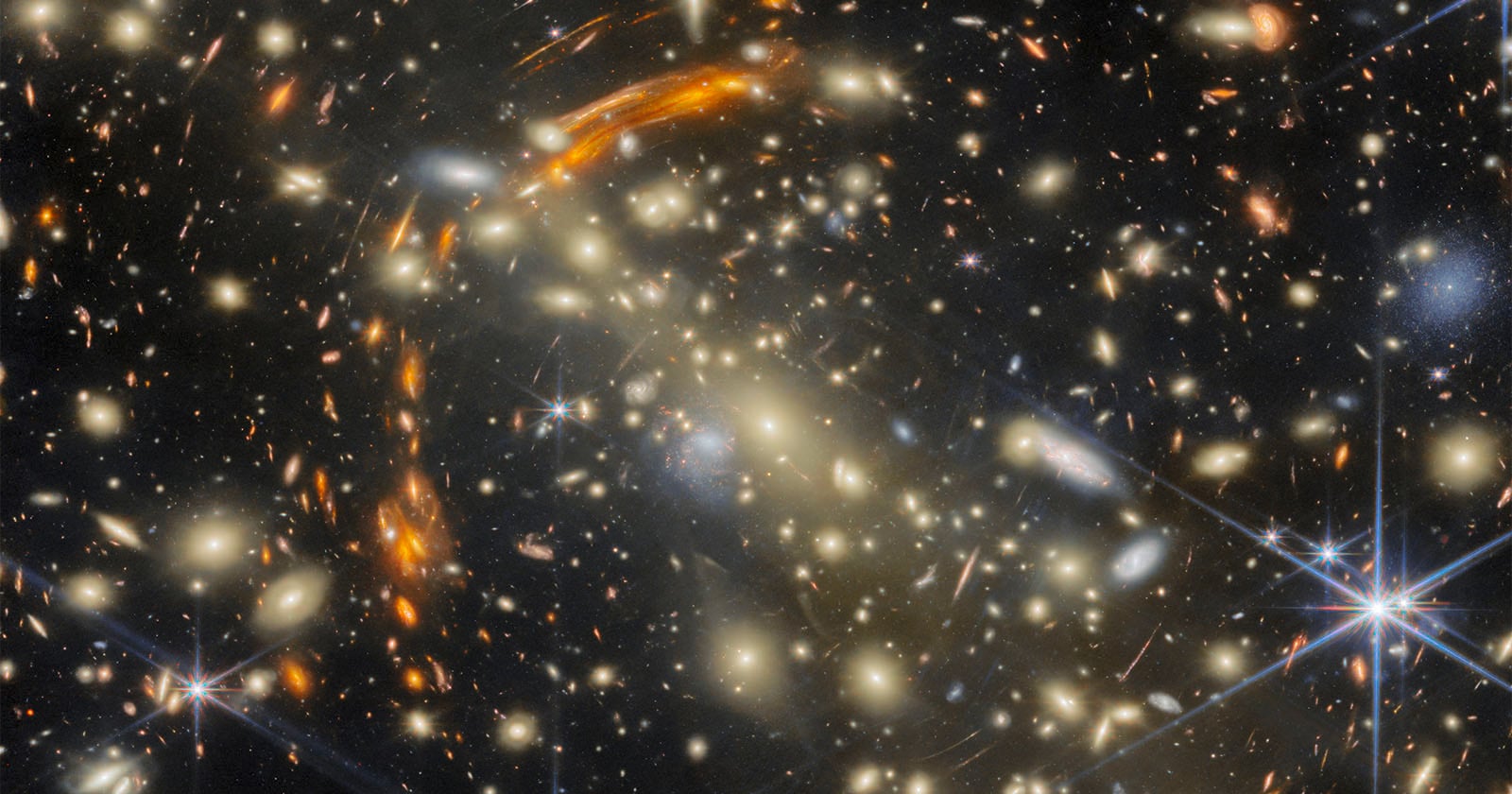
Beyond merely distorting the shape of light, these natural gravitational lenses function identically to optical magnifying glasses. They bend and concentrate light waves from objects that would otherwise remain permanently invisible to humanity—objects residing far beyond the standard detection limits of even our most sensitive instruments, rendered too faint and distant by the sheer expansion of the cosmos.
By pairing this naturally occurring magnification effect with the unprecedented gathering power of the JWST’s 6.5-meter beryllium-gold primary mirror, scientists have repeatedly shattered records for observing the most distant galaxies in the universe. This capability does not simply yield aesthetically striking imagery; it fundamentally extends humanity’s reach into the chronological history of the cosmos, providing direct empirical data on how early galaxies formed, evolved, and populated the nascent universe.
Chronology: From Hubble’s Early Gaze to Webb’s Revolution
To fully appreciate the technological leap represented by the new JWST image, it is necessary to examine the chronological progression of our observations of this specific sector of the sky.
- 2014: Twelve years prior to the current Webb release, the pioneering Hubble Space Telescope trained its instruments on the MACS J0454.1-0300 galaxy cluster. While groundbreaking for its time, Hubble’s optical and near-ultraviolet capabilities captured a dense field of distant galaxies interspersed with sharp, prominent foreground stars, establishing the baseline catalog for this cluster.
- The Intervening Years: As astronomical theories surrounding dark matter, galaxy formation, and gravitational lensing matured, researchers recognized that MACS J0454.1-0300 held untapped potential. However, ground-based and older space-based observatories lacked the infrared sensitivity required to pierce through the cosmic dust and capture the exceptionally redshifted light of the most distant, obscured background structures.
- September 2026: The James Webb Space Telescope targets MACS J0454.1-0300 as part of its ongoing mission cycles. Utilizing its advanced Near-Infrared Camera (NIRCam) and Mid-Infrared Instrument (MIRI), JWST captures an observation that radically transforms our visual and scientific catalog of the region. The resulting image reveals hundreds of background and embedded galaxies completely absent from Hubble’s historic 2014 frame, proving that these structures were present all along, waiting for an instrument sensitive enough to record their ancient, reddened light.
Supporting Data: Rare Configurations and Extreme Magnification
The newly published image of MACS J0454.1-0300 is remarkable not only for its clarity and depth, but also for specific geometric rarities that manifest within its borders.
Under precise physical conditions, gravitational lensing can multiply a single background source, projecting double, triple, or quadruple distinct images of the same galaxy across the observer’s field of view. These occurrences require a delicate alignment: the exact physical position of the background source, the mass distribution of the foreground lens, and the specific curvature of spacetime must align with extraordinary precision.
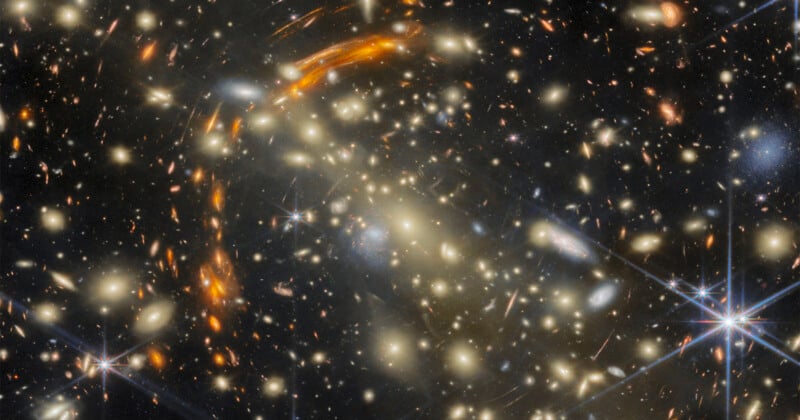
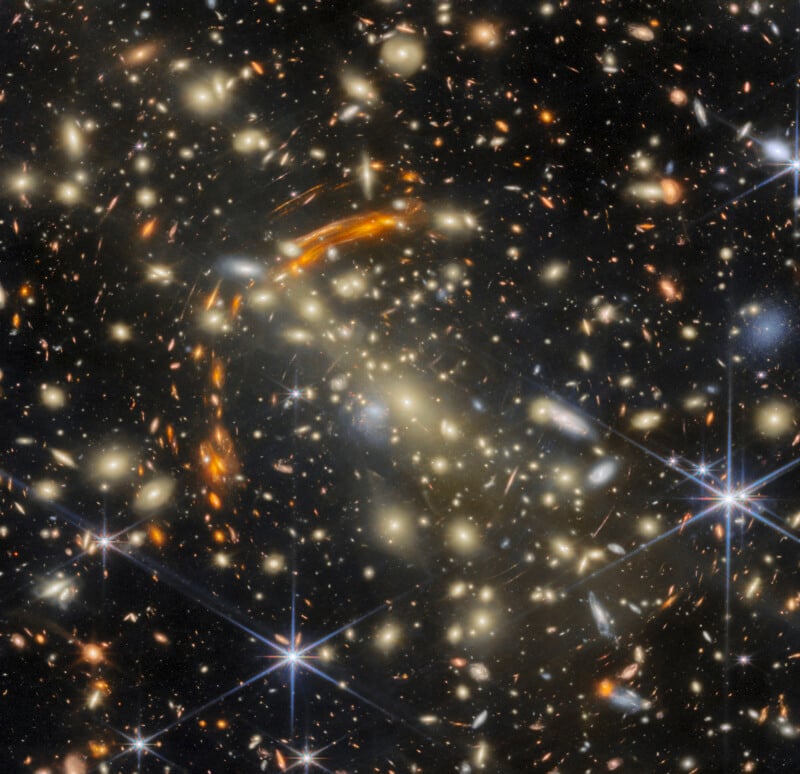
According to ESA Webb statistical data, this multi-image phenomenon—specifically yielding four or more distinct projections of a single background galaxy—is remarkably uncommon, appearing in only 10% to 20% of observed galaxy clusters. However, the latest JWST observation displays this "rare configuration" twice within the exact same image. Astronomers confirm that this is the first documented instance of a single galaxy cluster exhibiting multiple instances of this rare quadruple-image phenomenon simultaneously.
Furthermore, the scale of magnification achieved in specific localized pockets of the lens reaches staggering proportions. Certain regions within the gravitationally lensed arcs have been magnified by a factor of 300. This extreme amplification allows astrophysicists to resolve internal structures, star-forming regions, and galactic dynamics within early-universe galaxies that would otherwise appear as monolithic, structureless points of light.
Official Responses and Scientific Context
The astronomical community has responded to the release of the MACS J0454.1-0300 image with immense enthusiasm, viewing it as both a technical triumph and an invaluable scientific dataset. Researchers L. Furtak and S. Fujimoto, whose analytical work underpins the scientific processing of these observations, emphasize that images like this serve as vital laboratories for testing cosmological models.
"When we look at structures warped and multiplied like they stepped into a galactic carnival, we aren’t just looking at pretty pictures," notes a preliminary processing brief from the ESA/Webb science operations center. "We are looking at precise maps of mass—both luminous and dark—within the universe."
Because ordinary matter (stars, gas, and dust) accounts for only a fraction of a galaxy cluster’s total mass, gravitational lensing provides astrophysicists with a unique tool to map the distribution of dark matter. Since dark matter does not emit, absorb, or reflect light, it is entirely invisible to conventional telescopes. However, because dark matter possesses mass, it contributes directly to the gravitational curvature of spacetime. By measuring precisely how background light is bent, stretched, and multiplied around clusters like MACS J0454.1-0300, scientists can reconstruct the invisible architecture of the cosmos, weighing galaxy clusters with unprecedented precision.
Implications: Redefining Our Place in Space and Time
The implications of the MACS J0454.1-0300 observation extend far beyond the immediate excitement of a new Picture of the Month release. Each successful utilization of gravitational lensing as a natural telescope expands the empirical boundaries of observational cosmology.
- Refining Cosmological Models: By analyzing the exact geometry of multiplied and warped galactic images, theorists can test the limits of General Relativity in extreme gravitational regimes millions of light-years away from our solar system.
- Mapping Dark Matter Distribution: The detailed gravitational mapping enabled by high-resolution infrared imaging helps scientists understand how dark matter scaffolds the formation of large-scale structures, dictating how galaxies aggregate, collide, and evolve over billions of years.
- Probing the Epoch of Reionization: Capturing light from galaxies existing when the universe was only eight billion years old—and pushing toward even earlier epochs via magnification—provides crucial data on the chemical evolution of the universe, shedding light on how heavy elements were forged and distributed following the Big Bang.
As the James Webb Space Telescope continues its multi-year survey of the deep universe, observations like the "cosmic house of mirrors" in MACS J0454.1-0300 demonstrate that the universe remains full of hidden wonders. What once required theoretical speculation is now rendered in stunning, high-resolution clarity, bridging the gap between Einstein’s 20th-century equations and 21st-century space exploration.
 Reynand Wu
  Basiran
  Lina Irawan