
 By Basiran
WASHINGTON — As public opinion shifts rapidly across the globe and citizens grapple with complex questions regarding democracy, identity, and international relations, maintaining the integrity of data collection has never been more critical. The Pew Research Center has released its comprehensive methodological architecture for its major 2026 initiatives, including the Spring 2026 Global Attitudes Survey, Wave 190 of the American Trends Panel (ATP), and the 2026 National Public Opinion Reference Survey (NPORS).
These foundational frameworks offer a rare, transparent look into how premier research organizations tackle declining response rates, navigate the challenges of digital and offline communication divides, and construct representative samples of diverse populations. By combining multi-mode recruitment strategies, meticulous weighting protocols, and targeted oversampling, the center aims to capture an accurate snapshot of public sentiment in the United States and abroad.
Main Facts: The Scope and Scale of 2026 Research
The methodologies released by Pew Research Center outline three distinct, massive research operations designed to evaluate societal trends, political ideologies, and public trust in democratic institutions.

First, the Spring 2026 Global Attitudes Survey draws on cross-national datasets compiled via telephone, face-to-face, and online interviews conducted under the expert direction of Gallup, Langer Research Associates, and the Social Research Centre. To make meaningful international comparisons, Pew standardizes variables such as education levels using the United Nations’ International Standard Classification of Education (ISCED). Furthermore, economic comparisons are anchored by World Bank classifications, separating nations into high-income and middle-income categories based on per capita gross national income—a framework previously utilized in prominent studies analyzing global views of China, satisfaction with democracy, and international perspectives on globalization.
Domestically, the data relies heavily on two primary instruments:
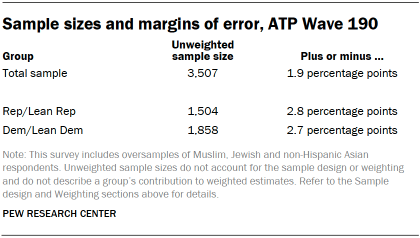
- The American Trends Panel (ATP) Wave 190: Conducted between March 23 and March 29, 2026, this wave surveyed 3,507 randomly selected U.S. adults out of 4,046 sampled panelists, yielding a survey-level response rate of 87% (and a cumulative response rate of 3%). Administered by SSRS primarily online (3,377 respondents) and via live telephone interviews (130 respondents), the survey carried a full-sample margin of error of plus or minus 1.9 percentage points at the 95% confidence level.
- The 2026 National Public Opinion Reference Survey (NPORS): Fielded from Jan. 30 to June 18, 2026, NPORS utilized an address-based sampling (ABS) and multi-mode protocol to reach 5,511 total respondents across the United States. This included 2,473 online completions, 2,694 paper survey submissions, and 344 phone interviews, achieving an AAPOR Response Rate 1 of 30%. The resulting overall margin of error, adjusted for design effects, stood at plus or minus 1.8 percentage points.
Chronology: The Lifecycle of a Major Survey Wave
Understanding how contemporary public opinion data moves from conception to publication requires tracing the distinct timelines of Pew’s data collection phases.
The American Trends Panel (ATP Wave 190) Timeline
- March 20, 2026: Pre-notification postcards are mailed to a subset of telephone panelists to prepare them for upcoming outreach.
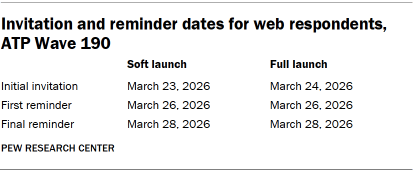
- March 23, 2026: The field period officially opens. Postcard notifications are mailed to select online panelists. A "soft launch" involving 60 panelists is initiated to test system logic, randomized question sequences, and mobile/PC compatibility. Dialing for phone interviews also begins.
- March 24, 2026: The full launch is deployed. Email and SMS invitations are sent out to all remaining English- and Spanish-speaking online panelists.
- March 23 – March 29, 2026: Active data collection period. Follow-up email and SMS reminders are staggered for non-respondents. Telephone interviewers conduct up to six call attempts per targeted household.
- Post-Field Period: Data quality checks identify and scrub satisficing behavior (such as straight-lining or excessive non-response), resulting in the removal of five respondents prior to weighting. Final raking and trimming procedures are applied to align the data with national demographic benchmarks.
The National Public Opinion Reference Survey (NPORS) Timeline
- January 30, 2026: Initial mailings are dispatched to 19,860 sampled households via first-class mail in 9-by-12-inch window envelopes. These contain a unique URL, QR code, toll-free telephone number, and two visible $1 bills as a pre-incentive to encourage participation.
- Early-to-Mid Spring 2026: Non-responding households receive reminder postcards followed by reminder letters.
- Mid-Spring 2026: After the primary web data collection window concludes, non-responding households with deliverable addresses are sent a Priority Mail envelope containing a $5 bill, a paper questionnaire (11-by-17-inch folded booklet), and a postage-paid return envelope. A second paper questionnaire is later sent via first-class mail to maximize yield.
- June 18, 2026: The extensive field period officially closes.
- Summer 2026: Data processing begins, incorporating adaptive mode adjustments, base weighting, raking calibration against noninstitutionalized U.S. adult population parameters, and design effect calculations.
Supporting Data: Ensuring Demographic Representation
Modern survey research faces continuous headwinds from declining response rates and shifting communication habits. To counteract these vulnerabilities, Pew employs sophisticated sampling designs, oversampling, and multi-stage weighting.
Tackling Underrepresented Groups via Oversampling
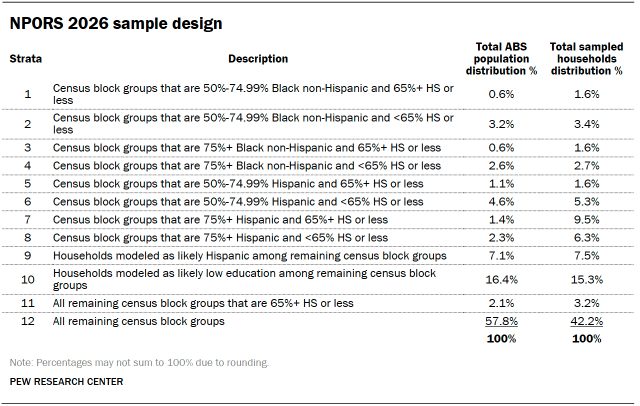
A cornerstone of Pew’s 2026 domestic strategy is the deliberate oversampling of smaller demographic subgroups. In ATP Wave 190, Muslim, Jewish, and non-Hispanic Asian adults were oversampled to provide statistically reliable insights into communities that might otherwise be obscured in standard random samples. Similarly, the NPORS sample design utilized stratified random sampling based on census block groups, focusing heavily on population density variations among racial, ethnic, and educational attainment demographics. Households in heavily Hispanic strata—alongside addresses predicted to have a high likelihood of Hispanic occupancy—received bilingual (English and Spanish) materials from the outset.
Weighting and Calibration Protocols
Raw survey data rarely mirrors the exact demographic breakdown of a nation. To correct for differential probabilities of selection, non-response to recruitment surveys, and panel attrition, Pew applies a rigorous multi-step weighting process:
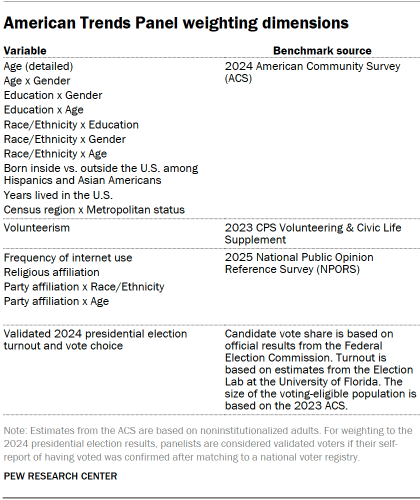
- Base Weights: Every respondent is assigned an initial base weight reflecting their specific probability of recruitment into the panel or selection from the U.S. Postal Service Computerized Delivery Sequence File.
- Raking Calibration: Base weights are adjusted through iterative proportional fitting (raking) to align with independent population benchmarks. These parameters account for age, gender, education, race, ethnicity, geographic region, and population density.
- Trimming: To prevent extreme weights from inflating variance and reducing statistical precision, weights are trimmed at the 1st and 99th percentiles.
- Design Effect (deff): For NPORS, the design effect—which accounts for how complex sample designs depart from simple random sampling—was factored into the final calculations, resulting in a conservative margin of error of $pm 1.8$ percentage points for full-sample estimates.
Official Responses and Methodological Rationales
Methodological transparency is vital for maintaining public and academic trust in survey research. Representatives and research directors at Pew Research Center emphasize that these protocols are continuously adapted to address real-world behavioral changes.
"Polling is not a static science; it evolves alongside the ways people communicate, consume media, and interact with the postal and digital worlds," notes internal methodological documentation from the center. By utilizing address-based sampling (ABS)—which covers an estimated 90% to 98% of U.S. households via the USPS delivery sequence file—Pew bypasses the historic limitations of landline-only or cell-phone random-digit-dialing methods.
Furthermore, the strategic use of financial incentives is defended as an operational necessity rather than a mere convenience. Incentives ranging from pre-paid cash bills ($2 in initial mailings) to post-paid electronic gift codes ($5 to $20 depending on the target group’s historical response propensity) are deployed to engage historically hard-to-reach populations, such as younger adults, lower-income households, and specific minority communities.
To safeguard data validity against malicious actors or disengaged respondents, automated and manual data quality checks are rigorously applied. Algorithms flag indicators of "satisficing"—such as respondents completing surveys in unrealistically short timeframes or systematically selecting the first available answer option—ensuring that compromised responses are eliminated before analysis begins.
Implications for Future Public Policy and Societal Discourse
The release of Pew Research Center’s 2026 methodology extends far beyond academic interest; it directly impacts how policymakers, journalists, and civic leaders interpret public opinion data.
As debates intensify around topics such as the health of democratic systems, the influence of social media on political polarization, and national identity, the baseline credibility of the data depends entirely on the mechanics of its collection. By transparently publishing error margins, response rates, disposition tables, and weighting dimensions, Pew sets a high benchmark for empirical accountability.
For policymakers, these findings provide a reliable mirror reflecting citizen satisfaction and ideological division. Whether examining how high-income versus middle-income nations view global economic structures, or tracking how American demographic subgroups perceive institutional integrity, policymakers rely on unbiased samples to shape legislative priorities.
Ultimately, the rigorous blueprint behind the 2026 surveys demonstrates that robust public opinion research remains achievable, provided organizations are willing to invest in multi-mode outreach, transparent adjustments, and uncompromising data hygiene.
 Lina Hope
  Siti Muinah
  Asep Darmawan