
 By Evan Lee Salim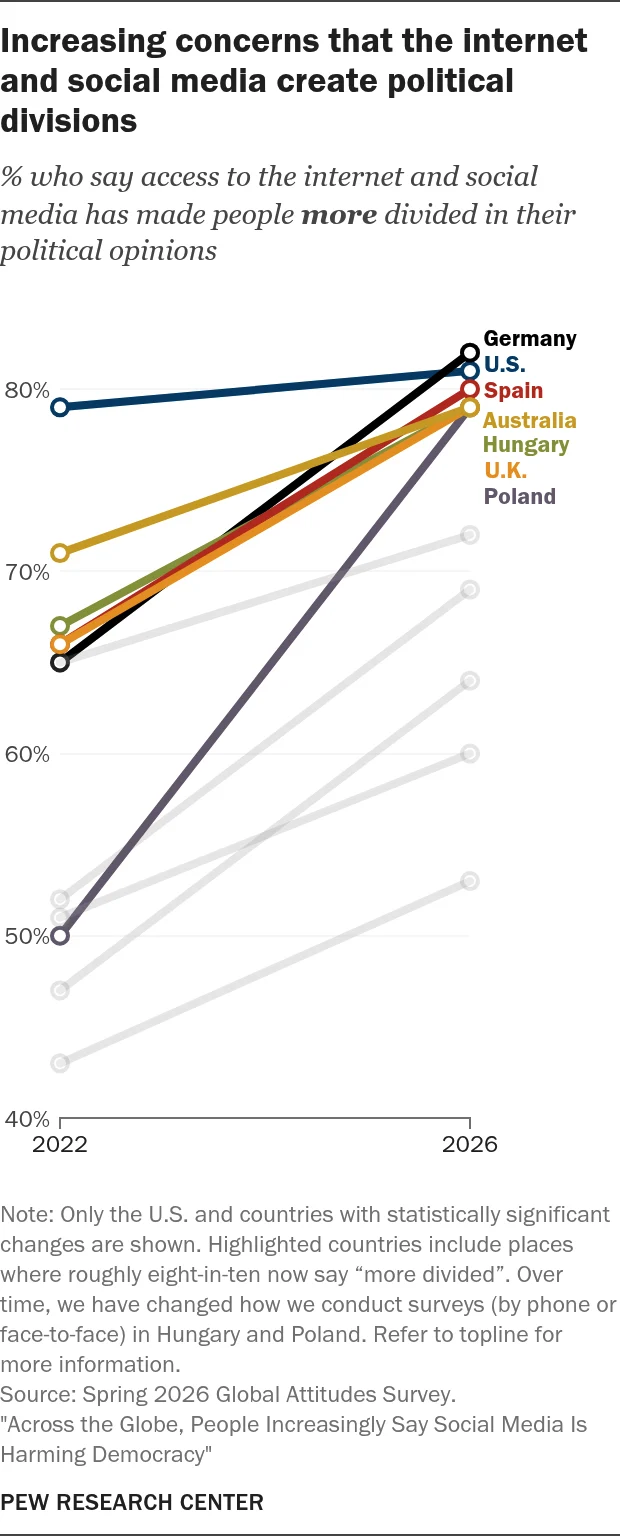
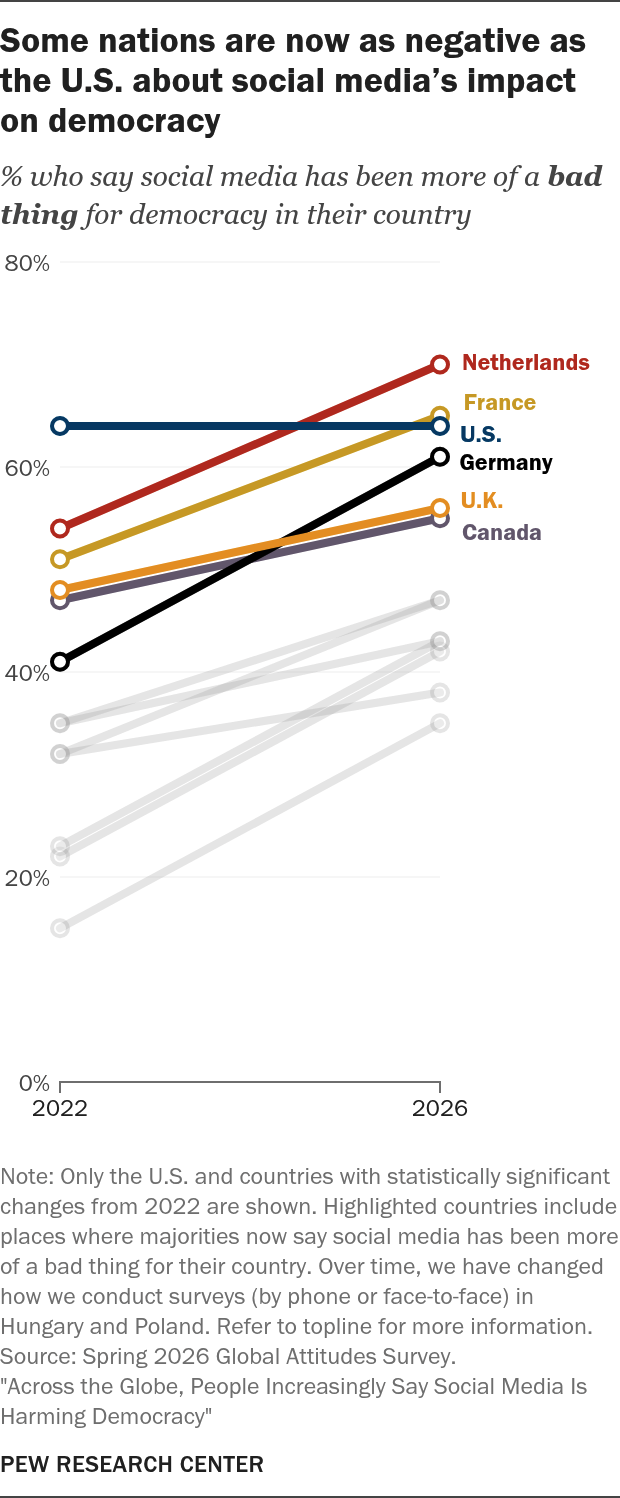
WASHINGTON — For years, the United States stood almost entirely alone at the vanguard of digital cynicism. When pollsters asked Americans if social media had been a net-positive or a destructive force for democratic institutions, the consensus was overwhelmingly bleak. Back in 2022, 64% of U.S. adults surveyed by the Pew Research Center declared that social media was a “bad thing” for democracy—a figure that placed the country a striking 10 percentage points ahead of its closest peer in public skepticism, the Netherlands.
Today, that lonely landscape of digital pessimism has vanished.
According to a sweeping, comprehensive 37-nation global survey conducted by the Pew Research Center between February and June 2026, the rest of the world has caught up to the United States. While American sentiment has remained steadfastly grim—with exactly 64% of U.S. adults maintaining their negative outlook—citizens across numerous high-income allied nations have dramatically shifted their views. Disillusionment with the digital public square is no longer an American exception; it has become a global democratic phenomenon.
Main Facts: A Paradigm Shift in Global Perceptions
The 2026 Global Attitudes Survey encompasses responses from 42,151 adults across 36 countries, paired with extensive U.S. polling data. The findings paint a sobering picture of how populations view the intersection of technology, political discourse, and democratic resilience.
Most notably, public sentiment has soured drastically across the globe. The share of the public believing social media has harmed democracy has grown in 16 of the 26 countries where comparative trend data from 2022 or 2023 is available.
Among the primary takeaways:
- The Netherlands Surpasses the U.S.: In a striking reversal, the Dutch are now even more pessimistic than Americans. Today, 70% of people in the Netherlands say social media has been bad for democracy—a massive leap from 54% just four years prior.
- Europe Matches American Skepticism: Negative evaluations have surged across Western Europe. France (65%) and Germany (61%) now mirror or closely trail American levels of discontent.
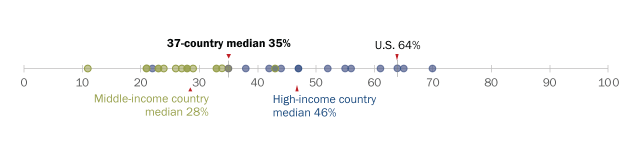
- The Income Divide: High-income nations are significantly more critical of social media’s political footprint than middle-income countries. While the median percentage of respondents in high-income nations viewing social media as a "bad thing" sits at 46%, the median for middle-income countries drops to 28%.
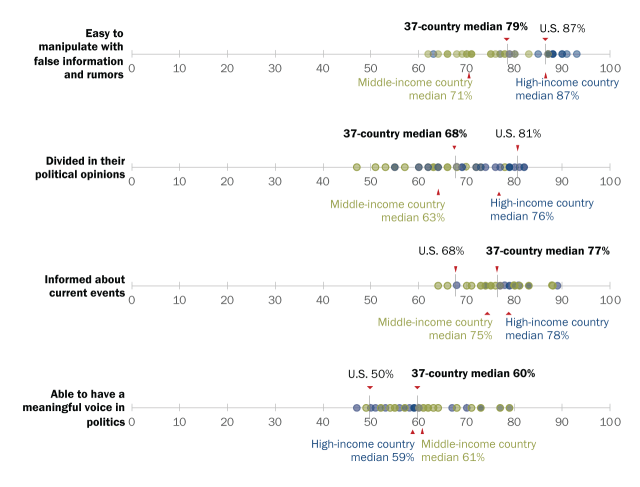
- The Ubiquity of Misinformation: Across all surveyed borders, a staggering majority—a 37-country median of 79%—agrees that access to the internet and social media has made individuals easier to manipulate with false information and rumors.
Chronology: The Evolution of Digital Discontent
To understand how the international community arrived at this juncture, it is vital to trace the timeline of public opinion over the past several years, mapping the transition from utopian optimism to widespread democratic anxiety.
Phase 1: The Era of Connective Optimism (Pre-2016)
For the better part of two decades, social media platforms were heralded by tech executives, civil society, and policymakers as engines of democratization. From the Arab Spring to decentralized grassroots organizing, platforms like Facebook, Twitter (now X), and YouTube were credited with empowering ordinary citizens, bypassing state-controlled media, and fostering global connectivity.
Phase 2: The Awakening and U.S. Divergence (2016–2022)
Following successive political shocks—including the 2016 U.S. presidential election, the Brexit referendum, and escalating concerns over targeted disinformation campaigns and data privacy scandals (such as Cambridge Analytica)—public sentiment began to fracture. By 2022, when the Pew Research Center first systematically polled 19 mostly high-income countries on social media’s democratic impact, a clear divergence emerged. The U.S. pulled away as the most critical nation (64% negative), while many European and Asian publics remained more cautiously optimistic or indifferent.
Phase 3: The Global Convergence (2022–2026)
The latest 2026 data marks a period of profound global convergence. Over the four-year span from 2022 to 2026, populations in countries like the United Kingdom, Canada, Spain, and Sweden experienced intensifying political polarization, culture wars, and election integrity crises. Consequently, skepticism that was once uniquely American permeated foreign borders. By early 2026, nations like Germany, France, and the U.K. saw double-digit jumps in public distrust, closing the gap with the United States.
Supporting Data: Deep-Dive Statistics from the 2026 Survey
The empirical data gathered by Pew researchers across 37 nations illustrates a multifaceted crisis of confidence in the modern information ecosystem.
1. Impact on Political Polarization
When asked whether access to the internet and social media has made people more divided in their political opinions, the global consensus points heavily toward yes.
- The U.S.: 81% (virtually unchanged from 79% in 2022).
- Germany: 82% (up significantly from 65% in 2022).
- Spain: 80% (up from 66%).
- U.K. and Australia: Both stand at 79%, up from 66% and 71% respectively.
- Global Median: Across all 37 nations, 68% feel social media deepens political divisions.
2. Vulnerability to Manipulation and Rumors
The fear that digital spaces make populations susceptible to malicious manipulation unites virtually all developed and developing economies alike.
- The Netherlands: 93% (the highest globally).
- U.K.: 91%.
- Sweden: 90%.
- U.S. and Canada: Both track at 87%.
- Global Median: 79% of respondents across all surveyed countries believe social media facilitates manipulation via false information and rumors.
3. Assessing Platform Preferences and Demographics
The survey also mapped platform usage across the globe, revealing that American habits closely mirror international trends.
- Facebook remains the dominant global giant, though demographic usage varies. In the U.S. and other high-income economies, adults aged 35 to 49 are the most frequent users, whereas in middle-income countries, platforms are heavily dominated by those under 35.
- Instagram and TikTok maintain massive strongholds among younger cohorts (ages 18 to 34) universally.
- X (formerly Twitter) accounts for a modest share, with 18% of Americans and an identical 18-country median reporting regular use.
- Snapchat proves to be an outlier where Americans display higher-than-average engagement, with 26% of U.S. adults using the platform compared to a global median of 18%.
Official Responses and Methodological Rigor
The breadth of the 2026 survey required rigorous methodological design to ensure accurate cross-cultural comparisons. Researchers interviewed 42,151 individuals across 36 countries between February 8 and May 13, 2026, capturing representative samples of adult populations.
In the United States, data was synthesized from two distinct, highly reliable instruments:
- The American Trends Panel: Surveying 3,507 U.S. adults between March 23 and 29, 2026.
- The National Public Opinion Reference Survey (NPORS): Surveying 5,511 U.S. adults between January 30 and June 18, 2026.
Pew Research Center representatives noted that the initiative was designed to provide independent, transparent insights to decision-makers, journalists, and the global public as they grapple with rapid technological transformations—extending from social media algorithms to emerging artificial intelligence systems.
"Pew Research Center does research to help the public, media and decision-makers understand important topics," the organization stated in its methodological briefs. "We study how people around the world feel about their democracies and the impact of social media and other emerging technologies."
Official analysts highlighted that while populations in developing regions—such as Nigeria (11%), Ghana (21%), and India (23%)—currently report lower levels of democratic disillusionment regarding social media, the structural trajectory across high-income democracies points uniformly toward a crisis of trust.
Implications: What the Global Backlash Means for Democracy
The convergence of global sentiment surrounding social media carries profound implications for geopolitical stability, national security, regulatory policy, and the future of democratic governance.
1. Regulatory Pushback and Free Speech Debates
As citizens in countries like France, Germany, the U.K., and the Netherlands join Americans in viewing social media as a corrosive element to civic health, political leaders face intense domestic pressure to act. This public consensus provides legislative backing for aggressive regulatory frameworks—such as the European Union’s Digital Services Act (DSA)—aimed at holding tech conglomerates accountable for content moderation, algorithmic transparency, and data protection. However, it also ignites fierce debates concerning where to draw the line between mitigating harmful disinformation and infringing upon free expression.
2. The Erosion of Shared Reality
With roughly 80% of citizens in major Western democracies agreeing that platforms exacerbate political polarization and render populations vulnerable to manipulation, the foundational premise of a shared democratic reality is under siege. When electorates operate from fundamentally disjointed information ecosystems fueled by engagement-maximizing algorithms, compromise becomes nearly impossible. This structural distrust risks paralyzing legislative bodies and fueling populist movements worldwide.
3. Strategic Vulnerability in Geopolitics
The pervasive belief that digital networks make nations easy to manipulate leaves democratic societies uniquely vulnerable to foreign interference, covert influence operations, and domestic bad actors. Adversarial nation-states can effortlessly weaponize existing social fractures, knowing that public skepticism toward institutional information sources is already at an all-time high.
Conclusion
The 2026 Pew Research Center findings mark a definitive turning point in the digital age. The era of uncritical techno-optimism is officially dead. What began a decade ago as a uniquely American realization has metastasized into a shared global diagnosis: social media, in its current design, poses a fundamental threat to the health of democratic institutions. As countries from the Americas to Europe grapple with these sobering realities, the pressure on lawmakers, civil society, and technology platforms to fundamentally restructure the digital public square has never been more urgent.
 Pevita Pearce
  Raul Delapena Setiawan
  Suro Senen