
 By Pevita Pearce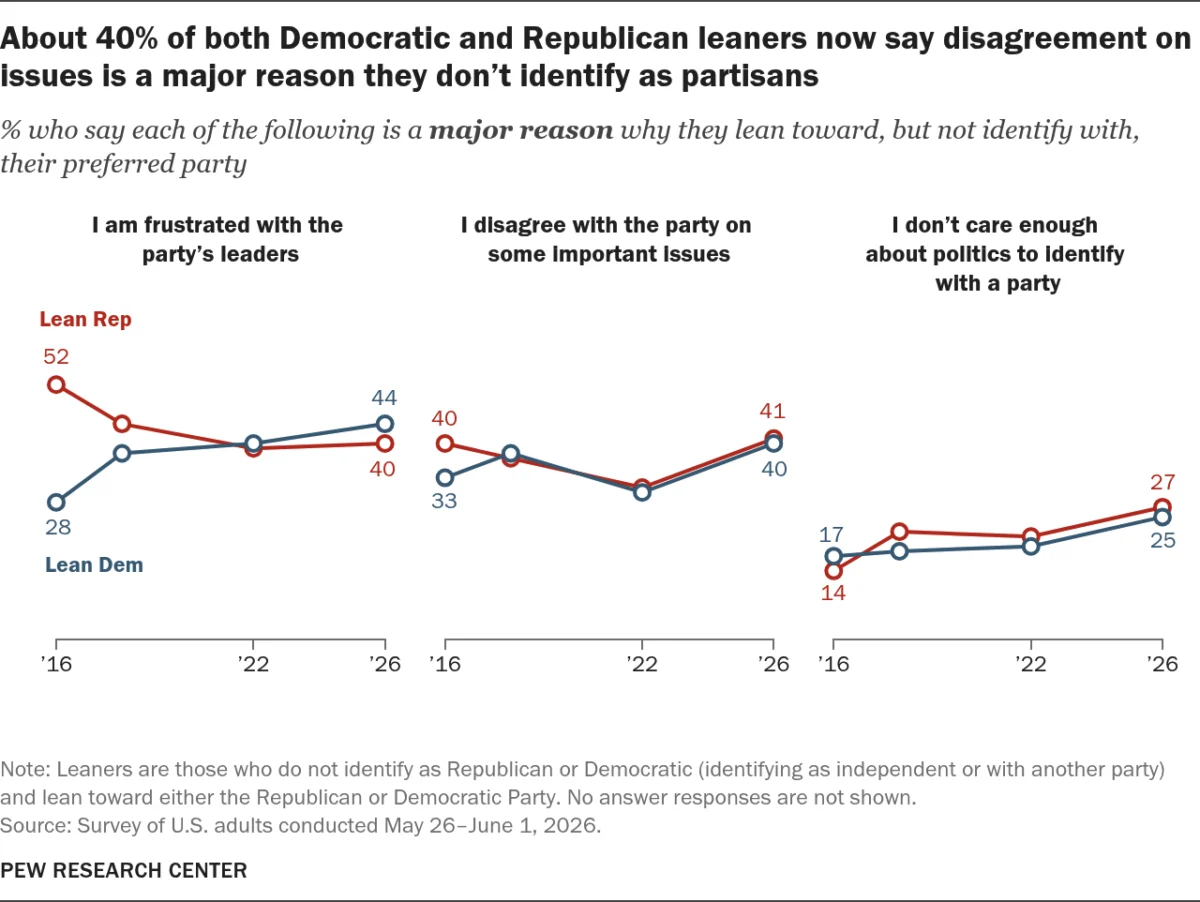
WASHINGTON — In an era defined by intense political polarization, the motivations driving how Americans view and participate in the political system are undergoing a profound psychological shift. While the vast majority of U.S. adults ultimately align themselves with either the Republican or Democratic Party, a comprehensive new study reveals that this affiliation is increasingly fueled less by a ringing endorsement of their own side’s agenda and more by a visceral opposition to the opposition.
According to a nationwide survey of 9,750 U.S. adults conducted by the Pew Research Center between May 26 and June 1, 2026, the mechanics of political identity reveal a stark paradox. While hardcore partisans are largely split evenly between pride in their own party’s policies and fear of the other side’s platform, political "leaners"—the vast pool of self-identified independents who tilt toward one of the two major parties—are overwhelmingly motivated by a desire to block the opposing party. Furthermore, a growing rift over policy disagreements and leadership frustration is keeping millions of Americans from fully committing to a political label.
Main Facts: The Core Drivers of Political Identity
To understand the contemporary American voter, researchers must look beyond the binary choice of the ballot box and examine the underlying psychology of party identification. The Pew Research Center analysis dissects these dynamics by separating voters into two distinct categories: dedicated partisans (those who explicitly identify as Republicans or Democrats) and leaners (independents or third-party identifiers who lean toward one of the major parties).
The findings paint a vivid picture of a deeply reactive political landscape:
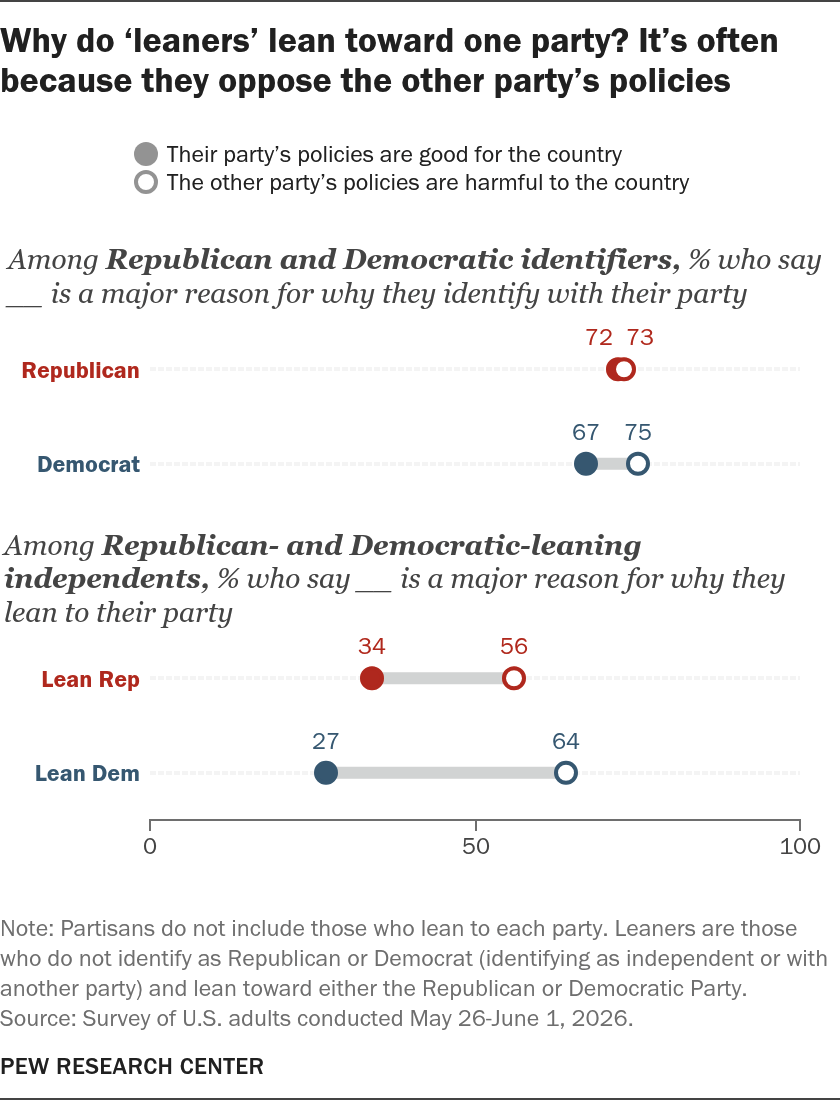
- The Partisan Split: Among self-identified Republicans, 72% cite the benefits of their party’s policies as a major reason for their affiliation, while 73% point to the perceived harm caused by Democratic policies. Among Democrats, 67% cite the merits of their own platform, while an even higher 75% point to the dangers of Republican policies.
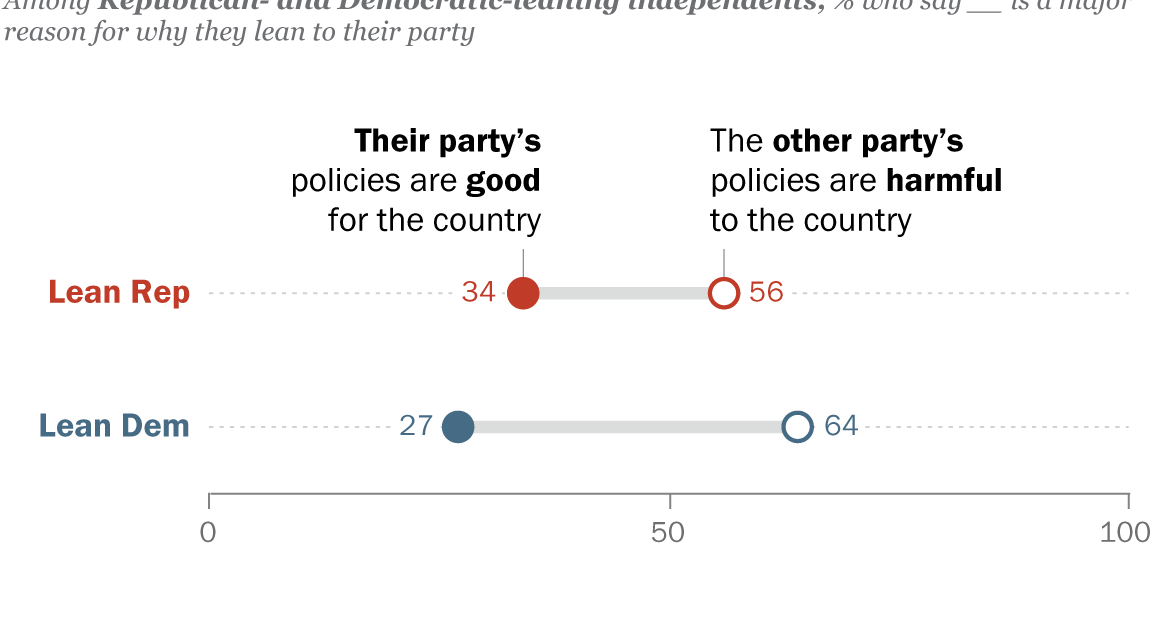
- The Power of Opposition for Leaners: For independent leaners, negative partisanship reigns supreme. A clear majority of Republican leaners (56%) and Democratic leaners (64%) say that the harmful nature of the opposing party’s policies is a major reason they tilt the way they do. By contrast, far fewer leaners cite the positive attributes of their preferred party (34% of Republican leaners and 27% of Democratic leaners).
- The Resistance to Full Affiliation: Approximately 40% of both Republican and Democratic leaners state that a major reason they refuse to formally join a party is that they fundamentally disagree with it on important issues. Another roughly 40% in both camps point directly to frustration with party leadership.
Chronology: A Decade-Long Slide Toward Discontent
The trajectory of independent "leaners" has not remained static. Historical data captured across successive Pew Research Center surveys highlights a gradual, yet steady, escalation in voter alienation and policy friction over the past ten years.
- The 2016 Landscape: In the wake of a contentious primary cycle leading up to the 2016 presidential election, political disaffection looked different. Back then, 52% of Republican leaners cited frustration with party leadership as a major reason they refused to join the GOP, compared to just 28% of Democratic leaners. Disagreement on issues stood at 40% for Republican leaners and 33% for Democratic leaners.
- The 2018 Midterm Shift: Following the 2018 midterms, the divide began to normalize. Frustration with GOP leadership dipped slightly to 44%, while Democratic leaners experiencing leadership frustration ticked up to 38%. Disagreement on core issues remained relatively steady at 37% and 38% for Republican and Democratic leaners, respectively.
- The 2022 Post-Pandemic Reality: By 2022, disillusionment had stabilized at historically high levels. Roughly 39% of Republican leaners and 40% of Democratic leaners reported deep frustration with their preferred party’s leadership. Meanwhile, roughly 30% in both groups pointed to issue-based disagreements as a barrier to formal affiliation.
- The 2026 Reality Check: In the most recent 2026 data, dissatisfaction has surged to new heights. Issue-based disagreements have climbed to 41% for Republican leaners and 40% for Democratic leaners—representing a notable jump from four years prior. Concurrently, 44% of Democratic leaners now express frustration with their party’s leadership, matching or exceeding historical highs on both sides of the aisle.
Supporting Data: Breaking Down the Numbers
The empirical data gathered from the May–June 2026 survey offers granular insight into the hierarchy of motivations that sustain the American two-party system.
Why Partisans Identify With Their Party
When asked what constitutes a "major reason" for their party identification, core partisans across both groups prioritize policy outcomes above tribal loyalty, social circles, or cultural identity:
- The Other Party’s Policies are Harmful:
- Democrats: 75%
- Republicans: 73%
- My Party’s Policies are Beneficial:
- Republicans: 72%
- Democrats: 67%
- The Party Sticks Up For "People Like Me":
- Democrats: 56%
- Republicans: 53%
- I Have a Lot in Common With My Party:
- Republicans: 48%
- Democrats: 46%
- Most Friends and Family Belong to the Party:
- Democrats: 18%
- Republicans: 16%
Notably, while most of these metrics have remained stable since 2022, the share of Democrats citing the harm of Republican policies as a major factor jumped from 68% in 2022 to 75% today.
Why Independent Leaners Tilt Toward a Party
For the millions of Americans who reject the formal partisan label but consistently vote for one side, the calculus shifts dramatically away from positive reinforcement:
- The Other Party’s Policies are Bad for the Country:
- Democratic Leaners: 64%
- Republican Leaners: 56%
- My Preferred Party’s Policies are Good for the Country:
- Republican Leaners: 34%
- Democratic Leaners: 27%
- The Party Sticks Up For People Like Me:
- Democratic Leaners: 28%
- Republican Leaners: 23%
- I Have a Lot in Common With the Party:
- Republican Leaners: 22%
- Democratic Leaners: 21%
Why Leaners Refuse to Join Fully
When examining why these independent-minded voters explicitly decline to cross the line into formal party registration, two primary grievances dominate:
- Disagreement on Important Issues: 41% of Republican leaners and 40% of Democratic leaners cite this as a major deterrent—up significantly from 31% and 30% in 2022.
- Frustration with Party Leaders: 44% of Democratic leaners and 40% of Republican leaners point to leadership dissatisfaction as a primary reason for keeping their distance.
- Political Apathy: A smaller, though growing, subset—27% of Republican leaners and 25% of Democratic leaners—admit that they simply "don’t care enough about politics" to formally join a party, up from roughly 20% across the board in 2022.
Official Responses and Expert Analysis
Steven Shepard, Associate Director of Politics at the Pew Research Center, emphasizes that the data reflects a long-term evolution in how citizens interact with political institutions.
"What we are seeing is not merely a temporary flash of anger, but a structural shift in how Americans define their political citizenship," Shepard notes. "For a long time, political science assumed that people gravitated toward a party because they loved what it stood for. While that remains true for core partisans, the modern independent leaner is effectively engaging in defensive voting. They are parking themselves on one side of the political fence primarily because the fence on the other side looks dangerous."

Political analysts observing the survey data point out that this dynamic creates a unique challenge for campaign strategists. In contemporary elections, mobilizing the base and capturing the crucial "leaner" demographic relies heavily on framing the opposition as an existential threat. Positive messaging touting legislative achievements or economic proposals often takes a back seat to contrast ads designed to highlight the perceived failures and extreme positions of the rival party.
Furthermore, the rising tide of discontent among leaners—evidenced by the 10-point jump in issue-based disagreements since 2022—suggests that neither the Republican nor the Democratic establishment has a firm lock on the independent middle. Both parties face a precarious balancing act: they must appeal to their most ideologically driven core supporters to maintain enthusiasm, while simultaneously attempting to placate leaners who are increasingly sensitive to party overreach and tone-deaf leadership.
Implications: The Future of the American Electorate
The implications of Pew Research Center’s findings extend far beyond academic sociology; they strike at the heart of governance, legislative productivity, and democratic stability in the United States.
1. Campaigns Driven by Fear, Not Hope
When the primary motivator for political alignment is the fear of what the other side will do, political campaigns naturally adapt to this reality. Negative campaigning, apocalyptic rhetoric, and cultural wedge issues become rational strategies because they directly target the psychological triggers that bind independent leaners to a specific column. Positive, future-oriented policy visions risk being drowned out by an electorate conditioned to view politics as an exercise in damage control.

2. The Volatility of the Independent Bloc
While independent leaners behave very much like partisans inside the voting booth—consistently pulling the lever for their preferred party—their psychological detachment makes them a volatile constituency. Because roughly four-in-ten leaners feel alienated by party leadership and at odds with specific party policies, they are prime candidates for defection if they feel their chosen party has overstepped. This fluidity can lead to dramatic, unpredictable electoral shifts from one cycle to the next.
3. Intra-Party Friction and Governance
The widening gap between core partisans and independent leaners also complicates governance once elections are won. Lawmakers find themselves caught between an energized, uncompromising base that demands ideological purity and a skeptical body of leaners who are deeply critical of party leadership and specific legislative priorities. This dynamic often paralyzes Congress, making bipartisan consensus exceedingly difficult to achieve as members fear retribution from both the left or right extremes and disillusioned independents.
Ultimately, the 2026 Pew Research Center study serves as a sobering diagnostic of the American body politic. It reveals an electorate that is deeply engaged, highly protective, and profoundly dissatisfied. Until political institutions can rebuild trust in their leadership and bridge the chasms of policy disagreement, American partisanship will likely remain defined not by a shared vision for the future, but by a shared resistance to the alternative.
 Suro Senen
  Evan Lee Salim
  Raul Delapena Setiawan