
 By Nana Wu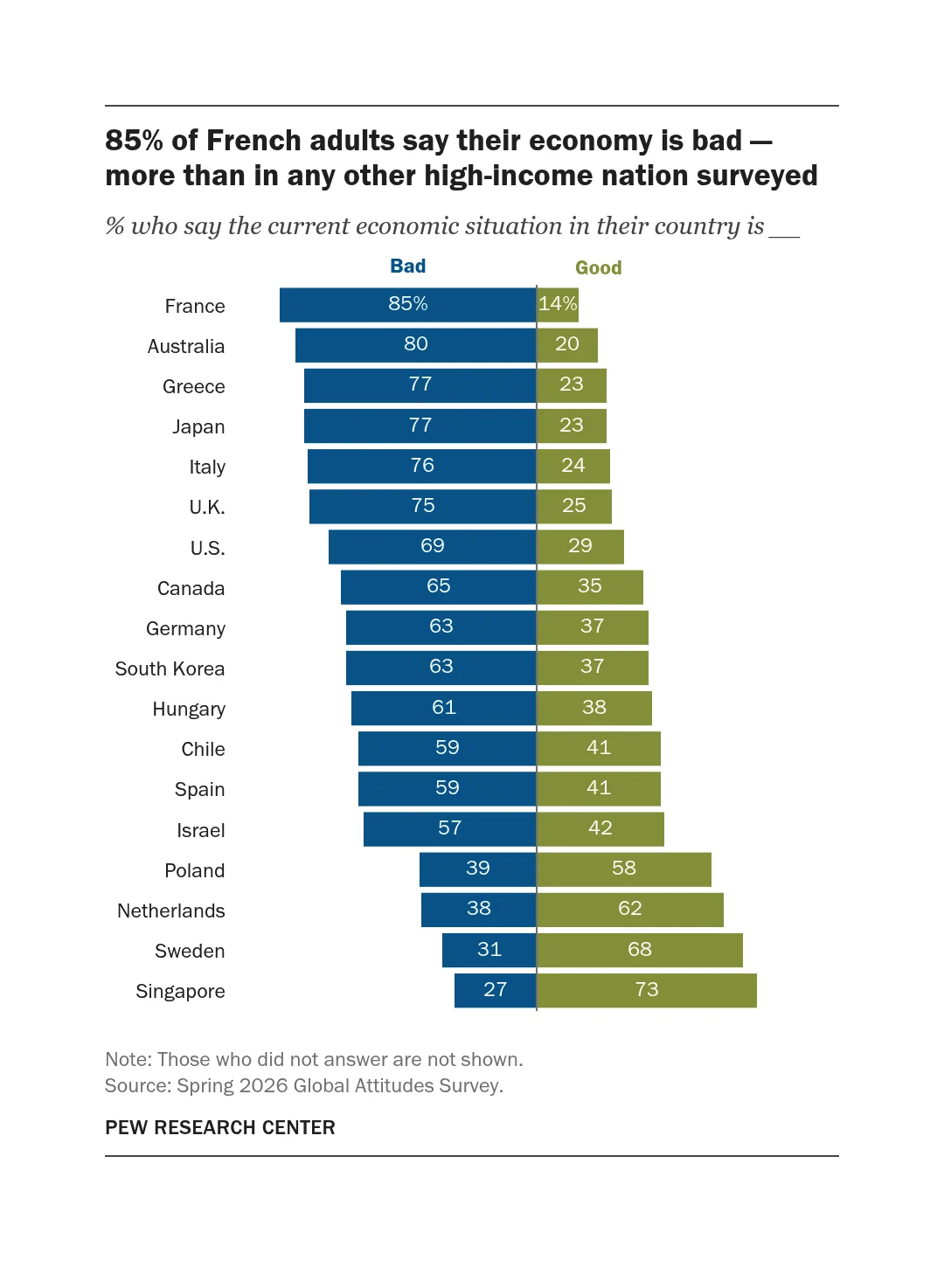
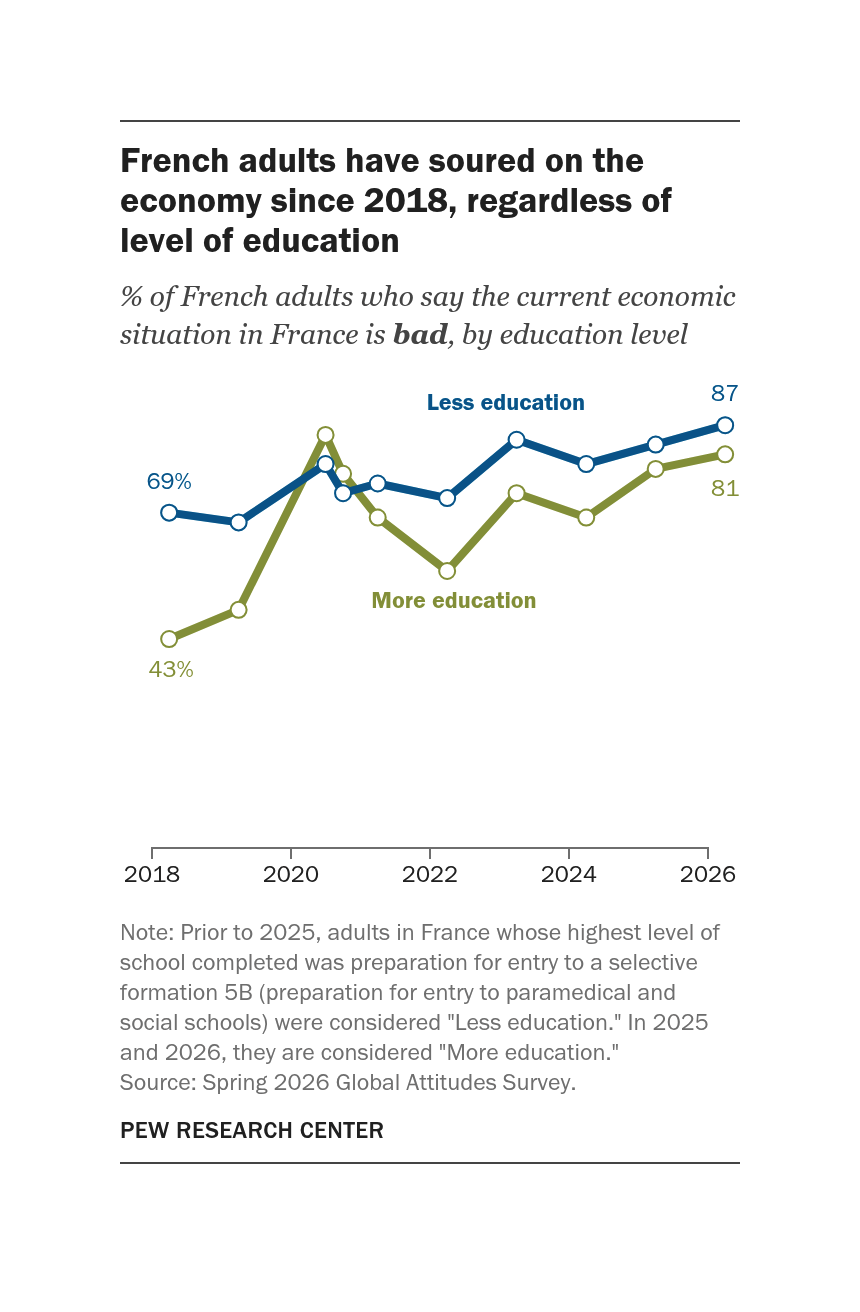
PARIS — Amid sweeping demonstrations that have brought hundreds of thousands of citizens into the streets, a comprehensive new international study reveals a deeply rooted societal crisis in France. According to a Spring 2026 Global Attitudes Survey conducted by the Pew Research Center, a staggering 85% of French adults view their country’s current economic situation as bad.
This historic level of pessimism positions France at the absolute bottom of economic sentiment among 18 high-income nations surveyed globally. The data paints a picture of a population profoundly alienated by fiscal realities—a sentiment driving fierce resistance against public spending cuts, overcrowded classrooms, and institutional decline.
Main Facts: The Anatomy of French Economic Despair
The Pew Research Center survey, which polled 1,006 adults across France between February 9 and April 17, 2026, highlights several critical metrics:

- Unmatched Pessimism: At 85%, France’s negative economic rating outpaces even chronically strained economies like Greece (77%) and Italy (76%), and dwarfs peer nations like the United Kingdom (75%), the United States (69%), and Germany (63%).
- Depth of Discontent: Approximately four in ten French respondents went so far as to describe the national economic situation as very bad.
- Universal Dissatisfaction: Economic gloom is no longer sequestered to specific demographics. It cuts sharply across age groups, education levels, and political affiliations, though right-wing populist supporters register the most extreme levels of discontent.
- Parallel Social Unrest: The release of the data coincides with widespread civil unrest. Hundreds of thousands have marched in French cities, protesting systemic issues such as underfunded, overcrowded schools and an intensifying national debt crisis.
Chronology of Crisis: From Pre-Pandemic Hope to Post-Crisis Disillusionment
To understand how France arrived at this juncture of historic economic pessimism, observers must trace the trajectory of public sentiment over nearly a decade. Longitudinal data from the Global Attitudes Survey illustrates a dramatic erosion of confidence:
1. The Pre-Pandemic Optimism (2018–2019)
- Spring 2018: Only 43% of highly educated French adults and 69% of those with less education viewed the economy negatively. While skepticism was already present, a substantial segment of the population retained hope in structural labor and tax reforms.
- Spring 2019: Negative economic views ticked upward slightly—49% among the highly educated and 67% among those with less education—as the initial friction of President Emmanuel Macron’s early labor reforms sparked friction, most notably through the Gilets Jaunes (Yellow Vests) movement.
2. The COVID-19 Shock (2020)
- Summer 2020: In the wake of the initial global coronavirus lockdowns, economic pessimism skyrocketed. Exactly 85% of adults with more education and 79% of those with less education labeled the economy bad. This matched the exact peak of national distress seen in the 2026 survey data, reflecting acute panic over pandemic-era business closures.
- Fall 2020: A brief stabilization occurred as government intervention cushioned the blow, bringing negative sentiment down to 77% for higher-educated adults and 73% for lower-educated adults.
3. The Post-Pandemic Inflationary Spiral (2021–2024)
- Spring 2022: As inflation began creeping upward following global supply chain disruptions, 57% of higher-educated and 72% of lower-educated adults rated the economy poorly.
- Spring 2023–2024: Russia’s invasion of Ukraine, soaring energy prices, and cost-of-living adjustments caused sentiment to plummet anew. By spring 2024, 68% of higher-educated adults and 79% of those with less education felt the economy was failing.
4. The Fiscal Reckoning and 2026 Protests
- Spring 2025–2026: Negative views surged past 80% across all educational brackets. By spring 2026, 81% of those with more education and 87% of those with less education deemed the economic reality poor. This set the stage for autumn 2026, characterized by massive student walkouts, labor strikes over underfunded public services, and intense battles over austerity measures designed to curb France’s spiraling national debt.
Supporting Data: Comparative Global Context and Demographic Breakdowns
When measured against other developed economies, French pessimism stands out as an outlier.
Global Comparison of Negative Economic Sentiments (% who say the economy is "Bad")
- France: 85%
- Australia: 80%
- Greece: 77%
- Japan: 77%
- Italy: 76%
- U.K.: 75%
- U.S.: 69%
- Canada: 65%
- Germany: 63%
- South Korea: 63%
- Hungary: 61%
- Chile: 59%
- Spain: 59%
- Israel: 57%
- Poland: 39%
- Netherlands: 38%
- Sweden: 31%
- Singapore: 27%
Demographic Shifts Within France
Historically, economic pessimism skewed heavily toward citizens with lower levels of formal education. However, the Pew Research Center data reveals that the gap has narrowed significantly.
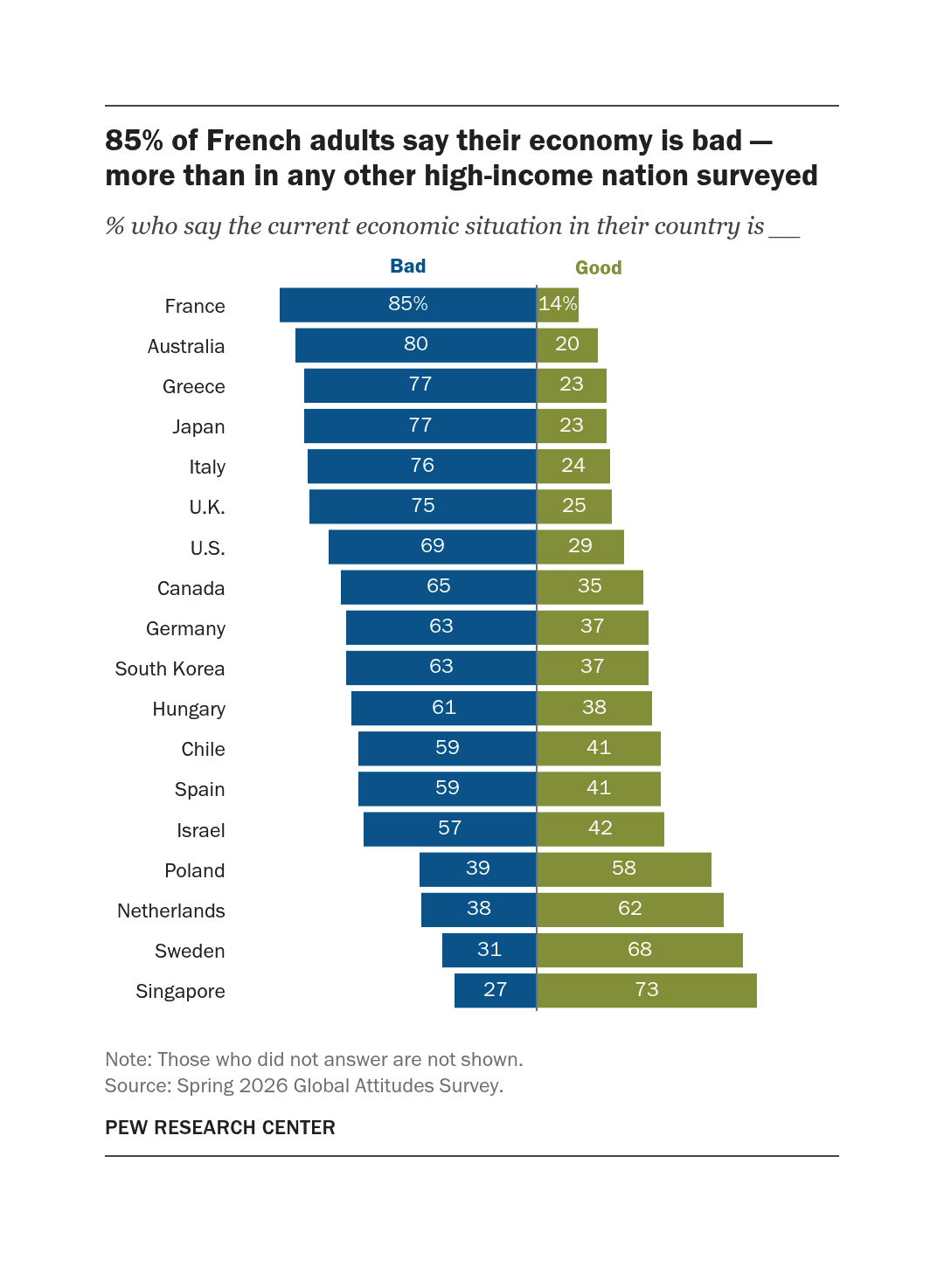
- Education: In Spring 2026, 87% of French adults with less education rated the economy as bad, compared to a remarkably close 81% of those with more education.
- Age Equality: Unlike many nations where younger generations are more optimistic about future economic horizons, France exhibits a uniform despair. Adults aged 18 to 34 are just as likely to report economic dissatisfaction as those aged 50 and older.
- Political Polarization: While negative views span the entire ideological spectrum, they reach a crescendo on the political right. Among individuals holding a favorable view of Marine Le Pen’s right-wing populist party, the National Rally, an astonishing 92% rate the economy as bad, with 58% categorizing it as very bad. Overall, 91% of right-leaning respondents expressed negative economic evaluations.
Official Responses: The Government Grapples with Public Anger
The stark disconnect between official fiscal policies and public lived experience has forced top-tier French leadership into defense mode.
On September 15, 2026, France’s Minister of the Economy, Finance and Industrial, Energy and Digital Sovereignty, Roland Lescure, alongside Bank of France Governor Emmanuel Moulin, held an emergency press briefing in Paris to address the compounding crises of public debt and social agitation.
Minister Lescure acknowledged the legitimacy of public frustration while defending the administration’s fiscal austerity framework. "The French people are experiencing legitimate anxieties regarding their purchasing power, the state of our public infrastructure, and the trajectory of our national debt," Lescure told reporters. "However, runaway borrowing is not a viable path forward. We must balance our books to preserve the long-term sovereignty of the French social model."
Governor Moulin echoed these sentiments, emphasizing that structural reforms are imperative to protect the euro zone’s second-largest economy from speculative market pressures. However, critics and union leaders have dismissed these warnings as tone-deaf, arguing that decades of budget cuts have degraded core public services—most visibly manifested in overcrowded classrooms, understaffed hospitals, and deteriorating regional transport networks.
Implications: A Crossroads for French Democracy and Social Cohesion
The convergence of record-breaking economic pessimism, swelling public debt, and widespread street protests carries profound implications for the domestic and geopolitical stability of France.
1. Political Vulnerability for the Establishment
With 92% of National Rally sympathizers and overwhelming majorities of the general populace viewing the economy as broken, mainstream political parties face an existential threat. Anti-establishment movements, particularly on the right, are poised to capitalize on this despondency ahead of future electoral cycles. Promising simple fixes to complex structural deficits resonates powerfully with a populace that feels neglected by traditional technocratic governance.

2. The Trap of Austerity vs. Investment
France is caught in a classic macroeconomic bind. To satisfy European Union fiscal rules and rein in its massive national debt, Paris must pursue spending restraint. Yet, cutting public spending directly impacts schools, healthcare, and social safety nets—sparking the very protests that paralyze urban centers and damage economic productivity further.
3. Generational Alienation
The fact that young adults (ages 18–34) are just as pessimistic as older generations signals a crisis of upward mobility. When the youth perceive the national economy as fundamentally compromised, long-term investments in family formation, housing acquisition, and career stability stall, threatening France’s demographic and economic future.
As the autumn protests continue to test the resolve of President Macron’s administration, the message from the French public—quantified definitively by the Pew Research Center data—is unequivocal: the social contract is under severe strain, and standard economic assurances are no longer enough to quell a deeply anxious nation.
 Asep Darmawan
  Sagoh
Sagoh  Nana
Nana 