
 By Iffa Jayyana
WASHINGTON — In the modern landscape of public opinion polling, methodological transparency has become the ultimate currency of credibility. As data saturation peaks and public skepticism toward traditional media and surveys grows, understanding how a poll is conducted is just as crucial as the findings it produces.
Pew Research Center’s landmark release of Wave 200 of its American Trends Panel (ATP)—conducted between September 28 and October 4, 2026—offers a textbook case study in rigorous, multi-layered survey methodology. Drawing on a nationally representative cohort of randomly selected U.S. adults, this milestone wave combines traditional address-based sampling, cutting-edge digital data collection, rigorous human-in-the-loop artificial intelligence coding, and meticulous post-stratification weighting.
This report provides an exhaustive, behind-the-scenes examination of Wave 200’s architecture, tracing the lifecycle of the data from initial household recruitment to final dataset publication.
Main Facts
At its core, Wave 200 of the ATP is designed to capture a statistically precise snapshot of the American public on critical economic and social issues. Executed in partnership with research firm SSRS, the survey gathered responses from a massive pool of everyday Americans while deliberately oversampling harder-to-reach demographics to ensure equitable representation.

- Field Period: Conducted from September 28 to October 4, 2026.
- Sample Size: A total of 5,062 completed responses out of 5,835 sampled panelists, yielding a survey-level response rate of 87%.
- Cumulative Response Rate: 3%, which meticulously accounts for nonresponse to recruitment surveys and multi-year panel attrition.
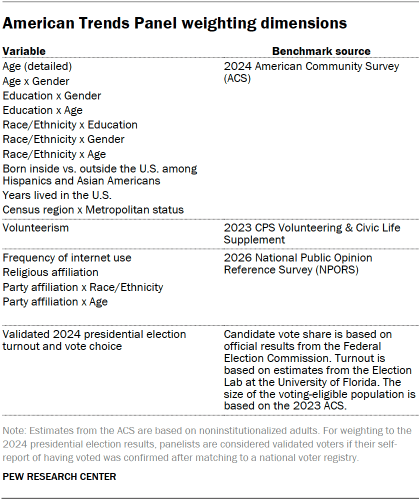
- Margin of Error: Plus or minus 1.6 percentage points for the full sample of 5,062 respondents at the 95% confidence level.
- Mode of Interviewing: Primarily online self-administered web surveys ($n=4,874$) supplemented by live telephone interviews ($n=188$), conducted in both English and Spanish.
- Oversampled Demographics: To provide granular, reliable estimates for smaller population segments, the survey intentionally oversampled Hispanic adults, non-Hispanic Asian adults, and young adults aged 18 to 29.
- Data Cleaning: Following intensive data quality checks that rooted out satisficing behavior (such as straight-lining or high nonresponse rates), exactly eight respondents were removed prior to analysis.
Chronology: The Lifecycle of ATP Wave 200
A high-stakes national survey does not materialize overnight. The production of ATP Wave 200 followed a carefully sequenced timeline spanning questionnaire design, pre-testing, multi-wave notifications, field execution, and data processing.
Phase 1: Pre-Launch Development and Testing (Early September 2026)
Before a single respondent saw a question, Pew Research Center and SSRS spent weeks designing and testing the instrument. The questionnaire was crafted by Pew researchers in close consultation with SSRS methodologists.
- Platform Stress-Testing: The web survey instrument underwent rigorous device-agnostic testing. SSRS project teams evaluated the code on personal computers, tablets, and smartphones to ensure flawless rendering across operating systems.
- Logic Verification: Test datasets were artificially populated by SSRS researchers and run through statistical software (SPSS) to verify that internal survey logic, skip patterns, and question randomizations operated precisely as intended.
Phase 2: Prefinancing and Notifications (Late September 2026)
Mobilizing a panel of thousands requires strategic communication.
- September 25: Pre-notification postcards were mailed to panelists selected for telephone interviews, alerting them to expect an upcoming call from a professional interviewer.
- September 28: Postcard notifications were mailed to a subset of online panelists. Concurrently, incentives and initial communications were dispatched.
Phase 3: The Soft Launch (September 28, 2026)
To catch any unforeseen technical glitches or confusing prompt phrasing in a live environment, a controlled "soft launch" was deployed:
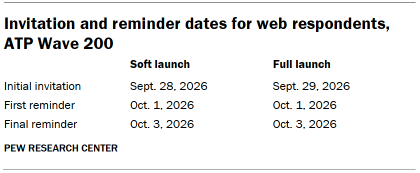
- Online: Exactly 60 panelists received an initial email invitation on September 28.
- Telephone: SSRS dialers initiated calls on September 28, continuing until a benchmark of three completed phone interviews was successfully reached and verified.
Phase 4: Full Launch and Field Period (September 29 – October 4, 2026)
Following a clean soft-launch review, the floodgates opened for full field operations.
- September 29: All remaining sampled English- and Spanish-speaking online panelists received their formal survey invitations via email. For panelists who had opted into SMS communications, text messages containing unique survey links were dispatched.
- Email and SMS Reminders: Non-respondents among the online cohort were sent up to two strategic email and SMS reminders throughout the week to bolster completion rates.
- Phone Operations: Trained live telephone interviewers dialed remaining phone panelists continuously through the field period, with individual numbers receiving up to six separate call attempts to maximize contact success.
- October 4: The field period officially closed, and data extraction began.
Supporting Data and Panel Architecture
The integrity of the American Trends Panel relies heavily on its foundational recruitment strategy and complex sample design, which have evolved significantly since the panel’s inception in 2014.
Address-Based Sampling (ABS)
Since 2018, the ATP has utilized Address-Based Sampling (ABS) as its primary recruitment vehicle. A stratified, random sample of residential addresses is pulled directly from the U.S. Postal Service’s Computerized Delivery Sequence File—a database estimated to cover between 90% and 98% of all American households.
- Recruitment Mechanics: Selected households receive a formal study cover letter accompanied by a pre-incentive to encourage participation. Within each sampled home, the adult whose birthday falls next is designated as the eligible participant.
- Historical Context: Prior to 2018, the panel relied on landline and cellphone random-digit-dial (RDD) telephone surveys. National recruitment efforts to refresh the panel have occurred roughly once a year since 2014, occasionally featuring targeted oversamples of historically underrepresented groups (such as Black adults in 2019, Hispanic adults in 2022, and Asian adults in 2023).
Incentives Strategy
Survey fatigue is a persistent challenge in modern polling. To combat nonresponse—particularly among hard-to-reach demographics—Pew Research Center implements a flexible post-paid incentive structure.
- Respondents who complete the survey are offered financial compensation ranging from $5 to $20.
- To maximize convenience and appeal, participants can choose their reward format: a traditional physical check or digital gift codes redeemable at major online retailers including Amazon.com, Target.com, and Walmart.com. Variable incentive amounts are purposefully allocated based on demographic propensities historically tied to lower response rates.
Official Responses and Quality Assurance Protocols
Ensuring that raw data accurately mirrors public sentiment requires rigorous validation protocols, spanning human oversight, technological innovation, and mathematical weighting.
Rooting Out "Satisficing"
In any large-scale survey, a small subset of respondents may rush through questions without thoughtful engagement—a phenomenon known as "satisficing."
- Prior to weighting and analysis, Pew researchers conducted granular data quality audits.
- Checks specifically flagged flat-lining behaviors, such as respondents selecting the exact same answer column (e.g., always the first or last option) across multiple batteries, or leaving an abnormal volume of items blank.
- As a direct result of these protocols, eight ATP respondents were flagged and purged from the dataset.
The Role of Artificial Intelligence in Coding
Wave 200 incorporated modern technological efficiencies by utilizing artificial intelligence-assisted text classification to initially code open-ended survey responses. However, Pew Research Center maintained a strict human-in-the-loop standard: human researchers systematically reviewed, validated, and, where necessary, overrode and corrected all AI-generated codes prior to final data analysis.
Multi-Stage Weighting and Calibration
Raw survey respondents rarely match the exact demographic makeup of the United States due to differential nonresponse and attrition. To correct this, ATP data undergoes a sophisticated, multi-tiered weighting process:
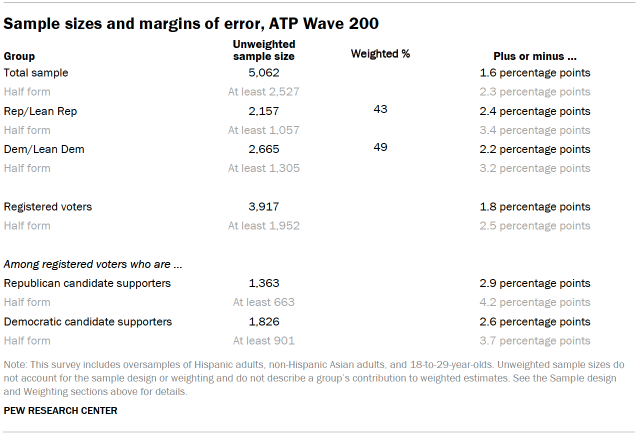
- Base Weights: Every panelist starts with a base weight reflecting their initial probability of selection during panel recruitment.
- Calibration for Attrition: Base weights are calibrated against known U.S. population benchmarks to correct for recruitment nonresponse and panel drop-off over time.
- Subsample Adjustments: Because Wave 200 utilized targeted oversamples (Hispanics, Asian Americans, and 18-to-29-year-olds), weights were adjusted to account for these varying selection probabilities.
- Final Trimming: Post-survey weights are recalibrated to align with current census benchmarks and trimmed at the 1st and 99th percentiles. This critical step prevents extreme weights from artificially inflating variance and eroding statistical precision.
Implications for Public Opinion Research
The methodological framework deployed in Wave 200 of the American Trends Panel carries profound implications for the broader field of survey research.
As trust in public institutions—and by extension, data collection—faces continuous scrutiny, transparency serves as the ultimate safeguard. By openly detailing its response rates (an 87% survey-level rate against a 3% cumulative rate), Pew Research Center acknowledges the inherent difficulties of modern polling while demonstrating how methodological rigor compensates for these hurdles.
Furthermore, the deliberate oversampling of minority and young adult cohorts ensures that policymakers, journalists, and researchers do not rely on homogenized data that overlooks the nuanced perspectives of America’s fastest-growing demographics. By blending traditional address-based recruitment with digital multi-channel outreach (web, SMS, and telephone) and balancing artificial intelligence efficiency with rigorous human oversight, Wave 200 sets a gold standard for transparency, accountability, and accuracy in twenty-first-century public opinion research.
 Ammar Sabilarrohman
  Nana Wu
  Asep Darmawan