
 By Ammar Sabilarrohman
WASHINGTON — Nearly seven months after the commencement of U.S. military engagement against Iran, American public sentiment has hardened into deep skepticism and widespread dissatisfaction. According to a comprehensive new survey conducted by the Pew Research Center, roughly two-thirds of U.S. adults (65%) now disapprove of the way President Donald Trump is handling the ongoing military campaign.
The data reflects a gradual erosion of public backing since the earliest days of the conflict in the spring of 2026. Beyond widespread disapproval of presidential management, the American electorate is increasingly convinced that the confrontation is far from over. A decisive majority anticipates that military operations will persist for months—if not years—fostering acute anxieties over the stability of domestic fuel prices, the safety of American service members abroad, and the long-term geopolitical fallout in the Middle East.
Main Facts
The Pew Research Center survey, which sampled 5,062 U.S. adults via the American Trends Panel between September 28 and October 4, 2026, details a public deeply at odds with the trajectory of the Iran campaign.
- Presidential Disapproval: 65% of Americans disapprove of President Trump’s handling of the military action, with 44% stating they "strongly disapprove" and 20% "somewhat disapprove." Conversely, only 33% express approval (14% strongly, 20% somewhat).
- Confidence in Objectives: When asked about the administration’s ability to achieve its stated strategic goals, 52% of respondents reported being "not too" or "not at all" confident. Only 16% feel "somewhat" confident, and an identical 16% feel "extremely" or "very" confident.
- Duration Expectations: Public optimism regarding a swift resolution is virtually nonexistent. Only 2% expect the conflict to wrap up in less than a month, and 18% anticipate a duration of one to six months. The vast majority project a protracted engagement: 30% expect the conflict to last between six and twelve months, while 47% believe it will extend for a year or more.
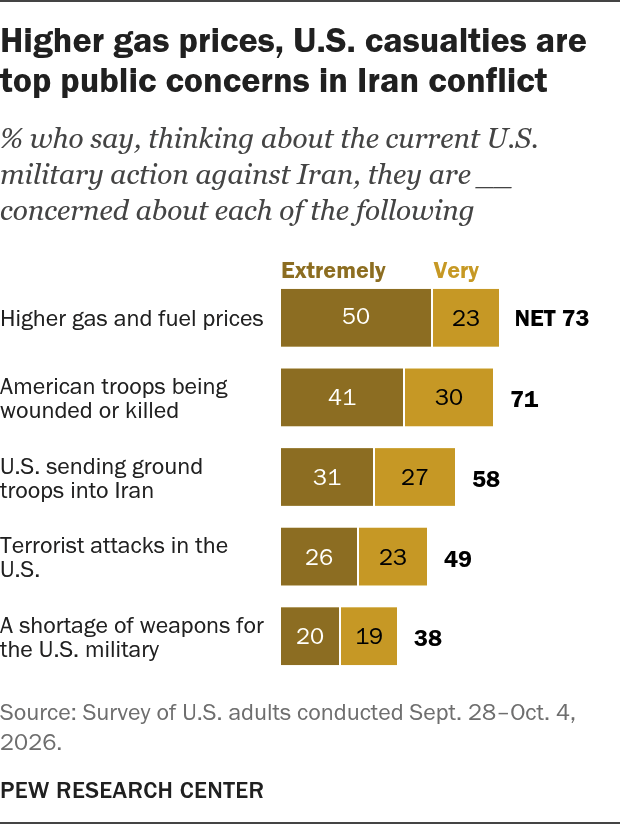
- Top Public Concerns: Economic anxiety and human cost dominate public worries. High gas and fuel prices lead the list at 73% (50% extremely concerned), closely followed by the prospect of American troops being wounded or killed at 71% (41% extremely concerned).
Chronology of a Widening Disconnect: From Spring Launch to Autumn Realities
The trajectory of the Iran conflict has been marked by a steady cooling of public enthusiasm since hostilities erupted earlier this year.
March 2026: The Initial Engagement
When U.S. military actions against Iran were first initiated in the early spring of 2026, the intervention was met with immediate polarization and a baseline level of public apprehension. Initial polling conducted shortly after the outbreak of hostilities showed that 61% of Americans already disapproved of President Trump’s management of the situation, while 37% offered their approval. At that time, roughly 71% of Republicans and Republican-leaning independents viewed the initial decision to use military force as the correct path forward.
Summer 2026: The Sinking Reality of a Quagmire
As operations stretched through the summer months without a decisive, clean resolution, logistical pressures and strategic realities set in. Reports of regional skirmishes, supply chain jitters, and the creeping realization that asymmetric retaliation from Iranian proxies could not be easily neutralized began to wear on public patience. While Democratic opposition remained entrenched and virtually unmoving, cracks began to form within the conservative coalition as moderate Republicans and right-leaning independents questioned the ultimate exit strategy of the White House.
September – October 2026: Deepening Skepticism
By the time the Pew Research Center surveyed the American public at the end of September and into early October, disapproval had climbed to 65%. Support for the initial decision to use force dropped to 34%—a modest 4-percentage-point decline overall, but one driven entirely by a softening among the president’s base. Furthermore, the timing of the poll just preceded a new wave of fiery rhetoric from the administration regarding potential retaliatory threats against U.S. metropolitan areas, promising to keep foreign policy at the absolute forefront of the national consciousness.
Supporting Data & Demographic Divides
While foreign policy issues traditionally cleave along stark partisan lines in contemporary American politics, the nuances within the 2026 polling data reveal shifting anxieties across the political spectrum.
The Partisan Gap on Approval
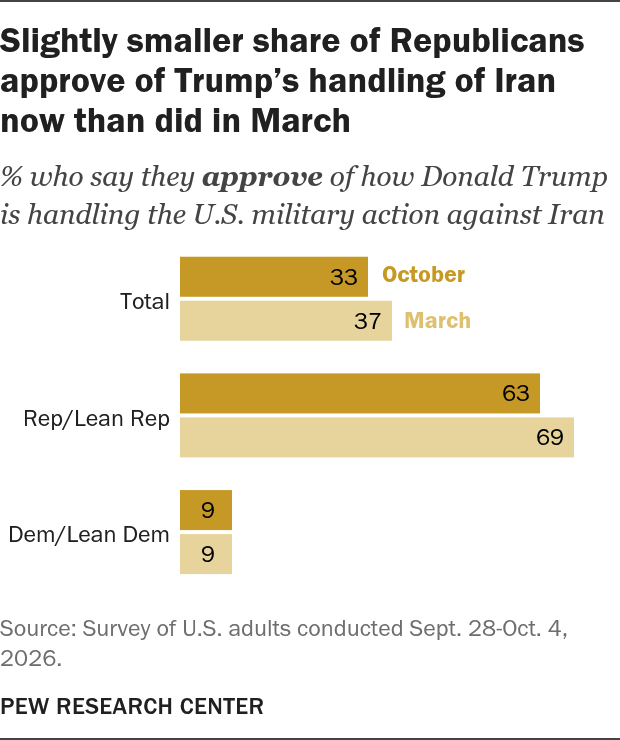
Republican backing for President Trump’s handling of the conflict, though still high relative to the general public, has experienced a measurable dip.
- In March, 69% of Republicans and Republican leaners approved of the administration’s handling of the Iran action. By October, that figure fell to 63%.
- Among Democrats and Democratic leaners, views remained completely static and overwhelmingly negative, holding steady at just 9% approval across both polling periods.
- Similarly, Republican agreement that the initial decision to use force was correct slipped from 71% in the spring to 65% in the autumn. Only 10% of Democrats consider the initial strike to have been the right choice.
Evolving Specific Anxieties
When broken down by specific threat categories, anxieties have fluctuated distinctly since March:
- Gas and Fuel Prices: Overall concern rose from 69% in March to 73% in October. This jump was propelled primarily by Democrats, whose extreme or very high concern over pump prices surged from 79% to 85%. Meanwhile, Republican concern remained relatively flat at 61% (up from 59%).
- Weapons Stockpiles: Concerns regarding potential shortages of military hardware for U.S. forces rose nationally from 31% to 38%. Again, this shift was driven by Democrats (moving from 34% to 45%), while Republican concern barely budged (30% to 31%).
- Domestic Terrorism and Ground Troops: Conversely, fear of domestic terrorist attacks fell across the board from 56% down to 49%. Anxiety over the deployment of ground troops into Iran also saw a slight national decline from 61% to 58%, though a yawning partisan chasm remains: 72% of Democrats view ground troop deployment as a major concern, compared to just 43% of Republicans.
Official Responses and Political Context
The White House has consistently defended its posture in the Middle East as a necessary deterrent against regional aggression and nuclear proliferation. Administration officials have argued that decisive preemptive and active measures are required to protect American assets, commercial shipping lanes, and regional allies from persistent threats emanating from Tehran.
However, the administration faces mounting pressure from Capitol Hill. Lawmakers from both sides of the aisle have increasingly questioned the constitutional breadth of the ongoing military engagement, demanding clearer benchmarks for success and pressing executive branch officials on whether current funding and munitions stockpiles can sustain a protracted campaign.
The geopolitical stakes were further heightened just days after the conclusion of the Pew survey, when President Trump publicly addressed potential escalations, including warnings concerning Iranian capabilities to target U.S. soil. While these remarks have rallied hawkish defenders who emphasize the necessity of absolute deterrence, they have simultaneously stoked anxieties among the majority of Americans who already view the conflict as an unpredictable and costly entanglements.
Broader Implications
The deep unpopularity of the Iran conflict carries profound political and economic implications as the United States navigates its domestic electoral calendar.
Economic Vulnerability
With nearly three-quarters of the country expressing extreme or very high concern over fuel costs, any volatility in global oil markets directly tied to the Strait of Hormuz or regional infrastructure attacks poses an immediate political hazard. Energy prices serve as a visceral, daily indicator of foreign policy blowback for the average American consumer, tying public perception of the war directly to household budgets.
Long-Term Strategic Fatigue
The data suggests that the American public is suffering from a deep-seated fatigue regarding protracted Middle Eastern engagements. With nearly half of the population (47%) bracing for a conflict that will last a year or more—and over half (52%) lacking confidence in the administration’s strategic endgame—any expansion of the conflict risks alienating the remaining pockets of public support.
As the campaign enters its winter phase, the administration must contend not only with military objectives abroad, but with a domestic populace that has signaled, clearly and repeatedly, its desire for a swift, secure conclusion to a deeply unpopular war.
 Iffa Jayyana
  Nana Wu
  Asep Darmawan