
 By Asep Darmawan
In an era increasingly dominated by the relentless encroachment of artificial intelligence and algorithmic perfection, Prada has chosen a decidedly defiant path. For its 2026 holiday campaign, titled “Drawing Prada,” the Italian fashion powerhouse has sidestepped the current trend of AI-generated “slop” in favor of the human touch, marrying high-fashion photography with the intricate, soulful legacy of traditional hand-drawn animation.
The campaign, which officially launches this Tuesday, represents more than a seasonal marketing push; it is a profound philosophical statement on the value of human craftsmanship in an age of automation. By enlisting the expertise of legendary animator John Pomeroy—whose pencil strokes have brought iconic cinematic figures to life for over five decades—Prada is championing the persistence of the analog spirit.
A Synthesis of Cinema and Style: The Core Concept
The “Drawing Prada” campaign is a masterful convergence of two distinct visual languages: the sharp, evocative photography of Glen Luchford and the whimsical, fluid world of 2D animation. Prada, a brand long celebrated for its deep, intellectual ties to the cinematic arts, has utilized this holiday window to explore the intersection of narrative fantasy and tangible reality.

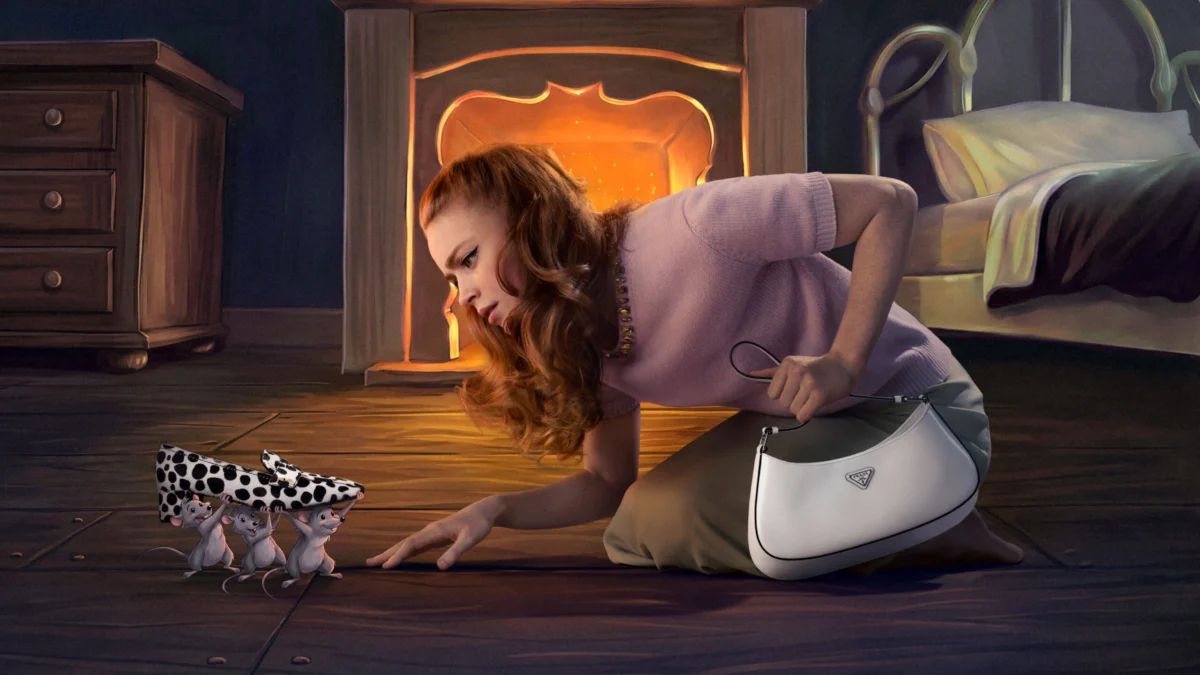
In the campaign’s imagery, an international cast of rising stars—including Stranger Things breakout actors Maya Hawke and Sadie Sink, Chinese singer-actor Chen Haoyu, Kelvin Harrison Jr., and Luther Ford—are depicted in immersive, snow-dusted winter wonderlands. However, they are not alone. Interacting with these figures are hand-drawn creatures, born from the imagination and technical mastery of Pomeroy’s team.
Whether it is a cynical fox trailing Maya Hawke through a pristine snowy landscape, mischievous mice making off with Sadie Sink’s Prada heels, or a snow lynx playfully stalking Chen Haoyu’s signature handbag, the campaign blurs the line between the physical luxury of the product and the ethereal, hand-drawn magic of the animation.
The Maestro Behind the Magic: John Pomeroy
The inclusion of John Pomeroy is the linchpin of this project. To the animation world, Pomeroy is a titan. His filmography reads like a history of modern cinematic storytelling, spanning from the charm of Winnie the Pooh and Tigger Too to the sweeping, dramatic heights of Disney’s Pocahontas and the experimental ambition of Fantasia 2000.

For Prada, Pomeroy’s role was not merely advisory; he served as the animation director, ensuring that the legacy of hand-drawn techniques remained the heartbeat of the project. In an industry currently obsessed with the speed and efficiency of AI rendering, Pomeroy’s commitment to the pencil-and-paper process acts as a bridge between the classic artistry of the 20th century and the luxury landscape of 2026.
“It was an absolute honor to have Prada ask me to direct this series of 2D animated films for their 2026 holiday campaign,” Pomeroy stated upon the project’s unveiling. “The merging of our two art forms took our combined creativity to the next level. It also advances the legacy of classic hand-drawn animation for many generations to enjoy.”
Chronology of the Project: From Pencil to Pavement
The development of “Drawing Prada” was a meticulous, multi-phase process that began months before its unveiling.

- Conceptualization: The brand’s creative leadership sought to move away from the sterile, often uncanny aesthetic of AI-generated media. The goal was to create a campaign that felt “alive,” imperfect, and deeply human.
- Photography Phase: Glen Luchford, a frequent collaborator with Prada, captured the cast in studio settings that provided the raw, high-contrast photographic base for the final composites.
- Animation Phase: Following the photo sessions, Pomeroy and his team of animators began the arduous task of creating the creatures. Each frame was drawn by hand to match the perspective, lighting, and movement of the actors, ensuring a seamless integration of the two mediums.
- Refinement: The post-production process involved layering the hand-drawn elements onto the photography, with color-grading applied to ensure the “winter wonderland” atmosphere felt cohesive across both the animated and live-action components.
The Cast: A Global Representation of Talent
The selection of the cast mirrors the global, youthful identity that Prada continues to cultivate. By pairing established indie darlings like Maya Hawke and Sadie Sink with global figures like Chen Haoyu, the brand maintains its reputation as a cultural tastemaker.
- Maya Hawke & Sadie Sink: Their inclusion taps into a demographic that values authenticity and artistic integrity. As icons of modern streaming culture, their presence grounds the high-concept animation in a relatable, contemporary aesthetic.
- Chen Haoyu (Amy Chen): Representing the massive influence of the Asian luxury market, her participation highlights Prada’s commitment to bridge Eastern and Western cultural dialogues.
- Kelvin Harrison Jr. & Luther Ford: These actors bring a gravitas to the campaign, reinforcing the brand’s interest in the intersection of fashion, film, and character-driven storytelling.
Implications: The Luxury Industry’s Stance on AI
The most significant implication of the “Drawing Prada” campaign lies in its implicit critique of the current technological climate. As luxury brands face increasing pressure to adopt generative AI for cost-cutting and rapid content creation, Prada has doubled down on the “slow craft” movement.
The campaign serves as a public declaration that the “luxury” in luxury goods is rooted in the labor, time, and human talent required to produce them. By showcasing a behind-the-scenes video that highlights the artists’ hands—holding pencils, sketching on paper, and working in a studio environment—Prada is elevating the “making-of” to the same status as the finished product.

Pomeroy’s commentary in the behind-the-scenes footage is telling: “There’s a very distinct and purposeful reason to do hand-drawn animation, and that’s to see that there’s value in it and that hand-drawn and handcrafted work is still alive in the world today. I learned my craft with pencil and paper… We’ve stuck to that, and we want to carry that forward into future generations.”
Supporting Data: The Consumer Sentiment Shift
While data on the immediate ROI of the campaign is pending its Tuesday launch, market analysts have noted a growing consumer fatigue regarding AI-generated advertising. A 2026 report on luxury consumer trends suggests that younger, affluent cohorts (Gen Z and Millennials) are increasingly prioritizing “human-made” provenance.
Brands that emphasize the “hand of the artist” are seeing higher engagement rates on social platforms compared to brands that rely on hyper-perfected, AI-assisted visuals. Prada’s investment in a veteran animator like Pomeroy is a calculated move to capitalize on this desire for tactile, authentic storytelling.

Conclusion: A Blueprint for the Future
As the holiday season approaches, the “Drawing Prada” campaign stands as a beacon of artisanal integrity. It does not just sell handbags, shoes, or leather accessories; it sells the idea that human imagination remains the most valuable resource in the creative industries.
By choosing the path of the hand-drawn, the animated, and the collaborative, Prada has effectively inoculated itself against the coldness of the digital age. The campaign is a reminder that while technology can mimic reality, it cannot replicate the nuance, the spirit, and the enduring magic of the human touch. As we look toward 2027 and beyond, Prada’s decision to celebrate the pencil-and-paper tradition may well be remembered as a pivotal moment where high fashion decided that, in the battle between the algorithm and the artist, it would firmly side with the latter.
 Reynand Wu
 Lina Hope
