
 By Nana
WASHINGTON — In an era marked by intense political polarization and shifting institutional trust, a comprehensive national survey released by the Pew Research Center sheds light on how Americans view key federal government departments and agencies. While sweeping bipartisan consensus remains elusive for many government institutions, a few universally relied-upon public services continue to command overwhelming favorability across the political spectrum.

Conducted from September 28 to October 4, 2026, and drawing responses from 5,062 U.S. adults, the Pew Research Center survey evaluates public sentiment toward 12 major federal agencies. The findings present a nuanced portrait of the American electorate: deep ideological fault lines have expanded regarding law enforcement and public health bodies, even as non-partisan service providers like parks, weather forecasting, and postal operations maintain robust public backing.

Main Facts: The Favorability Landscape
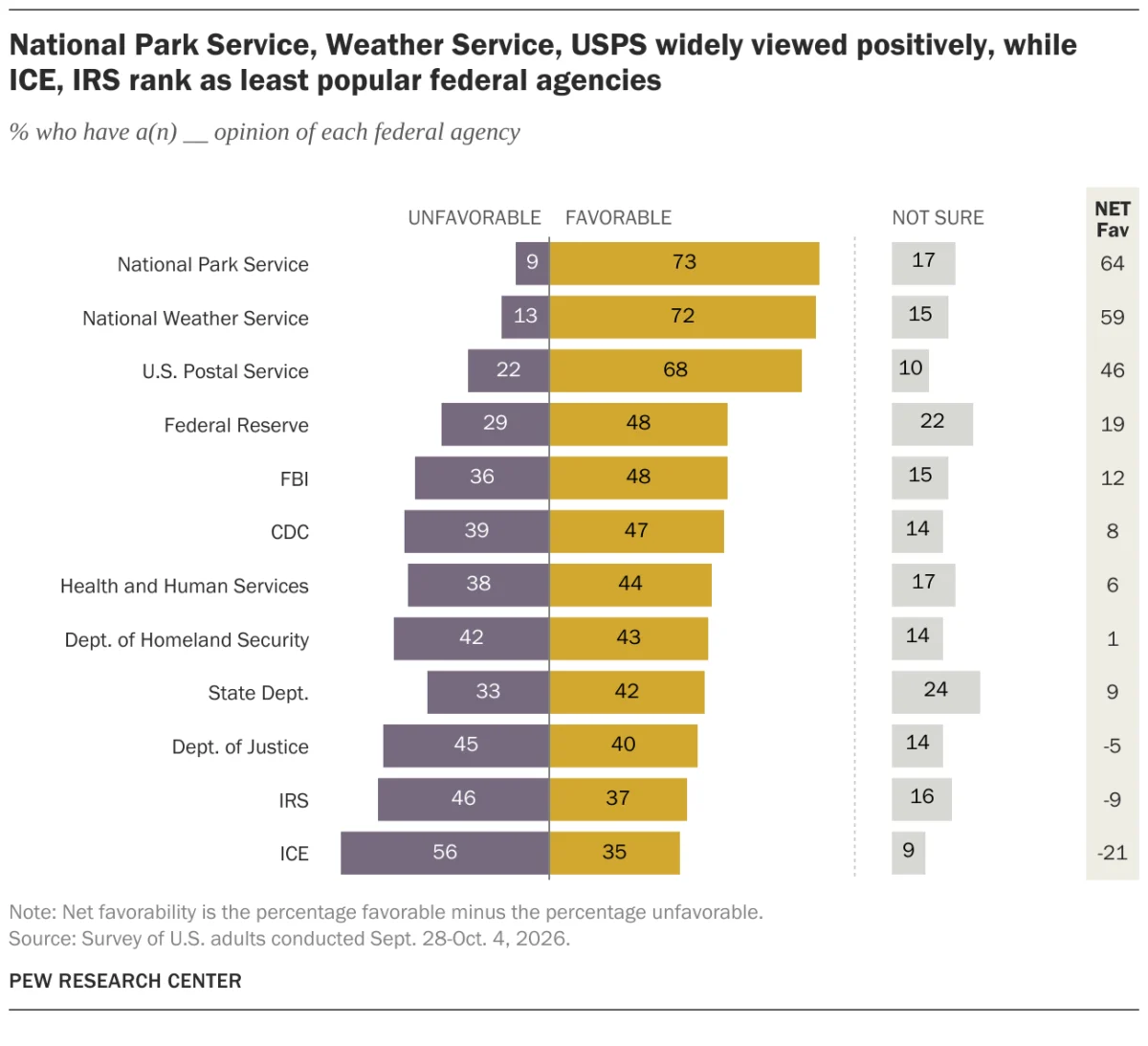
The core takeaway of the autumn 2026 survey is that Americans view eight of the 12 evaluated federal entities more favorably than unfavorably. However, public sentiment ranges dramatically—from a net favorability of +64 for the most popular agency to -21 for the least popular.
- The Top Tier: The National Park Service (NPS) leads all agencies with an impressive 73% favorable rating against just 9% unfavorable (a net favorability of +64). Close behind is the National Weather Service (NWS), boasting a 72% favorable and 13% unfavorable split (+59 net), followed by the U.S. Postal Service (USPS) at 68% favorable and 22% unfavorable (+46 net).
- The Bottom Tier: At the opposite end of the spectrum, Immigration and Customs Enforcement (ICE)—an operating component of the Department of Homeland Security (DHS)—ranks as the least popular agency among the 12 evaluated. A clear majority of Americans (56%) express an unfavorable opinion of ICE, compared to only 35% who view it favorably, resulting in a net favorability rating of -21.
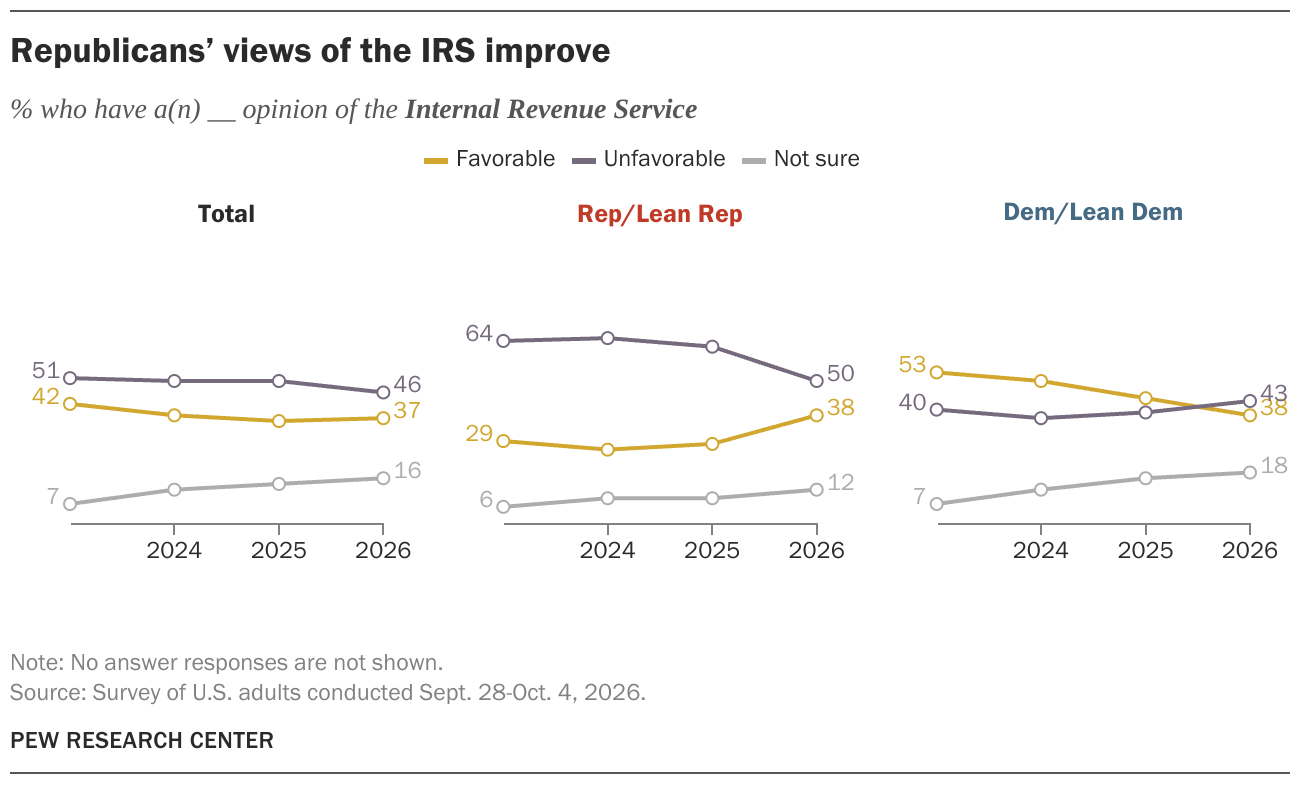
- Divided Institutions: Agencies sitting closer to the middle, such as the Department of Justice (DOJ), the Internal Revenue Service (IRS), and the Department of Health and Human Services (HHS), experience intense partisan crosscurrents, often yielding negative net favorability ratings due to deep ideological divides.
Chronology and Longitudinal Trends: A Year of Shifting Sentiment
To understand where public opinion stands in late 2026, researchers tracked responses against longitudinal data collected by the Center over previous years on the American Trends Panel. The 2026 data reveals notable year-over-year movements, particularly among Democratic and Republican leaners regarding public health, law enforcement, and regulatory bodies.

2023–2024: Post-Pandemic Realignments
Following the transition of federal agency polling to online methodologies starting in 2023, early trends highlighted a stabilization of public views away from traditional telephone polling baselines. During this period, security and immigration-related agencies began seeing pronounced partisan stratification. Republicans increasingly rallied behind border and law enforcement agencies, while Democrats grew more critical.

2025: The Widening Partisan Chasm
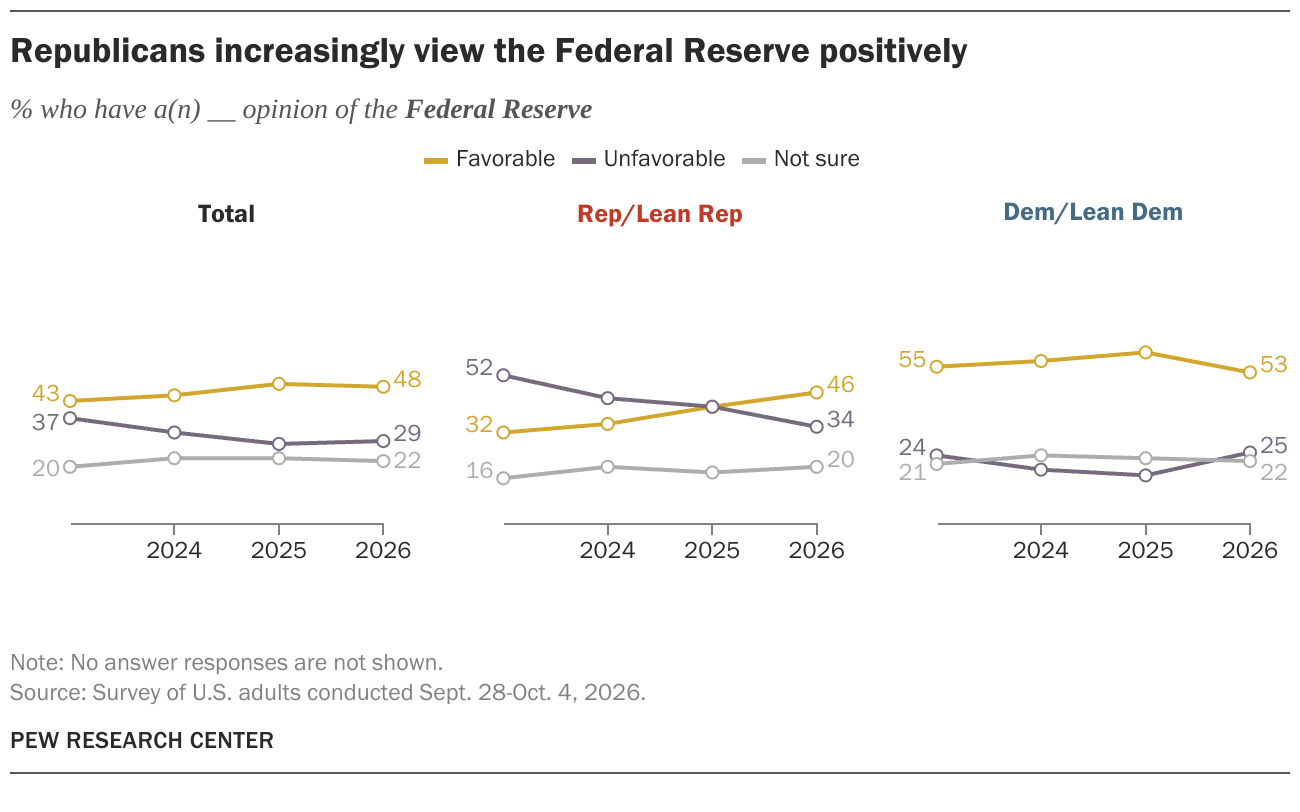
By late 2025, public sentiment toward bodies like the FBI, the DOJ, and the CDC showed significant volatility. Republicans’ opinions of the Justice Department and the FBI rebounded sharply from prior lows, while Democrats began registering increasingly skeptical or unfavorable stances toward public health infrastructure, including the CDC and HHS, in the wake of lingering pandemic-era debates.

2026: Polarization Deepens Across Health and Law Enforcement
The October 2026 survey captures a continuation—and in some cases an acceleration—of these divergence patterns:

- ICE and DHS: Public views of ICE grew more negative overall, with unfavorable ratings climbing from 49% in 2025 to 56% in 2026.
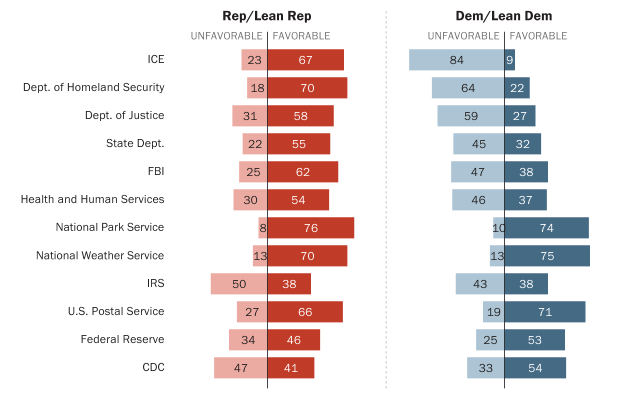
- The State Department: While Republican support remained steady (55% favorable), Democratic sentiment dropped below water, with 45% of Democrats and Democratic-leaning independents now viewing the State Department unfavorably compared to only 32% favorably.
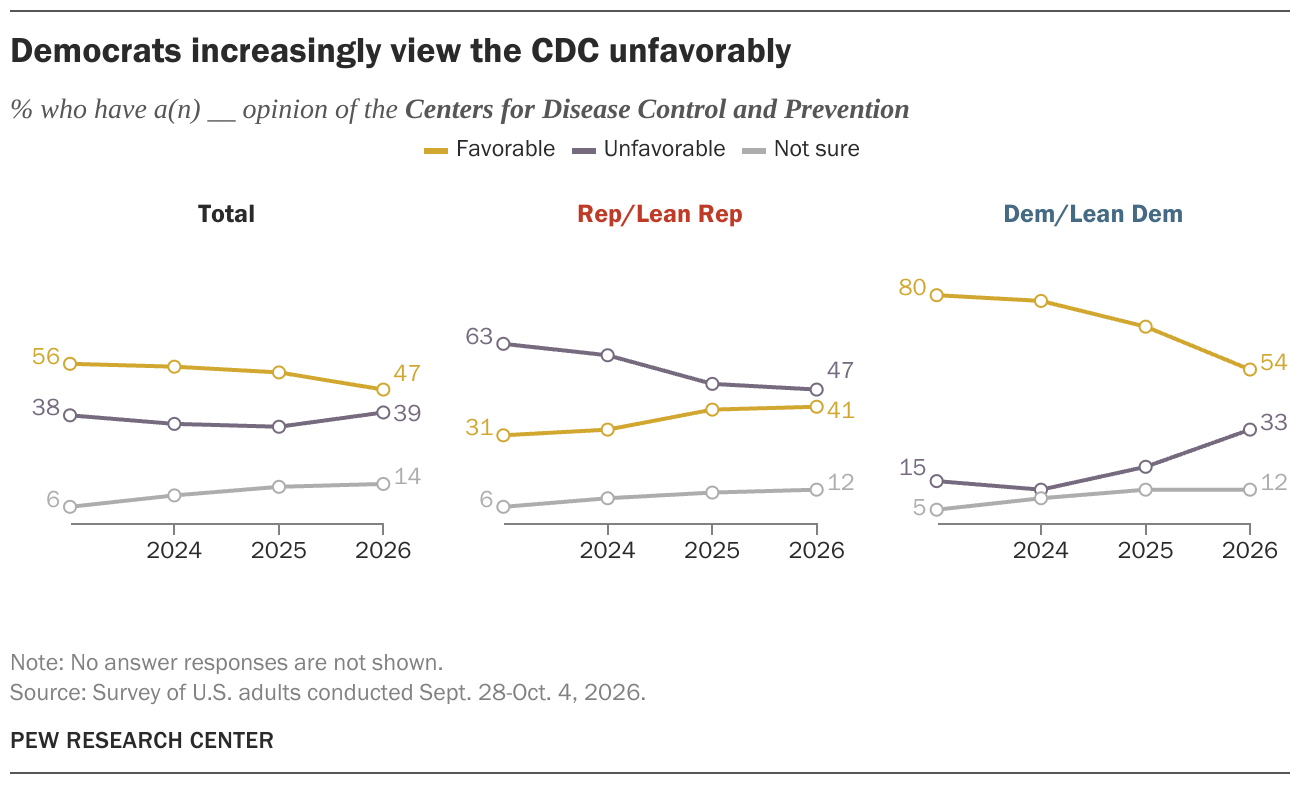
- Public Health Agencies: The CDC saw its overall favorability drop to 47% (down from 53% in 2025). This shift was driven primarily by a sharp drop among Democrats: 54% view the CDC favorably in 2026, a steep decline from 69% the previous year and 80% in 2023.
Supporting Data: Detailed Breakdown of Agency Ratings
The complete dataset from the autumn 2026 survey illustrates the precise standing of each federal agency evaluated by U.S. adults:
| Agency | Favorable (%) | Unfavorable (%) | Not Sure (%) | Net Favorability |
|---|---|---|---|---|
| National Park Service | 73 | 9 | 17 | +64 |
| National Weather Service | 72 | 13 | 15 | +59 |
| U.S. Postal Service | 68 | 22 | 10 | +46 |
| Federal Reserve | 48 | 29 | 22 | +19 |
| FBI | 48 | 36 | 15 | +12 |
| CDC | 47 | 39 | 14 | +8 |
| Health and Human Services | 44 | 38 | 17 | +6 |
| Dept. of Homeland Security | 43 | 42 | 14 | +1 |
| State Dept. | 42 | 33 | 24 | +9 |
| Dept. of Justice | 40 | 45 | 14 | -5 |
| IRS | 37 | 46 | 16 | -9 |
| ICE | 35 | 56 | 9 | -21 |
Partisan Splits: Republicans vs. Democrats
When breaking down the numbers by political affiliation, the data reveals stark contrasts:

- Consensus Favorites: Majorities in both parties continue to embrace the National Park Service (76% of Republicans/leaners vs. 74% of Democrats/leaners), the National Weather Service (70% vs. 75%), and the U.S. Postal Service (66% vs. 71%).
- Extreme Divergence on ICE: The single widest partisan gap occurs with Immigration and Customs Enforcement. While 67% of Republicans view ICE favorably (and only 23% unfavorably), a staggering 84% of Democrats view the agency unfavorably, with just 9% expressing a favorable opinion.
- Law Enforcement and Intelligence: Republicans have grown notably more favorable toward the FBI (62% favorable) and the Department of Justice (58% favorable). Conversely, pluralities or majorities of Democrats now view both institutions with skepticism (47% unfavorable toward the FBI, 59% unfavorable toward the DOJ).
Official Responses and Methodology
The Pew Research Center’s comprehensive documentation underscores the rigorous standards utilized to capture these insights. The survey was administered via the American Trends Panel, a nationally representative online survey pool designed to reflect the full scope of the U.S. adult population.
Researchers noted that comparisons to telephone surveys conducted prior to 2023 must be handled with care due to methodological differences—specifically, the inclusion of an explicit "Not sure" option in online surveys, which naturally alters response distributions compared to traditional telephone polling where uncertainty had to be verbally volunteered.
While institutional representatives across various federal departments often refrain from commenting directly on routine public approval polling, administrators frequently emphasize that public trust is earned through consistent, transparent operational delivery. Agencies like the National Park Service and National Weather Service frequently point to their direct, daily touchpoints with ordinary citizens as the cornerstone of their enduring public goodwill.

Implications for Governance and Public Policy
The 2026 data carries profound implications for federal governance, administrative oversight, and future legislative reform:

- The Perils of Partisan Polarization: As trust in core accountability and justice institutions—such as the FBI, DOJ, and IRS—becomes increasingly bifurcated along party lines, executing non-partisan enforcement and administration grows increasingly challenging. When half the country views key investigative or tax-collection bodies with institutional hostility, compliance, cooperation, and legislative oversight become heavily politicized.
- The Value of Non-Controversial Public Goods: The enduring popularity of the National Park Service, the National Weather Service, and the U.S. Postal Service demonstrates that Americans still deeply value visible, direct government services that enhance everyday life. Policymakers seeking to build bipartisan consensus would do well to look toward funding, protecting, and modernizing these universally appreciated public assets.
- Shifting Public Health Trust: The noticeable erosion of Democratic support for the CDC and HHS over the past three years highlights a fragile post-pandemic consensus. Rebuilding broad-based institutional confidence in federal health guidance will require targeted communication strategies that transcend traditional political divides ahead of future public health challenges.
Ultimately, the Pew Research Center’s findings serve as both a warning and a roadmap for Washington policymakers: while ideological battles continue to erode trust in complex regulatory and law enforcement agencies, the foundational infrastructure of daily American life retains a resilient, albeit strained, reservoir of public support.
 Neng Nana
 rifanmuazin
 Sagoh
