
 By Nana Wu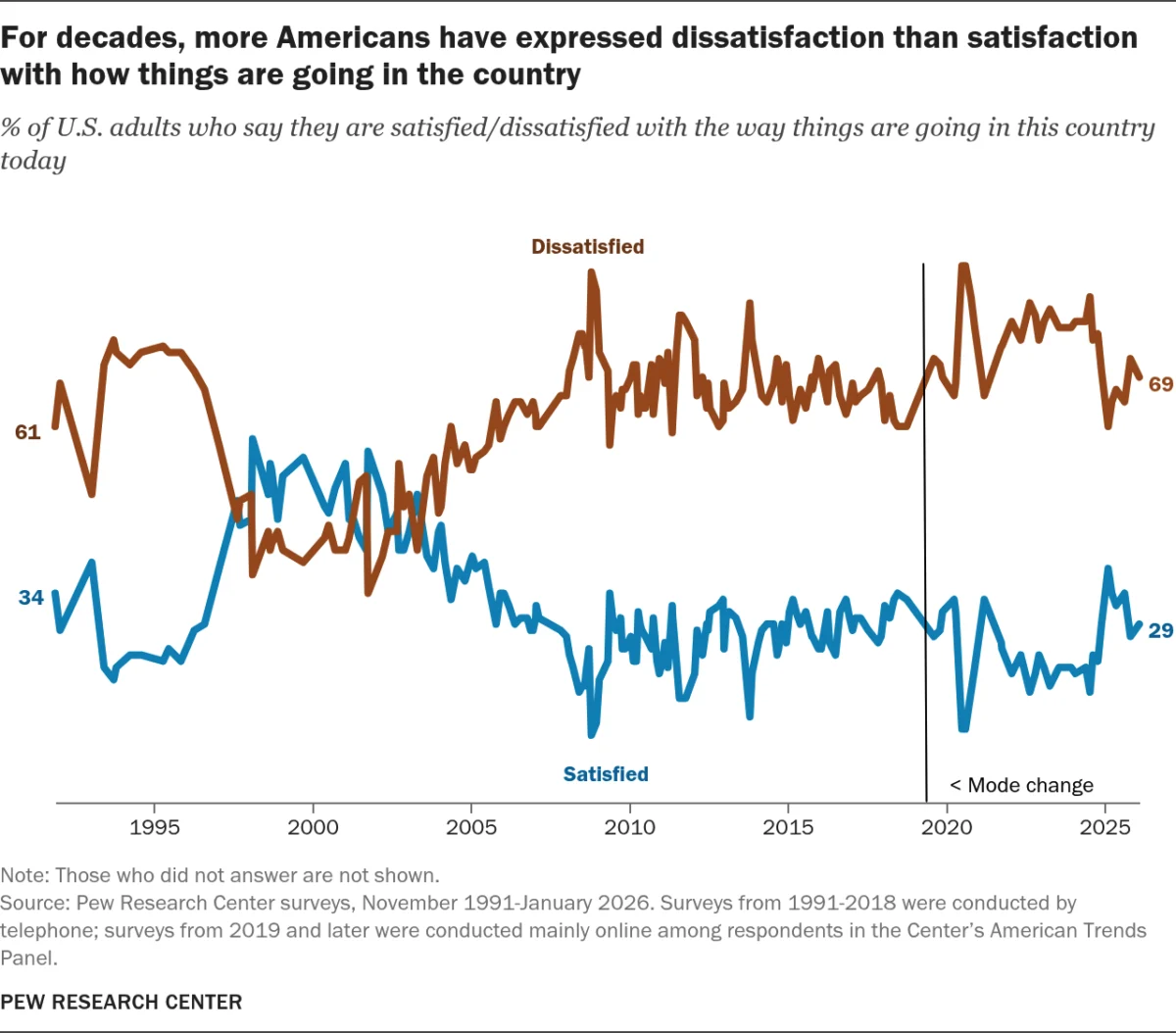
As the United States approaches the monumental milestone of its 250th anniversary, a complex and often contradictory portrait of the American public has emerged. Recent data from the Pew Research Center suggests that while the national mood is undeniably “sour,” characterized by long-term dissatisfaction and a pervasive sense that the country’s best days are behind it, there remains an undercurrent of resilience and cautious, forward-looking optimism.
This analysis, based on a survey of 3,592 U.S. adults conducted in April 2026 via the American Trends Panel, reveals a populace deeply affected by years of institutional distrust, political polarization, and economic anxiety. Yet, when prompted to look toward the mid-century mark, many citizens express a nuanced hopefulness that challenges the prevailing narrative of national decline.

The Weight of History: A Chronic State of Dissatisfaction
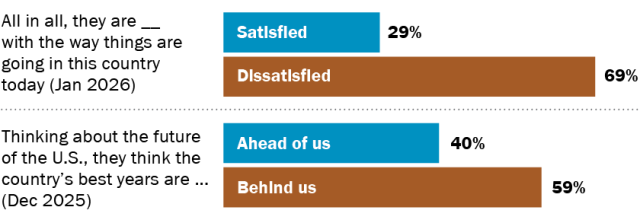
The prevailing sentiment among Americans today is one of dissatisfaction. For more than two decades, survey data has consistently shown that a majority of the public is unhappy with the direction of the country. As of January 2026, 69% of U.S. adults expressed dissatisfaction with the state of national affairs, while only 29% reported being satisfied.
This trend is not a sudden development but rather a hardening of sentiment that has persisted through multiple presidential administrations. The long-term data indicates that this “sour mood” has become a default setting for many, exacerbated by a decline in interpersonal trust and a steady erosion of confidence in foundational institutions, including the federal government, political parties, the media, and academia.
When compared with citizens of other high-income nations, Americans are particularly vocal about their frustrations with how their democracy is functioning. There is a palpable anxiety regarding the moral fabric of society, with a significant share of the public expressing doubt about the moral standing of their fellow citizens.
Chronology of a Shifting Landscape
To understand the current malaise, one must look at the trajectory of the last several years. The period from 2020 to 2024 was marked by extreme volatility, with satisfaction levels hitting record lows during the height of the COVID-19 pandemic. While there has been a slight, incremental rebound since early 2025, the baseline remains low.

The data reveals a striking link between partisan identity and the national mood. In the American political system, satisfaction is often a proxy for which party holds the executive branch. During the second term of President Donald Trump, Republicans have consistently reported higher levels of satisfaction with the country’s direction. Conversely, during the Biden administration, it was Democrats who maintained a more positive outlook. This pattern of “partisan cheerleading” has been a staple of American political life for decades, tracing back through the Clinton, Bush, and Obama eras.
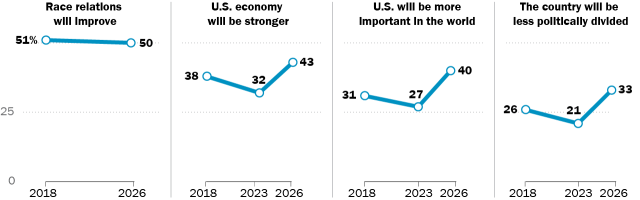
However, 2026 marks a unique moment. While the country remains divided, there are tentative signs of improvement in long-term expectations. When asked to forecast the state of the nation in 2050, more Americans in 2026 than in 2023 believe the economy will be stronger and that political divisions may become less severe.

The 2050 Horizon: Hopes and Fears
The Pew Research Center’s April 2026 survey asked respondents to project the state of the United States twenty-five years into the future. The results illustrate a population that is, at once, braced for difficulty and hopeful for renewal.
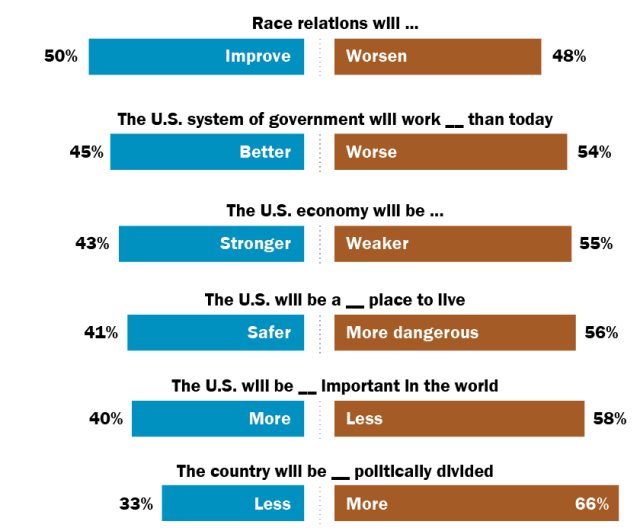
When projecting to 2050, a majority of U.S. adults foresee a bleaker landscape in several critical areas:

- Political Polarization: Two-thirds (66%) of adults believe the country will be more politically divided in 2050 than it is today.
- Global Standing: 58% expect the U.S. to be less important on the world stage.
- Economic Outlook: 55% fear the economy will be weaker.
- Governance: 54% believe the American system of government will work worse than it currently does.
Despite this pessimism, there is a core group of optimists. Approximately 43% of respondents believe the economy will be stronger by 2050, and 33% believe political divisions will decrease. Notably, these numbers represent an improvement from 2023, suggesting that the initial shock of recent political and social disruptions may be beginning to stabilize in the public consciousness.
The Paradox of Personal Hope
While the macro-view of the country is often grim, individual Americans maintain a surprising capacity for personal optimism. Most people report feeling "hopeful" when they think about the future in general terms, and 54% describe themselves as "happy" when considering the days to come.

This disconnect between the national outlook and personal disposition is a critical finding. It suggests that while Americans may feel the country as a political entity is struggling, they maintain a degree of faith in their own agency and the potential for their personal lives—and by extension, the lives of their families—to improve.
Partisanship as a Lens for Reality
The research confirms that partisanship continues to act as a powerful lens through which citizens view reality. The question of whether one’s “side” is winning in politics is highly correlated with the party in power.

For instance, following the first year of President Trump’s second term, 60% of Republicans felt their side was winning. In contrast, only 10% of Democrats reported the same. These figures flip dramatically when the White House changes hands, reflecting the reality that in a highly polarized environment, political success is often defined as the victory of one’s group over another, rather than a shared national achievement.
Despite these sharp divides, there are rare points of consensus. Both Republicans and Democrats share a similar dread regarding political polarization. Large majorities in both parties agree that the country will become more divided by 2050. This shared cynicism indicates that polarization is no longer viewed as a temporary glitch, but rather as an enduring feature of the American political system.

The Generational Divide
The survey also sheds light on how age influences expectations. Contrary to the idea that youth is synonymous with unbridled optimism, the youngest adults (ages 18–29) are, in some respects, more pessimistic than their elders regarding the nation’s future.
Younger adults are less likely than those 65 and older to believe that race relations will improve, that the system of government will function better, or that the economy will strengthen by 2050. However, this pessimism does not necessarily translate into unhappiness. Adults under 30 actually report higher levels of personal happiness about the future than those over 65. This suggests that the youngest generation is perhaps more realistic—or cynical—about the systemic challenges facing the nation, while remaining relatively content in their personal pursuits.
Implications for the 250th Anniversary
As the U.S. moves toward its semiquincentennial, the findings suggest that the nation is in a period of profound introspection. The 250th anniversary is not merely a celebration of past achievements; it is a moment of reckoning.
The widespread dissatisfaction and the fear of continued political division present a significant challenge to policymakers and civic leaders. If the majority of citizens believe the best days are behind them, the task of building a cohesive vision for the future becomes increasingly difficult. However, the modest improvements in long-term economic and geopolitical expectations since 2023 offer a glimmer of potential.
If the nation is to bridge these divides, the path forward may require addressing the deep-seated lack of trust in institutions that has defined the last two decades. The data shows that when people feel their side is winning, they are more optimistic, but true national stability may depend on fostering a sense of progress that is not tied to the victory of one partisan coalition over another.
Conclusion
The American mood on the eve of the 250th anniversary is, above all, a testament to the nation’s complexity. It is a country that is simultaneously grieving the loss of a certain national consensus and searching for a new definition of itself. While the current sentiment is undeniably sour, the enduring personal hope of the American people provides a foundation upon which a more stable future could be built. Whether the next quarter-century brings the decline many fear or the renewal some hope for will depend on how the nation navigates these internal divisions in the years ahead.
 Nana Muazin
  Suro Senen