
 By Muslim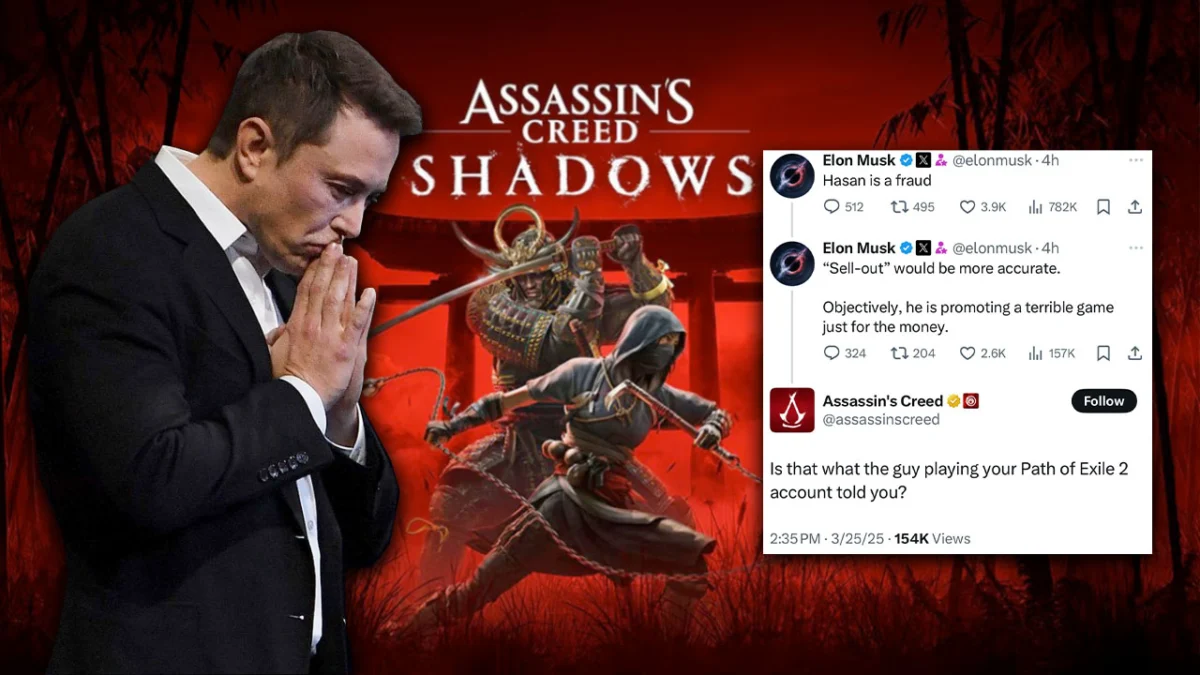
San Francisco, CA – In an unprecedented display of corporate social media savvy, the official Assassin’s Creed account delivered a resounding "ratio" to Elon Musk on his own platform, X (formerly Twitter), igniting a firestorm of memes and online commentary. The incident, which unfolded rapidly over the past 24 hours, saw the video game franchise directly challenge Musk’s credibility as a gamer, referencing a past controversy that has long haunted the tech mogul. This viral exchange not only captivated the gaming community but also underscored the evolving dynamics of celebrity engagement, brand marketing, and the often-blurry lines between personal opinion and public spectacle in the digital age.
The confrontation began when Musk, known for his frequent and often provocative posts, weighed in on a brewing controversy surrounding Ubisoft’s latest title, Assassin’s Creed: Shadows. His intervention, however, quickly backfired, transforming into a public relations coup for the game developer and another dent in Musk’s often-criticized public image. The episode has since been dissected across social media, with many hailing the Assassin’s Creed account’s response as a masterclass in direct, impactful communication that resonated deeply with the "chronically online" demographic.
A Viral Exchange Ignites the Gaming Community
The genesis of this digital skirmish can be traced back to criticism leveled by notorious video game commentator "Grummz" against Ubisoft. Grummz took issue with the Assassin’s Creed: Shadows team sponsoring prominent leftist Twitch streamer Hasan Piker to play their new game. This partnership, which aimed to leverage Piker’s massive audience for marketing reach, instead became a flashpoint for ideological debate within certain segments of the gaming community.
Elon Musk, never one to shy away from controversial topics or an opportunity to engage with perceived "culture war" issues, swiftly interjected. He publicly lambasted Hasan Piker, labeling him a "fraud" and a "sell out" for promoting what Musk unilaterally deemed a "terrible game just for the money." Musk’s comments, delivered to his vast following, quickly drew attention, setting the stage for the unexpected counter-attack.
The official @AssassinsCreed account, managed by Ubisoft, wasted no time in seizing the moment. In a move that surprised many with its directness and wit, the account responded to Musk with a pointed jab: "Is that what the guy playing your Path of Exile 2 account told you?" This single tweet, a direct callback to Musk’s widely publicized "fraud gamer" controversy earlier this year, immediately went viral. Overnight, it garnered over 400,000 likes and sparked an avalanche of memes, jokes, and expressions of schadenfreude at Musk’s expense. The strategic use of the "ratio" – where replies or quotes vastly outnumber the likes on an original tweet, signifying widespread disapproval or mockery – cemented the Assassin’s Creed tweet as a definitive win in the online arena.
The Core of the Controversy: Influencers, Ethics, and Hypocrisy
At its heart, this entire saga revolves around questions of authenticity, perceived hypocrisy, and the ethics of influence in the gaming world. Musk’s accusation of Piker being a "fraud" for accepting sponsorship money for a game he might not genuinely endorse struck a nerve, particularly given Musk’s own well-documented history of questionable gaming claims.
For many observers, the Assassin’s Creed response was not merely a witty retort but a necessary call-out of perceived double standards. It tapped into a collective sentiment that figures like Musk, who often position themselves as arbiters of truth or integrity, should themselves be held to account, especially when their criticisms are hypocritical. The incident also highlighted the increasing tension between traditional game criticism, influencer marketing, and the often-politicized online spaces where these interactions unfold. Ubisoft’s decision to partner with Hasan Piker, a figure known for his progressive political views, had already made the collaboration a target for critics from a different ideological spectrum, adding another layer of complexity to the unfolding drama.
A Chronology of Online Conflict
To fully appreciate the impact of the Assassin’s Creed ratio, it’s crucial to trace the sequence of events that led to this memorable digital confrontation.
The Genesis: Grummz’s Critique of Ubisoft’s Partnership
The initial spark was ignited by "Grummz," a figure known for his outspoken opinions within the gaming community. Grummz publicly criticized Ubisoft for its decision to sponsor Hasan Piker, a popular Twitch streamer with a significant following, to play Assassin’s Creed: Shadows. Grummz’s critique seemed to stem from a broader discomfort with the perceived political leanings of Piker, suggesting that Ubisoft was aligning itself with a "leftist" figure, a move that Grummz and his followers viewed as problematic or inappropriate for a gaming company. This initial volley set the stage for a debate that quickly transcended mere game promotion, morphing into a proxy battle over cultural and political values within the gaming sphere.
Musk’s Intervention: Accusations of Fraud and Sell-out Culture
Observing the brewing controversy, Elon Musk entered the fray. Leveraging his immense platform on X, Musk amplified Grummz’s sentiments, but with his characteristic bluntness and personal attacks. He specifically targeted Hasan Piker, labeling him a "fraud" and a "sell out" for accepting compensation to promote Assassin’s Creed: Shadows. Musk further asserted that Piker was endorsing a "terrible game just for the money." These statements, coming from a figure of Musk’s stature, were not merely casual remarks; they were a direct challenge to Piker’s integrity and a condemnation of Ubisoft’s marketing strategy. Musk’s comments resonated with a segment of his audience that shares similar views on influencer marketing and the perceived politicization of entertainment, creating a significant ripple effect across the platform.
The Assassin’s Creed Counterpunch: A Masterclass in Social Media Trolling
The pivotal moment arrived when the official @AssassinsCreed account, rather than issuing a generic corporate statement or ignoring the barb, delivered a precise and devastating counterpunch. Their tweet, "Is that what the guy playing your Path of Exile 2 account told you?", was a surgical strike. It bypassed Musk’s critique of Piker and Assassin’s Creed: Shadows entirely, instead redirecting the focus squarely onto Musk’s own past gaming embarrassments. This move was particularly effective because it leveraged a widely known and ridiculed incident in Musk’s recent history, turning his accusation of "fraud" back on him with undeniable irony. The tweet’s virality was instantaneous, demonstrating the power of a well-timed, contextually relevant, and subtly aggressive corporate social media post. It was a calculated risk that paid off handsomely, solidifying the brand’s image as one that isn’t afraid to stand its ground and engage directly with its critics, even those as prominent as Elon Musk.
Hasan Piker’s Response: From Barbs to Elden Ring Challenges
While the Assassin’s Creed ratio stole the show, Hasan Piker himself was not silent. Following Musk’s initial accusations, Piker engaged in a lively exchange of barbs with Musk, with Grummz often acting as an instigator or mediator by sharing screenshots of their interactions. Piker, a seasoned online personality, met Musk’s criticism head-on, eventually escalating the challenge by proposing a "duel" in the notoriously difficult action role-playing game Elden Ring. Musk, in turn, retaliated by calling Piker "chickenshit" for allegedly blocking him on X. This secondary skirmish, while overshadowed by the Assassin’s Creed tweet, further highlighted the personal nature of the conflict and the readiness of online personalities to engage in direct, often confrontational, dialogue. The Elden Ring challenge, in particular, was a clever move by Piker, attempting to turn the abstract concept of "gamer fraud" into a tangible, skill-based contest.
Unpacking the "Fraud Gamer" Allegations: The Path of Exile 2 Scandal
The potency of the Assassin’s Creed tweet lay entirely in its direct reference to Musk’s "fraud gamer" controversy surrounding Path of Exile 2. For those "chronically online" or deeply embedded in gaming communities, this scandal was a recent and highly publicized embarrassment for Musk, making the Assassin’s Creed callback exceptionally effective.
The Unmasking: How Players Spotted Musk’s Deception
Earlier this year, Elon Musk found himself at the center of a storm of ridicule after attempting to project an image of a skilled, high-level player in the upcoming action RPG, Path of Exile 2. He live-streamed his gameplay, proudly suggesting he had achieved his advanced character status through his own efforts. However, eagle-eyed Path of Exile veterans, intimately familiar with the game’s intricate mechanics and demanding progression, quickly spotted glaring inconsistencies.
Players observed that despite controlling a seemingly high-rank character, Musk’s actual gameplay betrayed a profound lack of understanding of fundamental mechanics. His movement patterns were often inefficient, his skill usage was suboptimal, and his decision-making indicated an unfamiliarity with the game’s systems that simply didn’t align with someone who had legitimately progressed to such a high level. For seasoned players, it was akin to watching someone with a professional race car driver’s uniform fumble with the gear stick and struggle to stay on the track. This discrepancy between the character’s apparent strength and the player’s demonstrated incompetence quickly fueled suspicions of account boosting.
The Account Boosting Admission: "Impossible to Beat Asian Players"
Further investigation by the Path of Exile community uncovered additional damning evidence. Publicly available game data indicated that Musk was "playing from Asia or using a VPN to play from Asia." This geographical anomaly was particularly suspicious, as it’s a common tactic used by players who employ "boosters" – individuals hired to play on another person’s account to rapidly level up characters or acquire rare items. These boosters are often located in regions where labor costs are lower, and they can dedicate extensive hours to grinding, a practice known as "gold farming" or "power leveling."
Faced with mounting evidence and widespread mockery, Musk eventually conceded to the allegations. He admitted to "account boosting," attempting to justify his actions with a rather curious explanation: "It’s impossible to beat the players in Asia if you don’t, as they do!" This defense, suggesting that boosting was a necessary evil to compete with highly dedicated Asian players, was met with further derision. Critics pointed out that legitimate competition involves personal skill and effort, not outsourcing gameplay. The admission solidified the perception that Musk was not the authentic, hardcore gamer he often portrayed himself to be, but rather someone willing to cut corners and then offer flimsy excuses when caught.
The entire saga was encapsulated in a viral tweet by Alex Alarga, who posted:
What an ego-trip Elon Musk has been livestreaming himself playing overpowered Path Of Exile 2 character, proudly and seriously pretending that he got there *himself*, and actual POE veterans are laughing their asses off watching and dissecting that charade. Why Elon, why?
— Alex Alarga (@AlexAlarga) January 9, 2025
This incident became a well-known meme within gaming circles, perfectly illustrating the concept of a "fraud gamer" – someone who pretends to have achieved skill or status they have not earned. It was this specific, public humiliation that the Assassin’s Creed account so expertly weaponized in their response, making Musk’s accusation against Piker ring hollow and hypocritical.

Broader Implications for Gaming Authenticity
The Path of Exile 2 controversy wasn’t just about one celebrity’s gaming habits; it touched upon broader issues of authenticity and integrity within online gaming. Account boosting, while prevalent, is often frowned upon by communities as it undermines the spirit of fair play and personal achievement. When a high-profile figure like Musk is caught engaging in such practices, it casts a spotlight on these ethical dilemmas, prompting discussions about what it truly means to be a "gamer" and the value of earned skill versus purchased progression. The incident served as a potent reminder that in the highly scrutinized world of online gaming, attempts at deception are rarely successful and often lead to public shaming.
The Business of Influence: Marketing, Politics, and Community
Beyond the personal jabs, this entire episode sheds light on the complex interplay between influencer marketing, corporate strategy, and the often-politicized landscape of online communities.
Ubisoft’s Strategy: Leveraging Streamers for Reach
Ubisoft’s decision to partner with Hasan Piker for Assassin’s Creed: Shadows was a calculated marketing move. Piker boasts a massive and highly engaged audience on Twitch, representing a valuable demographic for game promotion. Influencer marketing has become a cornerstone of the video game industry, allowing developers to reach potential players through trusted (or at least popular) personalities who can offer live, interactive demonstrations of new titles. The goal is to generate buzz, create anticipation, and drive pre-orders or early sales.
While the partnership itself was standard practice, the choice of Piker, a figure with outspoken political views, introduced an element of risk. However, it also signaled a willingness by Ubisoft to engage with diverse online communities and potentially broaden its appeal beyond traditional gaming demographics. The subsequent viral engagement, fueled by the controversy, arguably delivered far more reach and attention than a standard, uncontroversial sponsorship might have achieved, turning a potential PR headache into an undeniable marketing win.
The Undercurrents of "Culture War" in Gaming
The initial criticism from Grummz, and Musk’s subsequent amplification, clearly tapped into the ongoing "culture war" dynamics prevalent in online spaces, including gaming. Certain segments of the gaming community express strong opinions against what they perceive as the "politicization" of video games or the entertainment industry at large. Partnering with a streamer like Hasan Piker, known for his progressive stance, can be viewed by these critics as an endorsement of specific political ideologies, rather than a neutral marketing decision.
This incident, therefore, became more than just a debate about game quality or influencer ethics; it was a microcosm of broader societal tensions playing out in the digital realm. It highlighted how even seemingly innocuous marketing campaigns can become embroiled in ideological battles, with figures like Musk and Grummz positioned as champions of a particular viewpoint, and companies like Ubisoft navigating these turbulent waters. The willingness of Assassin’s Creed to engage directly with Musk, rather than retreating from the controversy, could be seen as a strategic choice to align with a younger, more progressive, and less ideologically rigid segment of its audience, demonstrating that even corporate entities are taking sides, or at least strategically positioning themselves, in these ongoing cultural debates.
Official Responses and the Silence That Follows
The aftermath of the Assassin’s Creed ratio saw a flurry of public reaction, but a notable silence from certain key players, underscoring the nature of online engagement.
The Deafening Roar of the Ratio
The official @AssassinsCreed tweet achieved immediate and widespread acclaim. Its virality was undeniable, with countless internet users sharing, quoting, and dissecting its brilliance. Many users "conceded to the corporate ratio," humorously adopting the meme phrase, "I owe you an apology, I wasn’t really familiar with your game," implying that the account’s wit had earned their respect or even loyalty. X user @soundaholism, for instance, explicitly vowed to purchase AC: Shadows without waiting for a sale, solely motivated by the account’s successful ratio of Musk. This anecdotal evidence suggests a direct, positive impact on brand perception and even potential sales, demonstrating the tangible benefits of successful, authentic (or seemingly authentic) online engagement.
The general sentiment across social media was one of collective amusement and satisfaction. Jokes about Musk "paying $44 billion just to get cooked on his own website" proliferated, highlighting the profound irony of the situation. The incident provided a moment of unified online mockery against a figure who often wields significant influence through his platform.
Corporate Savvy vs. Personal Recriminations
Following the decisive ratio, Elon Musk did not issue a direct public response to the Assassin’s Creed tweet. His silence, in this instance, spoke volumes, suggesting either an acknowledgment of defeat in the online arena or a strategic decision to avoid further legitimizing the viral mockery. The lack of a counter-retort from Musk allowed the Assassin’s Creed tweet to stand as the definitive statement, solidifying its victory in the court of public opinion.
Ubisoft, for its part, allowed the tweet to speak for itself. There were no further official statements or elaborations from the company, which was a wise move. The tweet had achieved its desired effect – massive engagement, positive brand sentiment, and a viral moment – without the need for further corporate PR speak that might have diluted its impact. Hasan Piker, while continuing his verbal sparring with Musk, also acknowledged the power of the Assassin’s Creed response, recognizing it as a pivotal moment in the unfolding drama. The incident served as a potent example of how a well-crafted social media post, delivered at the opportune moment, can become a powerful, self-sustaining narrative.
Far-Reaching Implications: From Memes to Market Share
The viral showdown between Assassin’s Creed and Elon Musk carries implications far beyond a single tweet, impacting personal brand, corporate strategy, and the very nature of online discourse.
Elon Musk’s Enduring Gamer Image Problem
For Elon Musk, this incident represents yet another public relations misstep and further solidifies his "gamer image problem." Despite his attempts to portray himself as a savvy, hardcore gamer, his repeated gaffes, from the Path of Exile 2 scandal to his often-criticized opinions on game design (e.g., his take on Cyberpunk 2077), have consistently undermined his credibility within the gaming community. This latest episode reinforces the narrative that Musk is often out of touch, hypocritical, or simply not as genuinely engaged with gaming culture as he claims. Each such incident contributes to a growing perception of inauthenticity, making it harder for him to connect with an audience that highly values genuine passion and skill in their hobbies. The irony of being "cooked" on his own platform by a corporate account he now owns serves as a poignant reminder of the unpredictable nature of online engagement and the difficulty of controlling one’s narrative, even with immense power and resources.
A PR Victory for Assassin’s Creed and Ubisoft
Conversely, for Assassin’s Creed and Ubisoft, the incident was an undeniable PR victory. By directly engaging with Musk in such a witty and effective manner, the brand demonstrated a surprising level of personality and internet savviness. This move likely resonated positively with younger, digitally native audiences who appreciate directness, humor, and a willingness to stand up to powerful figures. It helped to position Assassin’s Creed as a brand that is not afraid to defend itself or its partners, and one that understands the nuances of online culture.
The massive virality generated by the tweet translated into significant organic reach and brand exposure for Assassin’s Creed: Shadows. The promise from users to purchase the game, purely out of appreciation for the ratio, indicates a direct, positive impact on consumer sentiment and potentially, future sales. In an increasingly crowded market, such viral moments can be invaluable, distinguishing a brand and generating buzz that traditional advertising campaigns might struggle to achieve. It also showcased a clever adaptation to the modern marketing landscape, where authenticity and quick-witted engagement can often outperform polished, but sterile, corporate messaging.
The Shifting Landscape of Online Corporate Communication
This event serves as a significant case study in the evolving landscape of corporate communication on social media. It illustrates a growing trend where brands are moving away from overly cautious, generic messaging towards more bold, personality-driven, and sometimes confrontational engagement. In an era dominated by memes, ratios, and direct interaction, companies that can effectively leverage these tools can gain a significant advantage. However, it also highlights the inherent risks: such direct engagement requires a deep understanding of internet culture, precise timing, and the ability to anticipate and manage potential backlash. The Assassin’s Creed team demonstrated a mastery of these elements, turning a celebrity’s criticism into a moment of viral triumph. This incident will likely be studied by marketing professionals as an example of how to navigate the volatile yet powerful currents of online discourse.
Conclusion: The Echoes of a Digital Skirmish
The digital skirmish between Elon Musk and Assassin’s Creed stands as a memorable moment in the annals of internet culture, offering a stark reminder of the power of online communities and the unforgiving nature of social media. It was a confrontation rooted in questions of authenticity, the ethics of influence, and the ever-present undercurrents of ideological debate within the gaming world.
Elon Musk, by attempting to cast judgment on another’s integrity, found himself hoisted by his own petard, his past gaming controversies weaponized against him on the very platform he owns. The official Assassin’s Creed account, in a masterstroke of social media engagement, not only defended its game and its partners but also delivered a humiliating "ratio" that resonated across the internet. This moment was more than just a witty tweet; it was a powerful statement about accountability, the value of genuine engagement, and the unpredictable, democratic nature of online discourse.
As the memes continue to circulate and the dust settles, the incident leaves behind a clear message: in the arena of social media, even the most powerful individuals are susceptible to the collective wit and memory of the internet. And sometimes, the most effective defense is a well-aimed, perfectly timed, and undeniably ironic jab. For Assassin’s Creed, it was a viral victory; for Elon Musk, another lesson in the harsh realities of being "cooked" on his own digital turf.
 Asro
Asro  Nana
Nana  Laily UPN