
 By Asro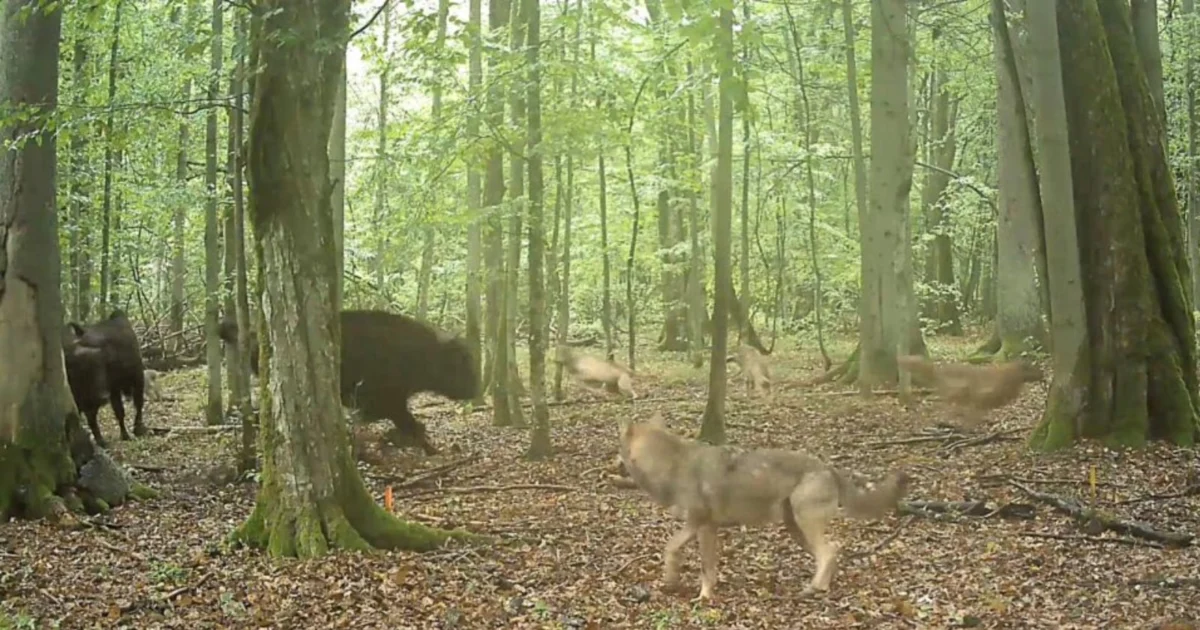
In the shadowed, emerald depths of the Białowieża Primeval Forest—one of the last and largest remaining parts of the immense primeval forest that once stretched across the European Plain—a dramatic scene of primal survival has been captured for the first time. Remote camera traps, positioned to monitor the elusive inhabitants of this UNESCO World Heritage site, have provided researchers with the first-ever video evidence of a wolf pack attempting to hunt a herd of European bison.
The footage, published in the journal Ecology and Evolution, serves as a powerful reminder of the complex predator-prey dynamics that define the European wilderness. While wolves and bison have coexisted for millennia, the visual documentation of this specific interaction challenges long-held assumptions about the vulnerability of Europe’s largest land mammal.
The Encounter: A Chronology of Survival
The incident took place on September 15, 2025, deep within the Polish sector of the Białowieża forest. The sequence, captured by automated sensors, offers a rare, unfiltered look at a high-stakes standoff.
The Initial Strike
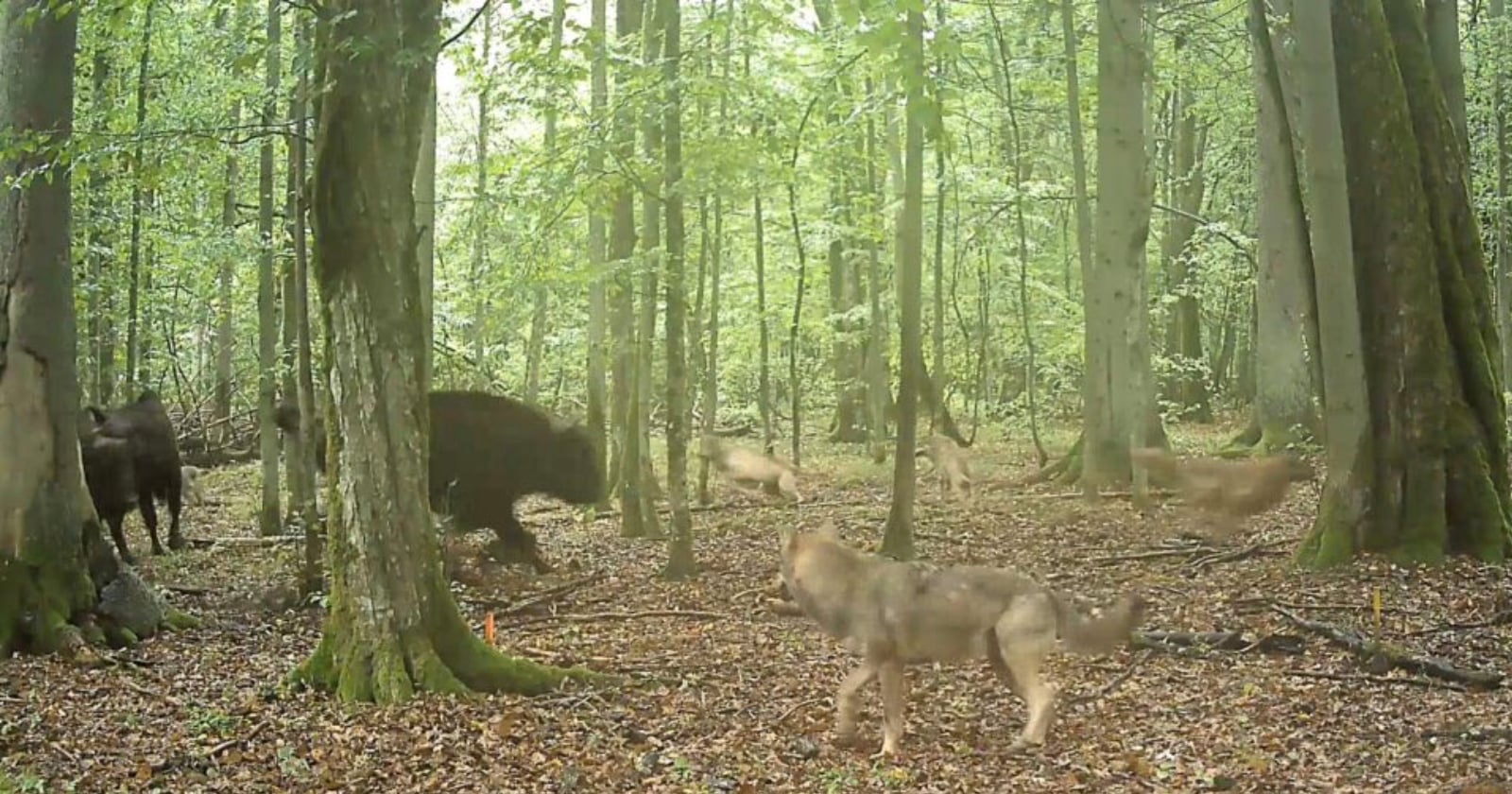
The video begins with a herd of 11 European bison navigating the dense undergrowth. Quietly trailing them is a pack of seven wolves, demonstrating the calculated patience characteristic of the apex predators. The wolves identify a vulnerable target within the group: a newborn calf. As the pack closes the distance, the wolves strike, focusing their aggression on the calf and successfully managing to bite it, attempting to drag the animal away from the protection of the herd.
The Defensive Response
What follows is a testament to the social structure and protective instincts of the bison. Despite the overwhelming ferocity of the pack, two adult female bison immediately break from the herd’s formation, charging directly at the wolves. Their sheer size and aggressive counter-attack force the predators to break their grip and retreat momentarily.
The Standoff
The wolves, however, are not easily deterred. Recognizing the calf’s vulnerability, the pack regroups and launches a second assault, seizing the calf once again. For a second time, the adult bison intervene, charging the wolves and driving them back. Recognizing that the defensive wall of the herd is impenetrable, the adult bison gather closely around the calf, effectively shielding it from further harm. Having failed to isolate their prey, the wolf pack eventually ceases the pursuit and disappears into the forest canopy.
Supporting Data: Why This Footage Matters
The significance of this footage lies in its rarity. While wolves are known to hunt American bison (Bison bison) with some regularity in North America, documented, successful, or even attempted predation on the European bison (Bison bonasus) has been almost exclusively anecdotal or historical.
A Species Reborn
To understand the gravity of this discovery, one must look at the turbulent history of the European bison. Often referred to as the "King of the Forest," these majestic creatures became extinct in the wild in 1919 following the aftermath of World War I. The last free-roaming individuals were killed by poachers and military forces.
The species owes its continued existence to intensive captive breeding programs. In 1952, the first bison were reintroduced into the Białowieża forest. Since then, conservation efforts have been remarkably successful, with Poland now hosting the largest population of European bison in the world. However, because of this "bottleneck" in their history, researchers have long wondered how these animals—once absent from the ecosystem for decades—interact with the natural predators that have remained in the forest.
Scientific Context
Researchers from the Polish Academy of Science, who analyzed the footage, noted that while the video does not record a kill, it provides irrefutable evidence that the European bison is a potential prey species for wolves. The study authors emphasize that this encounter highlights the re-establishment of a natural ecological balance in the Białowieża region. The predator-prey relationship is a fundamental pillar of biodiversity, and this footage confirms that these dynamics are functioning as they did centuries ago.
Official Perspectives and Ecological Implications
The research team behind the study has been careful to manage expectations regarding the impact of this predation on the broader population of bison.
No Threat to Population Stability
"Although the video did not show a direct kill, our observation demonstrated that the European bison is, in fact, a potential prey for wolves," the authors stated. Despite this, experts at the Polish Academy of Science maintain that there is currently no evidence to suggest that wolf predation poses a threat to the overall population stability of the bison.
The Białowieża bison population is robust and well-managed. Occasional predation, particularly of calves or sick individuals, is a natural part of an ecosystem. Far from being a negative development, many ecologists view this as a positive indicator of a "wilder" and more resilient forest. Predation can actually serve to strengthen a herd by removing weaker individuals, thereby maintaining the health of the population through natural selection.
The Role of the Camera Trap
The success of this documentation highlights the increasing importance of camera trap technology in wildlife conservation. By removing human presence from the observation process, researchers can observe "true" behavior. The cameras at Białowieża provide a window into a world that humans rarely witness, capturing the subtleties of animal intelligence, communication, and conflict resolution that would otherwise remain hidden.
Broader Implications for European Conservation
This discovery has sparked a renewed interest in the "re-wilding" of Europe. As populations of large carnivores like wolves, lynx, and bears recover across the continent, managing the interface between these predators and herbivores becomes a critical task for conservationists.
Rewilding and Coexistence
The Białowieża incident provides a blueprint for how scientists can monitor these interactions. By understanding that wolves can and will target bison, wildlife managers can better predict the movement of herds and the potential for "conflict" scenarios—not just with predators, but with the human communities that live on the periphery of these protected forests.
Ethical Considerations
The footage has also ignited discussions regarding human intervention. Should conservationists intervene if a wolf pack is seen hunting a protected species like the bison? The current scientific consensus, supported by the researchers involved, suggests a hands-off approach. The bison are not at risk of extinction, and the wolves are fulfilling their ecological role. Allowing these interactions to play out naturally is considered the gold standard for modern conservation management.
Conclusion: The Forest Unmasked
The footage captured on September 15, 2025, is more than just a viral moment for nature enthusiasts; it is a profound scientific document. It captures a moment of raw, unmediated nature that reminds us of the delicate, ancient dance between predator and prey.
The European bison, once a ghost of the past, has reclaimed its place in the primeval forest. The wolves, ever-present and opportunistic, continue to test the strength of the herd. As these two species continue to share the Białowieża landscape, researchers will continue to watch through the "eyes" of their camera traps, waiting to see what other secrets this ancient forest has yet to reveal.
The message from this study is clear: the wilderness is not a static museum exhibit, but a living, breathing, and sometimes violent system. And in the heart of Poland, the circle of life continues, largely unchanged by the passage of time.
For further reading on the research conducted by the Polish Academy of Science, please refer to the full study titled "Predator-prey interactions in the Białowieża Primeval Forest," published in the journal Ecology and Evolution (2026).
 Laily UPN
  Reynand Wu
  Lina Hope