
 By Neng Nana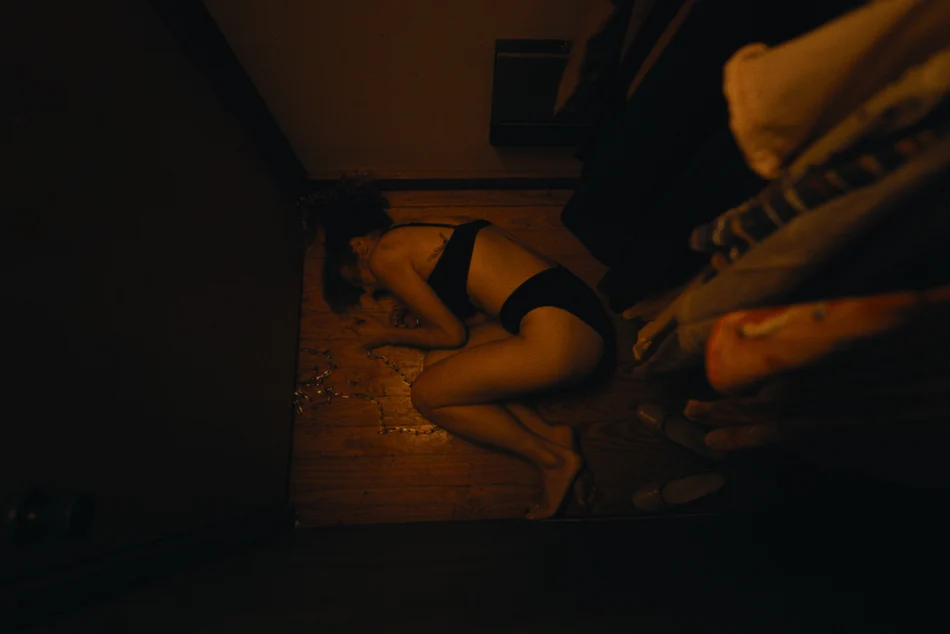
In the crowded landscape of contemporary independent horror, where elevated genre fare often retreats into metaphor and psychological abstraction, writer-director John Valley is staging a return to the visceral, character-driven roots of the slasher film. His latest project, American Dollhouse, which made waves at this year’s South by Southwest (SXSW) and the prestigious Overlook Film Festival, is not merely a homage to the genre’s past—it is a pointed critique of the modern surveillance state, delivered through the lens of a suburban nightmare.
The Premise: A Home Invasion of the Soul
The narrative of American Dollhouse is deceptively simple, echoing the foundational anxieties of classics like Halloween or The Stepford Wives. The story follows Sarah (played by Hailley Lauren), a young woman who returns to her childhood home in the wake of her mother’s death. Her objective is clinical and grounded: settle the estate, renovate the property, and reorganize her life.
However, the domestic tranquility is shattered by the arrival of Sandy (Kelsey Pribilski), a neighbor whose seemingly helpful interest in Sarah’s home improvements quickly curdles into a suffocating, unhinged obsession. Sandy is not merely a "nosy neighbor"; she is a manifestation of a societal rot—the terror of being constantly judged, watched, and policed by those living just on the other side of the fence. As the film progresses, the house becomes less of a sanctuary and more of a cage, transforming the familiar geography of a neighborhood into a theater of psychological and physical violence.
Chronology: From Concept to Festival Circuit
The journey of American Dollhouse has been one of grassroots momentum. Conceived by Iowa native John Valley, the film was developed with an eye toward capturing the specific, lingering paranoia that has defined the American social climate over the last decade.
- Development Phase: Valley, drawing on his extensive background in various production departments—ranging from grip and electric to art design—developed the script with a focus on collaborative filmmaking. He viewed the production as an ensemble effort rather than a singular auteurist vision.
- Production: Utilizing his "boots on the ground" experience in the industry, Valley fostered an environment on set where actors were encouraged to deviate from the script to find "the truth" in their performances, ensuring the film felt raw and authentic.
- Premiere: The film’s debut at SXSW positioned it as a standout in the indie circuit, garnering attention for its sharp screenplay and intense performances.
- Festival Run: Following its Austin debut, the film traveled to the Overlook Film Festival, where it cemented its reputation as a "rollicking" yet deeply disturbing entry in the horror genre. Currently, the film remains in the acquisition phase, seeking a distribution partner to bring its specific brand of terror to a wider audience.
Supporting Data: The Genre’s Evolution
To understand the significance of American Dollhouse, one must contextualize it within the history of the "larger-than-life villain." Horror cinema has long relied on iconic antagonists to act as mirrors for societal anxieties.
Valley points to the progression from the silent, unstoppable force of Leatherface in The Texas Chain Saw Massacre (1974) to the more grounded, domestic terrors seen in modern hits like Weapons (featuring an Oscar-nominated turn by Amy Madigan). By placing Sandy in this lineage, Valley is engaging in a dialogue with genre history.
Valley notes that while the tropes of the slasher are fixed—the "hard guideposts" of the genre—each generation utilizes these conventions to tell a story specific to its time. "What Psycho is saying about society is very different than what Black Christmas is saying about society," Valley explains. "They aren’t that far apart in their mechanics, but they reflect unique moments in history." American Dollhouse, he argues, is a "snapshot of life in 2025," utilizing the familiar language of the slasher to document contemporary American anxiety.
Official Responses: The Philosophy of the Panopticon
In a series of discussions regarding the film’s thematic underpinnings, Valley has been candid about his inspirations. When asked what scares him, he points to the erosion of private space.
"There’s a sense of paranoia out on the street," Valley says. "There are these places where we are supposed to be safe, where we should be able to operate without feeling like we’re being watched all the time or judged. The idea that sidewalks or our streets in broad daylight are places where terror is looming at any hour of the day is crushing to me."
This, he claims, is the core of the character of Sandy. "Sandy is a manifestation of the panopticon," he states. "She is the terror of polite society." By making the villain a neighbor rather than a supernatural entity or a masked killer in the woods, Valley taps into the very real, very modern fear of social surveillance.
Furthermore, Valley emphasizes the importance of the collaborative process in achieving this vision. Having worked as a production assistant, an art department hand, and a lighting technician, he rejects the notion of the "dictatorial director." Instead, he prioritizes the input of his cinematographer and actors. "I show up to set and ask my cinematographer, ‘How are you feeling? What direction do you want to look?’" he says. "The crew and the actors are the people who ultimately make the movie. You set up a structure that is rock-solid, and then you do your best to get out of their way."
Implications for the Horror Genre
The success of American Dollhouse at the festival level suggests a hunger among audiences for horror that is both technically proficient and thematically grounded. By utilizing the "machinery" of horror—the lighting, the camera movement, the editing—Valley is proving that the genre remains the most effective medium for social critique.
The implications for the industry are clear: there is a shifting tide toward independent filmmakers who possess a "holistic view" of production. By understanding the mechanical reality of filmmaking, these directors can create higher-value horror on smaller budgets, allowing for more creative freedom and a deeper exploration of the "dark" ideas that larger studio productions might shy away from.
Looking ahead, Valley shows no signs of slowing down his exploration of the macabre. His future projects continue to lean into the genre he clearly loves. "I have a monster movie in my back pocket that I’m very excited about," he reveals. "It’s kind of a culty West Texas monster movie. I have a vampire movie, too. But the monster movie has my heart at the moment."
Conclusion
American Dollhouse stands as a testament to the enduring power of the slasher film when it is treated with intelligence and intentionality. It is a film that respects the tropes of the past while firmly anchoring itself in the anxieties of the present. As it continues to seek distribution, the industry should take note: John Valley is a filmmaker who understands that the most terrifying monsters are not found in the shadows, but in the glaring, judgmental sunlight of our own front yards. Through his lens, the "American Dream" of home ownership is stripped back to reveal the surveillance state lurking just behind the picket fence—a chilling, necessary reflection of the world we live in today.
 Lina Irawan
  Asep Darmawan