
 By Basiran
Why do we crave specific items with such irrational intensity? Why do certain brands feel like an essential extension of our personality, while others—despite offering better utility or lower prices—evoke nothing but indifference?
The answer lies in a fundamental shift in consumer psychology. We have moved past the era where a product’s value was determined solely by its function. In the modern marketplace, the most successful companies are no longer selling commodities; they are selling entry into an identity. Whether it is a Dairy Boy sweatshirt, a Dyson Airwrap, or a niche wellness smoothie, consumers are purchasing a shortcut to the person they aspire to become.
The Evolution of Consumption: From Utility to Identity
For decades, the standard marketing playbook focused on "utility." If a vacuum cleaned better, or a shirt lasted longer, it won the market. However, the contemporary consumer landscape has shifted toward the psychological. We are living in an economy of "identity signaling," where the goods we purchase act as shorthand for our values, our tastes, and our social standing.
The Psychology of the "Extended Self"
Psychologist Russell Belk’s landmark theory of the "extended self" posits that our possessions are not merely external objects; they are psychological appendages. We integrate the brands we own into our sense of self. When this is paired with M. Joseph Sirgy’s "self-congruity theory," we see a clear pattern: consumers gravitate toward brands that mirror either their current reality or their idealized self.
A consumer buying a high-end pair of running shoes might be doing so to reinforce their identity as an athlete, or to bridge the gap between their sedentary reality and their aspirational fitness goals. In both instances, the shoe is a psychological tool, not just footwear.
Cultural Capital and Social Belonging
Pierre Bourdieu’s work on cultural capital remains as relevant today as it was decades ago. Consumption is a performance. By choosing the "right" brand—the one that holds cachet within a specific cultural subset—the consumer signals to their peers that they possess the necessary taste and knowledge to belong. This is the "I understand this world" signal. When a brand successfully builds an aesthetic and a set of shared rituals, it creates a moat that competitors—who are merely fighting on price or features—cannot cross.
The Role of Creators as Architects of Desire
If brands are building "worlds," then creators are the master builders. In the past, advertising was a monologue: the brand spoke, and the consumer listened. Today, the conversation is mediated by creators who hold the trust of their communities.
Moving Beyond the "Influencer" Label
The most effective partnerships today do not involve creators "selling" a product. Instead, they involve creators inviting their audience into a lifestyle. When a brand partners with a creator who authentically lives within that brand’s "world," the advertisement disappears. It is replaced by an invitation.
For enterprise brands, this is a massive challenge. Large corporations often possess the distribution, the R&D, and the capital, but they frequently lack "cultural fluency." They struggle to speak the language of the internet, which is nuanced, ironic, and highly community-driven. By treating creators as co-architects rather than just another distribution channel, brands can borrow the trust and the "vibe" that they cannot manufacture in a boardroom.
Chronology of the Shift: How We Got Here
To understand the current state of brand strategy, one must look at the evolution of digital marketing over the last decade:
- 2010–2014: The Era of Digital Utility. Brands focused on SEO and search-based advertising. The goal was to be "found" when a consumer had a problem.
- 2015–2019: The Rise of Social Proof. The birth of the influencer economy. Brands realized that third-party validation via social media personalities could drive sales more effectively than traditional celebrity endorsements.
- 2020–2022: The Pandemic Pivot. During lockdowns, digital communities became the primary source of belonging. Brands that fostered community and shared values saw exponential growth.
- 2023–Present: The "World-Building" Era. Brands are now focusing on long-term ecosystem development. They are creating "cultural moments" that allow consumers to participate in a larger narrative.
Supporting Data: Why "World-Building" Drives ROI
While the concept of "world-building" sounds intangible, the financial implications are measurable. Data consistently shows that brands that lean into community-driven narratives see higher customer lifetime value (CLV) and lower customer acquisition costs (CAC).
- Retention vs. Acquisition: A brand that sells identity creates a "tribal" loyalty. Customers who feel they belong to a brand’s world are less likely to churn when a cheaper competitor enters the market.
- Conversion Rates: Campaigns that utilize "creator-led storytelling" (as opposed to product-focused ads) have shown to increase conversion rates by as much as 30% in high-competition categories like beauty and wellness.
- Cultural Fluency Premium: According to recent market analysis, brands that successfully integrate cultural trends into their core identity see a 2.5x higher engagement rate on social platforms compared to brands that maintain a purely functional marketing strategy.
The Strategic Imperative for Enterprise Brands
For the modern enterprise, the path forward is clear but difficult. The traditional "media plan" approach—where influencers are just a line item—is becoming obsolete. The brands that win will be those that learn to relinquish some control.
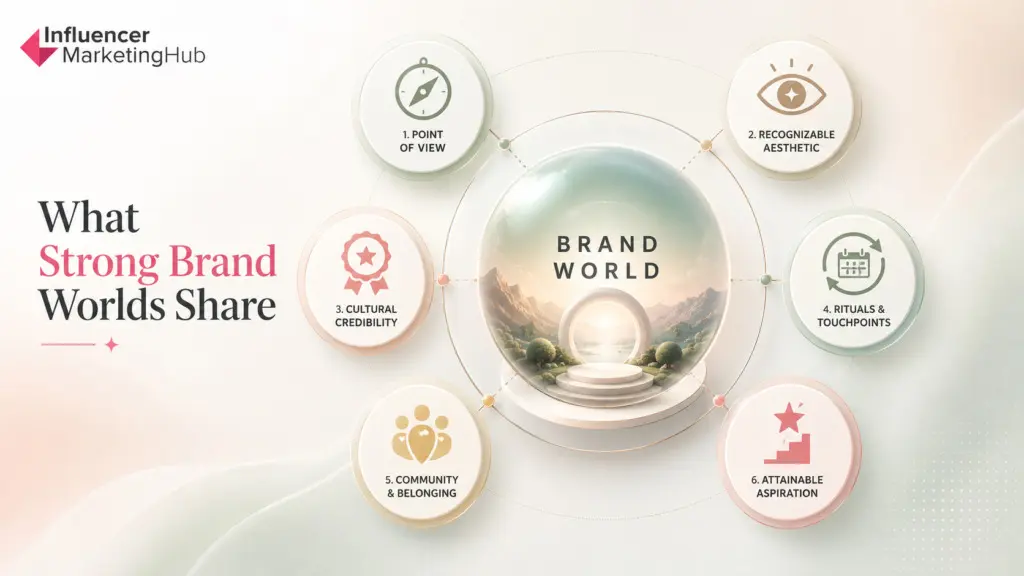
The Six Pillars of a Strong Brand World
To succeed, a brand must ensure it possesses the following:
- A Clear Aesthetic: A visual language that is instantly recognizable across platforms.
- A Defined Ritual: A specific way the product is used or consumed that creates a sense of community.
- Cultural Currency: A brand must know how to participate in, rather than disrupt, the digital conversation.
- Shared Values: A commitment to a mission that transcends the product itself.
- Creator Integration: A strategy that empowers creators to tell the brand story in their own voice.
- Persistent Narrative: A long-term commitment to a theme that evolves with the audience.
Official Responses and Industry Sentiment
Industry experts and CMOs of leading consumer brands have begun to acknowledge this shift in public forums. In recent quarterly reports, several CPG (Consumer Packaged Goods) giants have cited "community-led growth" as a primary driver of their digital transformation.
"We are no longer looking for impressions," noted a lead strategist at a major global beverage company. "Impressions are cheap. We are looking for ‘cultural resonance.’ We want to be the brand that people talk about when they talk about their weekend, their workout, or their morning routine. That doesn’t come from a banner ad; it comes from being part of a community."
Conversely, brands that have failed to pivot remain trapped in a "race to the bottom" on pricing. Without a strong brand identity, the only differentiator is the cost, which is a losing battle against global supply chains and agile startups.
Implications for the Future of Marketing
The implications for the marketing industry are profound. First, the definition of a "marketing team" is expanding. It now includes community managers, cultural strategists, and creator relations specialists. Second, the metrics of success are changing. We are moving away from "clicks" and toward "community sentiment" and "identity alignment."
As we look toward the future, the boundary between "content" and "commerce" will continue to blur. The most powerful brands will be those that feel less like companies and more like cultural movements.
Conclusion: You Cannot Build a World Alone
The most vital lesson for the modern enterprise is that you cannot force-feed a community a brand. You must invite them in.
The strongest brand worlds today are not being built in boardrooms; they are being built in the "wild"—through creators, fans, rituals, and the shared, persistent desire to belong. The brands that understand this—that view their customers as partners and their creators as architects—will be the ones that define the next generation of commerce.
In a world where we can buy almost anything at the click of a button, the most valuable commodity is no longer the product itself. It is the world the brand invites us to step into, and the person we become once we arrive.
 Iffa Jayyana
  Siti Muinah
  Asro
Asro 